
The most comforting mystery in the animal world
Anyone with a cat at home knows that soft, rhythmic sound that seems to come from deep within the animal’s chest. Purring is one of the experiences most associated with living with domestic felines — and also one of the most intriguing. After all, why do cats do this? Is it a sign of happiness? Is it communication? Or does it have some biological function that goes far beyond what we imagine?
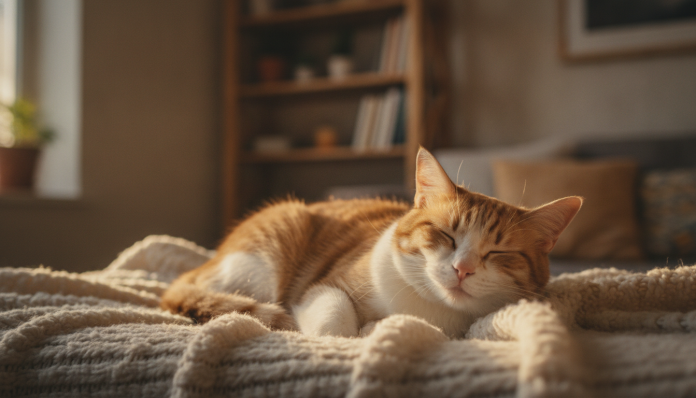
The short answer is: all of it at once. Purring is a complex, multifunctional phenomenon that science has not yet fully deciphered. What researchers have already discovered, however, is fascinating — and completely changes the way we look at that creature stretched out on the sofa, eyes half-closed, vibrating like a miniature motor.
Let’s dive into what science knows — and still tries to understand — about one of the most beloved sounds in the animal kingdom.
How purring is physically produced
For a long time, scientists debated the mechanical origin of purring. Today, the most accepted explanation involves the larynx (the cats’ “voice box”) and the muscles that control it.
During breathing — both inhaling and exhaling — the cat’s laryngeal muscles contract and dilate rapidly, at a frequency ranging between 25 and 150 Hz (hertz, or cycles per second). This movement widens and narrows the glottis (the opening between the vocal cords), creating turbulence in the airflow that generates the characteristic sound.
The result is that continuous purring, which doesn’t stop when the cat inhales or exhales — which differentiates it from other sounds that animals produce in only one direction of the respiratory cycle.
Do all felines purr?
No. And this distinction is important. Felines are divided into two large functional groups:
- Felines that purr but don’t roar: such as domestic cats, pumas, cheetahs and lynxes. They have a more rigid hyoid bone (a structure in the throat), which allows continuous purring.
- Felines that roar but don’t purr: such as lions, tigers, leopards and jaguars. In them, the hyoid is more flexible and cartilaginous, which enables roaring — but prevents classic purring.
The cheetah is an especially curious case: it is the largest feline that truly purrs, and it does so quite intensely.
Purring is not just happiness
This is perhaps the biggest surprise for those who live with cats: they purr in situations far beyond satisfaction. Behavioral studies show that cats also purr when they are:
- In pain or physical discomfort
- Stressed or anxious
- Giving birth to kittens
- Sick or recovering from injuries
- In situations of fear
This suggests that purring has multiple functions — and that interpreting it only as “my cat is happy” can cause caregivers to miss important signals about the animal’s emotional or physical state.
The “solicitation” purr
Researchers from the University of Sussex in the United Kingdom identified a specific type of purring that cats use when they want something from humans — usually food. Called “solicitation purring”, it has a high-pitched frequency embedded in the deeper sound, similar to a human baby’s cry.
This frequency — around 300 to 600 Hz — triggers instinctive responses in humans, making the solicitation purr difficult to ignore. In other words: cats may have learned, over millennia of coexisting with humans, to use purring as a tool for strategic communication.
The science of healing: purring as natural medicine
One of the most surprising discoveries in recent decades is that purring can have real therapeutic properties — both for the cats themselves and possibly for the humans around them.
The vibration frequency of purring — especially between 25 and 50 Hz — coincides with ranges used in physical therapy to stimulate bone regeneration, relieve pain and reduce inflammation. Research in sports medicine and rehabilitation shows that vibrations in this range can:
- Increase bone density
- Accelerate healing of tendons and muscles
- Reduce swelling and pain
This led some researchers to propose that cats evolved purring, in part, as a mechanism of self-healing. Cats are animals that spend long periods at rest — and continuous vibration during this rest could function as a kind of “built-in physical therapy,” maintaining muscles and bones in good condition even without constant physical activity.
There’s even an expression in veterinary circles in English: “If you put a cat and a bunch of broken bones in the same room, the bones will heal” — a humorous way of recognizing felines’ reputation for physical resilience.
And for humans?
Epidemiological studies — those that analyze patterns in populations — have suggested associations between having cats and lower rates of cardiovascular disease. A 2008 University of Minnesota study that followed about 4,000 people for ten years found that those who never had a cat had a significantly higher risk of death from heart attack than those who had or had previously had a feline as a pet.
It’s important to note: correlation is not causation. These studies do not prove that purring itself protects the human heart. It could be that people with calmer personality profiles tend to have cats — or that other factors explain the relationship. But the research opened doors for more in-depth investigations into the effects of sound vibrations on human health.
Why do cats purr for humans?
This is a fascinating behavioral question. Kittens purr to their mothers from the first days of life — probably as a sign that they are well and to maintain bonding during nursing. The mother purrs back.
But adult cats, in the wild, rarely purr to each other. The behavior seems to resurface — and even intensify — in the context of the relationship with humans.
Behavioral researchers suggest that domestic cats may have developed a kind of “behavioral neoteny” — that is, they retain in adulthood behaviors typical of kittens, such as purring, because these behaviors work very well in the relationship with human caregivers. In other words, cats learned that purring at humans produces positive responses: affection, food, attention.
This doesn’t mean the bond is false or manipulative — it means it is co-evolved: cats and humans have lived together for at least 10,000 years, and in that time have developed sophisticated ways to communicate with each other.
What your cat’s purring can tell you
Although each cat is unique, there are patterns that can help caregivers better interpret what that purring means. Always pay attention to context:
- Soft purring, relaxed body, half-closed eyes: classic sign of well-being and comfort
- Purring while eating or receiving affection: satisfaction and affection
- Purring at the veterinarian’s office or in new situations: stress or anxiety — purring functions as self-calming
- Purring with tense posture, ears back or dilated pupils: possible physical or emotional discomfort
- Loud and insistent purring near feeding time: probably the “solicitation purr”
- Purring in isolation, without external stimuli: may indicate pain or illness
> Important: if your cat shows sudden changes in behavior — including excessive or unusual purring — it’s best to consult a veterinarian. General information about animal behavior does not replace the evaluation of an animal health professional for individual cases.
Scientific curiosities about purring
To close on a high note, some facts that few know:
- Purring is bidirectional: it occurs during both inhalation and exhalation, making it unique among sounds produced by mammals.
- Cats born blind purr normally: which confirms that the behavior is innate, not learned through visual imitation.
- Frequency varies between individuals: like human voice, each cat has its own purring “timbre.”
- Some cats purr more than others: breeds like Ragdoll and Maine Coon are known for purring frequently and intensely; others, like the Siamese, prefer to vocalize in other ways.
- Cats can purr and vocalize at the same time: producing those mixed meow-purr sounds that caregivers know well.
Conclusion: a sound with many stories
Cat purring is, at the same time, a language, a survival mechanism, a bonding tool and possibly a healing instrument. What seemed to be merely “the sound of a happy cat” revealed itself, under the lens of science, to be a biologically sophisticated and evolutionarily purposeful phenomenon.
Understanding purring is understanding a little more of the long and complex history between humans and felines — a partnership that began millennia ago and continues to reinvent itself every day, on every couch, bed or lap where a cat decides to settle and vibrate.
The next time your cat purrs, it’s worth paying attention: they may be saying much more than it seems.


