
Brazil that won the world: athletes who wrote history in sports
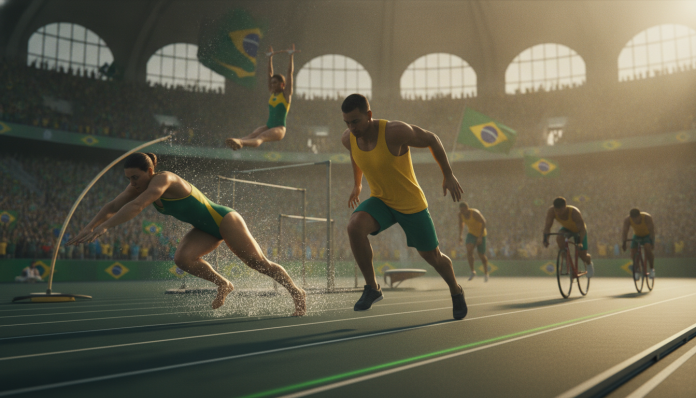
Brazil is a country that breathes sports. From the beaches of Rio to the interior courts, from the Amazon rivers to the running tracks, Brazilian talent found, over decades, ways to express itself that left the world speechless. It is no exaggeration to say that some athletes born on Brazilian soil transformed not only the sports they practiced, but the very way the world sees competition, overcoming challenges, and spectacle.
Talking about these names is revisiting achievements that transcend medals and trophies. It is understanding how men and women, often from humble backgrounds, carried on their shoulders the hopes of millions of Brazilians and delivered — sometimes in such an extraordinary way that it seemed like fiction. This article brings together some of the greatest icons of national sports, in different modalities, who left indelible marks in history.
Pelé: the king who never needed a last name
Edson Arantes do Nascimento, known as Pelé, is perhaps the most famous Brazilian athlete on the entire planet. Born in 1940 in Três Corações, Minas Gerais, he became a professional while still a teenager at Santos FC and quickly revealed a talent that defied logic.
With the Brazilian National Team, Pelé won three World titles: 1958, in Sweden (when he was only 17 years old, becoming the youngest World Cup champion to date); 1962, in Chile; and 1970, in Mexico — the latter considered by many experts as the greatest team in the history of football. Throughout his career, he scored over 1,000 goals in official matches and friendlies, a number that, regardless of any counting criteria, remains the absolute reference.
Pelé passed away in December 2022, but his legacy lives on. He was the only player to win three World Cups as an athlete on the field, a feat that no other player has repeated to this day.
Ayrton Senna: speed, genius, and tragedy
If Pelé represents Brazilian football to the world, Ayrton Senna did the same for Formula 1. Born in São Paulo in 1960, Senna reached the grassroots categories of European motorsport in the 1980s and quickly showed that he possessed something different from other drivers: an almost mystical ability to extract the maximum from cars often inferior to those of his competitors.
Senna won three Formula 1 World titles: in 1988, 1990, and 1991, all with the McLaren team. His battles with Frenchman Alain Prost are considered one of the greatest rivalries in the history of motor sports. He also held, at the time of his death, the record of 65 pole positions — starting positions achieved with the best qualifying time.
On May 1st, 1994, during the San Marino Grand Prix in Imola, Italy, Senna died as a result of an accident at the Tamburello corner. He was 34 years old. The commotion in Brazil was one of national mourning, and to this day his name is synonymous with excellence, dedication, and Brazilian identity in the world.
Gustavo Kuerten: the smile that conquered Roland Garros
In 1997, a young man from Santa Catarina named Gustavo Kuerten — Guga — at just 20 years old did something that seemed impossible: he won Roland Garros, the most prestigious clay court tennis tournament in the world, making his debut at the event and defeating along the way three former tournament champions.
What could have been a fluke proved to be pure genius: Guga won Roland Garros two more times, in 1999 and 2001, and reached the number 1 position in the ATP ranking. His characteristic celebration — drawing a heart in the clay after victories — became one of the most iconic images in world sports.
Kuerten transformed Brazilian tennis, previously restricted to elites, into a matter of national interest. Today, he is remembered not only for his achievements, but for the charisma and elegance with which he always represented the sport.
Hortência and Magic Paula: the roots of Brazilian women’s basketball
Brazilian women’s basketball experienced its golden age between the 1980s and 1990s, and two names are inseparable from this story: Hortência Marcari and Maria Paula Gonçalves da Silva, known as Magic Paula.
Hortência, nicknamed “The Queen”, is considered by many the greatest basketball player in Brazilian history. Throughout her career, she won medals at Pan-American Games, World Championships, and was instrumental in the growth of the sport in the country. In 1994, the Brazilian Women’s National Team won the basketball world title — a historic achievement that had Hortência and Magic Paula as absolute protagonists.
Magic Paula, in turn, was elected the best player in the world in 1994, a rare recognition for a South American athlete at that time. Both helped pave the way for subsequent generations of Brazilian female athletes in the sport.
Daiane dos Santos: the dance that became gymnastics
Born in Porto Alegre in 1983, Daiane dos Santos grew up in difficult conditions and found in artistic gymnastics a way out and a calling. She became the first gymnast in the Americas to perform a double twist pike — an element so associated with her that it became known worldwide as “the Dos Santos”.
In 2003, Daiane won the World Championship of Artistic Gymnastics on floor, becoming the first Brazilian woman to win an individual world title in this modality. In 2005, she repeated the feat. Her presentation combined impeccable technique with musicality and expressiveness that enchanted judges and audiences alike.
Daiane dos Santos not only opened doors for Brazilian gymnastics — she created a standard of excellence that influenced an entire generation of gymnasts in the country.
Isaquias Queiroz: from riverbanks to Olympic podium
Few paths in Brazilian sports are as inspiring as that of Isaquias Queiroz. Born in 1994 in Ubaitaba, in rural Bahia, he grew up on the banks of the Marauim River and learned to row in improvised boats before discovering speed canoeing.
Isaquias was one of the highlights of the Rio de Janeiro Olympic Games in 2016, when he won three medals — one silver and two bronze — in different events, becoming the Brazilian athlete with the most podiums in a single Olympic edition. In Tokyo 2020 (held in 2021), he went even further: he won the gold medal in the C1 1000m, ending decades of drought for Brazil in rowing and canoeing at the Olympic level.
His trajectory is a powerful example of how sports can be a path to social and personal overcoming. If you are also inspired by stories of overcoming and want to start a physical activity, check out our guide Starting to Run from Scratch: A Beginner’s Guide to Running — a step-by-step ideal for those who want to take the first step.
Other names that cannot be forgotten
The history of Brazilian sports is too rich to fit into a few paragraphs. Other athletes who deserve mandatory mention:
- Éder Jofre: considered by many sports entities one of the greatest boxers of all time, two-time world champion in the 1960s
- Maria Lenk: pioneer of Brazilian women’s sports, first woman in the Americas to participate in an Olympic Games, in 1932, representing Brazil in swimming
- Cesar Cielo: world record holder in 50m and 100m freestyle in swimming, Olympic gold medalist in Beijing 2008
- Formiga (Miraildes Maciel Mota): women’s football player who participated in seven editions of the Olympic Games, absolute record in world football
- Anderson Silva: considered by many MMA analysts as the greatest fighter of all time, UFC champion for over six consecutive years
- Rebeca Andrade: gymnast who won historic medals at the Tokyo 2020 and Paris 2024 Games, becoming one of the greatest names in contemporary Brazilian Olympic sports
What unites these athletes
Despite practicing completely different sports, there is a common thread among all these names: the ability to turn adversity into fuel. Most come from challenging socioeconomic backgrounds. Many found in sports not only a career, but an identity and a purpose.
It is also striking how each of them transcended their own sport. Pelé was walking Brazilian diplomacy. Senna was a symbol of a nation that wanted to show itself to the world. Guga humanized an elite sport. Daiane showed that art can live within competition. Isaquias proved that talent exists in places that the system often ignores.
Conclusion: a legacy that inspires generations
Brazil will continue to produce great athletes. This is not guesswork — it is the result of a combination of rooted sports culture, ethnic and geographic diversity, and an almost visceral relationship of the Brazilian people with overcoming challenges. The names mentioned in this article are more than champions: they are characters in a collective story that the country tells about itself.
Knowing these trajectories is also a way to understand Brazil. Each medal, each title, each record carries a piece of our identity — our grit, our joy, our ability to enchant the world. And as long as there are young people dreaming on the banks of rivers, on dirt courts, and on improvised tracks in the interior, this story will continue to be written.


