
Every day, each Brazilian generates on average more than a kilogram of waste. Multiply that by over 200 million people, and you have a mountain of waste that needs to go somewhere. The good news is that part of this material can — and should — have a second life through recycling. The bad news is that Brazil still recycles only a small fraction of what it produces, even though it has the infrastructure and legislation to do much more.
Understanding how this process works, from the moment you throw something away to the time it becomes a new product, is more than just curiosity. It’s the kind of knowledge that changes habits, helps communities, and eases the pressure on landfills that are already operating at capacity in various regions of the country. In this article, we will explore this journey clearly and directly.
If you’ve ever wondered why separating waste at home makes a difference, or how that neighborhood cooperative works, the answers are here.
What is Recycling and Why It Matters
Recycling is the process of transforming discarded waste into raw material for the production of new products. It sounds simple, but it involves a complex logistical, technological, and social chain.
In Brazil, the legal basis that organizes this chain is the National Solid Waste Policy (PNRS), established by Law No. 12.305 of 2010. This legislation sets principles such as shared responsibility — meaning manufacturers, importers, distributors, traders, consumers, and public urban cleaning service providers each have their role in the product life cycle.
Recycling matters for practical and environmental reasons:
- Reduces the volume of waste deposited in landfills and, especially, in open dumps
- Saves energy and water in the process of manufacturing new products (producing recycled aluminum, for example, consumes about 95% less energy than producing it from raw ore)
- Generates income for thousands of waste pickers and cooperative workers across the country
- Decreases greenhouse gas emissions associated with waste decomposition in landfills
The Journey of Waste: From Disposal to Factory
1. Generation and Disposal
It all starts at home, in the office, at school, or in commerce. When a product is discarded, it can take three basic paths: common waste (destined for the landfill), selective collection (separated for recycling), or irregular disposal (thrown in vacant lots, rivers, or drains — the worst-case scenario).
2. Selective Collection
Selective collection is the system by which recyclable waste is collected separately from organic waste and refuse. In Brazil, it can happen in two main ways:
- Door-to-door collection: trucks pass through neighborhoods on specific days collecting the material separated by the resident
- Voluntary drop-off points (PEVs): fixed locations, such as supermarkets, schools, and condominiums, where anyone can deposit recyclables
The standardization of bin colors follows the CONAMA Resolution No. 275/2001: blue for paper, red for plastic, green for glass, yellow for metal, and brown for organic waste. Black is used for refuse and orange for hazardous waste.
3. Sorting at Cooperatives
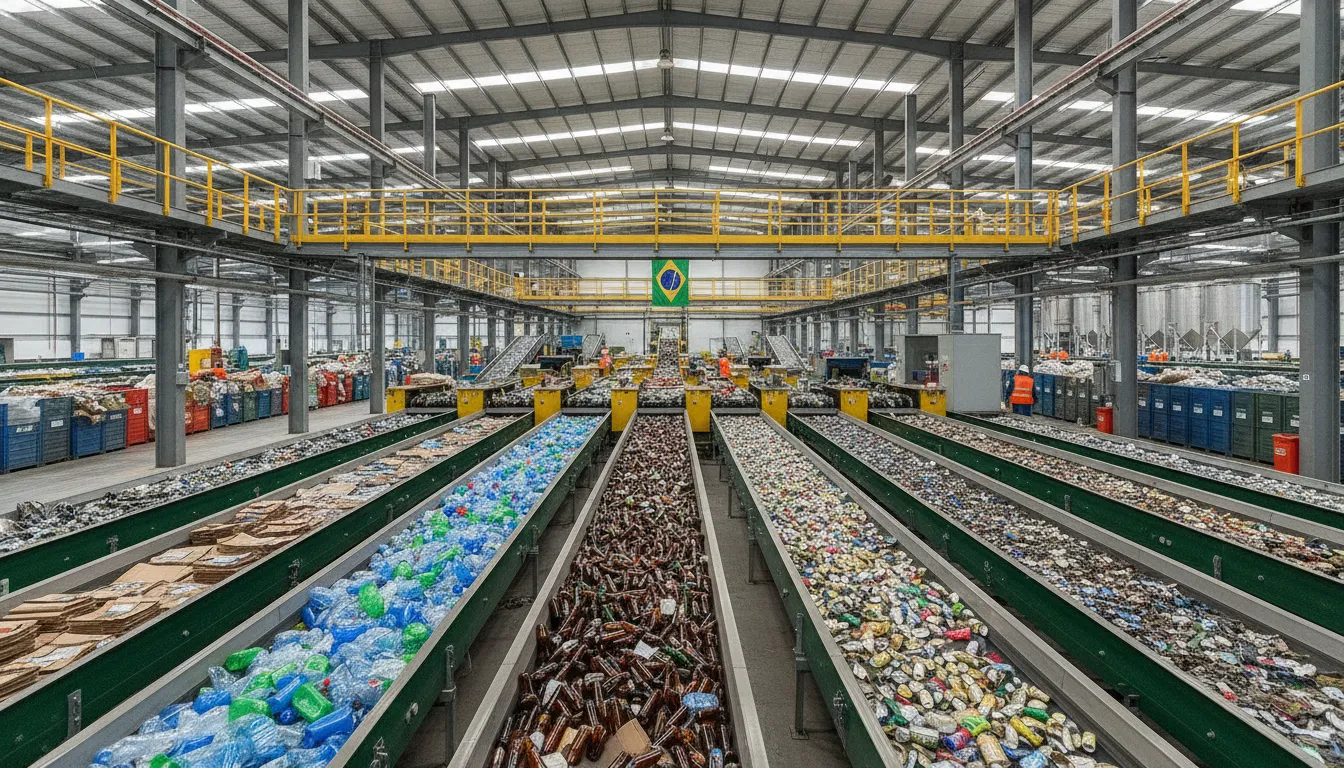
Once collected, the material goes to sorting centers or waste picker cooperatives, where workers manually separate different types of materials — cardboard from magazines, PET from PP, steel cans from aluminum cans, and so on. This stage is crucial because the recycling industry requires raw materials of specific specifications.
Waste picker cooperatives play a huge social role in Brazil. It is estimated that waste pickers — organized or informal — are responsible for recovering a very significant portion of all recyclable material that actually reaches the industry in the country.
4. Pressing, Baling, and Marketing
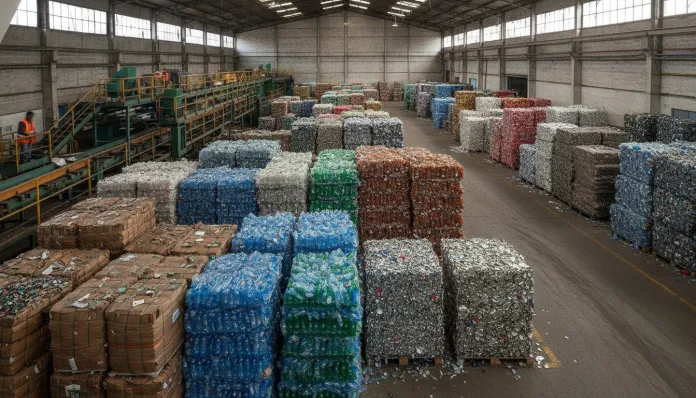
After sorting, the material is pressed and baled to facilitate transport. These bales are then sold to scrap dealers (paper sector intermediaries), junk dealers, or directly to recycling industries.
5. Industrial Processing
Each type of material has its specific recycling process. In recycling plants, the material is cleaned, shredded, melted, or disaggregated and transformed into secondary raw material — plastic pellets, recycled paper, aluminum ingots, crushed glass (called cullet) — which returns to the market to manufacture new products.
Which Materials Can Be Recycled
Not everything that seems recyclable really is, at least not on a commercial scale in Brazil. Here’s an overview:
Material Recyclable? Note Paper and cardboard ✅ Yes Avoid used toilet paper and napkins PET plastic (bottles) ✅ Yes One of the most recycled in the country Aluminum (cans) ✅ Yes Brazil is a world reference in this sector Glass ✅ Yes Must be clean; separate lids Steel (food cans) ✅ Yes Test with a magnet: steel can sticks Styrofoam ⚠️ Partially Some municipalities accept it; check locally Used toilet paper ❌ No Considered refuse Disposable diaper ❌ No Refuse Mirror ❌ No Different composition from common glass Batteries ⚠️ Special Dispose at specific points — they are hazardous waste Electronics ⚠️ Special Mandatory reverse logistics by law The Role of Waste Pickers and Cooperatives
Talking about recycling in Brazil without mentioning waste pickers would be telling only half the story. These are workers — many in vulnerable social situations — who roam the streets with carts or work in cooperatives, doing sorting that economically enables the entire chain.
The National Movement of Waste Pickers of Recyclable Materials (MNCR) is one of the main organizations representing this category. The PNRS of 2010 was an important step forward because it formally recognized the role of these workers and established instruments to support their cooperatives and associations.
Still, working conditions and income vary greatly. Well-structured cooperatives, with adequate equipment and contracts with municipalities, can offer more dignified conditions. Others still operate precariously. Strengthening these organizations is pointed out by industry experts as one of the most effective ways to expand recycling in the country.
How Brazil Compares Globally
Brazil has an undeniable success story: aluminum. For several consecutive years, the country led the world ranking of aluminum can recycling, recycling more than 90% of the cans produced — a rate higher than countries like Japan and Germany. This result is due to a combination of the economic value of the material (which encourages collection) and a well-structured chain.
However, when looking at plastic, paper, and glass, the picture is different. The recycling rates for these materials are well below potential, especially compared to European countries with more comprehensive and consolidated selective collection systems.
Part of the problem lies in the coverage of selective collection: although the law requires municipalities to implement it, many still do not have the service functioning regularly, especially in regions further from major urban centers.
If you are interested in Brazil’s socio-environmental issues and want to deepen your knowledge visually, check out our list of documentaries to learn: the best of the moment — there are great productions about the environment and sustainability.
What You Can Do Practically
Recycling depends on the entire chain, but the starting point is the consumer. Here are simple habits that make a real difference:
- Separate waste at home — at least into organic (food scraps, toilet paper) and recyclable (plastic, metal, clean paper, glass)
- Clean and dry packaging before separating — dirty material contaminates the rest and can make sorting unfeasible
- Crush cans and PET bottles to save space in collection
- Remove lids and labels when indicated (glass, for example, has a different composition from metal lids)
- Dispose of electronics and batteries at specific points — manufacturers and retailers are required by law to provide them
- Get informed about the days and rules of selective collection in your municipality — each city may have specifics
- Get to know the cooperatives in your neighborhood — many accept direct donations and it is a way to ensure the material reaches the right destination
Challenges and Prospects for the Sector
Recycling in Brazil faces structural obstacles that go beyond individual will. Among the main ones are:
- Insufficient coverage of selective collection in smaller municipalities
- Lack of systematic environmental education in schools and communities
- Informality in the waste picker chain, which hinders organization and access to credit and equipment
- Commodity price variation in the international market, which affects the economic viability of recycling certain materials
- Inadequate disposal still very present, especially of special waste like electronics and batteries
At the same time, there are positive movements: the growth of structured cooperatives, the advance — albeit slow — of reverse logistics for packaging, and increasing pressure from consumers and companies for more sustainable practices.
Conclusion
Waste recycling in Brazil is a story of contrasts: a country that is a world reference in aluminum, but still sends much of its waste to landfills without separation; an advanced legislation on paper, but with uneven implementation in practice; thousands of workers who sustain an essential chain in conditions that need improvement.
Understanding how this system works — from your kitchen trash can to a cooperative’s conveyor belt, to the factory that produces a new bottle or package — is the first step to participating in it more consciously. Each clean and correctly separated package is a small step with a real impact when multiplied by millions of people.
The scale change Brazil needs in recycling depends on public policies, investment, and organization. But it also depends on you.
Mais Lidas
O Jornal Meia Hora é um portal de notícias que oferece informações atualizadas sobre política, economia, esportes, entretenimento e mais. Nosso compromisso é manter nossos leitores informados com notícias precisas e imparciais.
Redação
Trending
Categorias
© Jornal Meia Hora. Todos os direitos reservados.
- Lack of systematic environmental education in schools and communities
- Clean and dry packaging before separating — dirty material contaminates the rest and can make sorting unfeasible
- Voluntary drop-off points (PEVs): fixed locations, such as supermarkets, schools, and condominiums, where anyone can deposit recyclables
- Saves energy and water in the process of manufacturing new products (producing recycled aluminum, for example, consumes about 95% less energy than producing it from raw ore)