
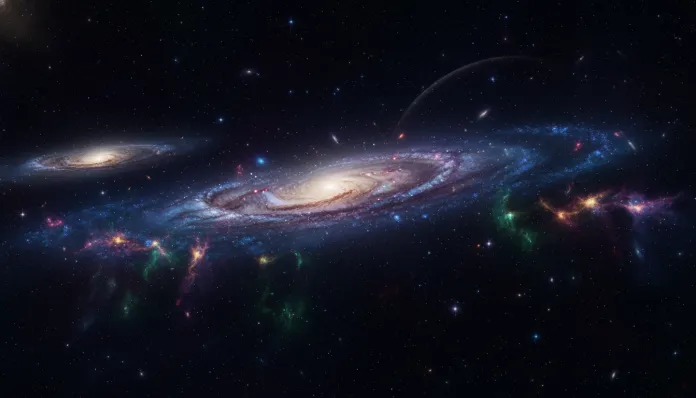
Space has always been humanity’s grandest stage of mysteries. From the first astronomers who gazed at the night sky to modern telescopes capturing light from galaxies billions of light-years away, each discovery seems to reveal not just answers but an even greater collection of questions. The universe, in its almost incomprehensible vastness, holds secrets that defy logic, physics, and even imagination.
What is most fascinating is that the more science advances, the more evident it becomes that the cosmos is strange in ways no science fiction writer could invent. There are objects that defy known laws of matter, phenomena that occur on time scales impossible to visualize, and places where everyday rules simply cease to apply. All this is not found in the pages of a fantasy book — it is recorded in scientific articles, astronomical observations, and data collected by probes traveling through the solar system for decades.
In this article, we will explore some of the most curious, surprising, and verifiable facts about the universe — those that remind us, with healthy humility, how much there is still to discover.
The Universe Is Unfathomably Vast
When scientists talk about the “observable universe,” they are referring to the portion of the cosmos that light has had time to traverse since the Big Bang, about 13.8 billion years ago. This observable universe has an estimated diameter of approximately 93 billion light-years — and this is not the entire universe, just the part we can, in theory, detect.
To get an idea of the scale: a light-year is equivalent to about 9.46 trillion kilometers. The closest star to the Sun, Proxima Centauri, is approximately 4.24 light-years away. Even traveling at the speed of light — something impossible for objects with mass, according to current physics — it would take us more than four years to get there.
What’s most intriguing is that the universe is expanding at an accelerated pace. Distant galaxies are moving away from us faster and faster, and some regions of the cosmos are moving so quickly that their light will never reach us. This means that the observable universe is, in practice, shrinking in terms of what we will be able to see in the future — an astounding paradox of modern cosmology.
Black Holes: The Most Extreme Objects in the Cosmos
Few phenomena capture the human imagination like black holes. These are regions of space where gravity is so intense that not even light can escape. The point of no return is called the event horizon, and what happens beyond it remains, by definition, beyond the direct reach of any observation.
Black holes generally form when massive stars — much larger than the Sun — reach the end of their life and collapse under their own gravity. But there are also supermassive black holes, which inhabit the center of most large galaxies, including the Milky Way. The central black hole of our galaxy, called Sagittarius A*, has a mass equivalent to about 4 million times that of the Sun.
In 2019, the Event Horizon Telescope project obtained the first direct image of a black hole — that of the galaxy M87, with a mass equivalent to 6.5 billion suns. In 2022, the same scientific collaboration released the image of Sagittarius A*, a historic milestone for astronomy.
Neutron Stars: Matter at Its Extreme Limit
If black holes are the most dramatic end of massive stars, neutron stars represent another equally extraordinary fate. When a star with between 8 and 20 times the mass of the Sun explodes in a supernova, the remaining core can collapse into an object about 20 kilometers in diameter — but with a mass greater than that of the Sun.
The density of a neutron star is hard to imagine: a teaspoon of its material would weigh about a billion tons on Earth. The matter is so compressed that protons and electrons merge to form neutrons, essentially creating a giant atomic nucleus.
Some neutron stars spin hundreds of times per second and emit regular pulses of radio waves — these are pulsars, which astronomers use as cosmic clocks of extraordinary precision. Other special cases, called magnetars, have magnetic fields trillions of times more intense than Earth’s magnetic field.
Dark Matter and Dark Energy: What We Cannot See
Here is one of the greatest enigmas of modern physics: about 95% of the universe is composed of something we cannot see, touch, or directly detect. “Normal” matter — stars, planets, gas, dust, everything that emits or interacts with light — represents only about 5% of the total content of the cosmos.
The other 95% is divided between dark matter (approximately 27%) and dark energy (approximately 68%). Dark matter neither emits nor absorbs light, but its presence is inferred by the gravitational effects it exerts on galaxies and galaxy clusters. Without it, galaxies would rotate differently than we observe — they would dissolve.
Dark energy is even more mysterious: it is responsible for the accelerated expansion of the universe, a discovery that earned the Nobel Prize in Physics in 2011 for Saul Perlmutter, Brian Schmidt, and Adam Riess. Its exact nature remains unknown, and understanding it is one of the greatest goals of cosmology in the 21st century.
The Solar System Also Holds Surprises
You don’t have to go to distant galaxies to find astonishing facts. Our own solar system is full of curiosities:
- Venus rotates backward compared to most planets in the solar system. If you could observe the Sun from there, it would rise in the west and set in the east. Additionally, a day on Venus (complete rotation) is longer than a Venusian year (complete orbit).
- Jupiter has at least 95 confirmed moons, according to recent astronomical data. The largest, Ganymede, is larger than the planet Mercury.
- Jupiter’s Great Red Spot is a storm that has lasted for centuries — it was first observed in the 17th century and has dimensions that were once larger than the entire Earth, although it has been shrinking over the decades.
- Saturn would float in water, at least in theory: its average density is lower than that of water. Of course, a bathtub capable of containing it would be impossible in practice.
- Enceladus, a moon of Saturn, ejects plumes of water vapor and organic materials from its south pole — an indication that there may be a liquid ocean beneath its icy surface, making it one of the most serious candidates for the search for life in the solar system.
- Interstellar space is not empty: it is permeated by gas particles, cosmic dust, magnetic fields, and radiation.
The Light from the Past
Every time you observe a star in the night sky, you are literally looking into the past. Light travels at approximately 299,792 kilometers per second, but even at this extraordinary speed, covering astronomical distances takes time.
Sunlight takes about 8 minutes and 20 seconds to reach Earth. Light from the star Proxima Centauri takes more than 4 years. And when astronomers observe distant galaxies with powerful telescopes — such as the James Webb Space Telescope, launched in December 2021 and operational since 2022 — they are seeing how these galaxies were billions of years ago, when the universe was young.
This means we never see the universe as it is now: we always see snapshots of the past. The James Webb telescope has already observed galaxies formed less than 400 million years after the Big Bang, pushing the limits of human knowledge about the origin of cosmic structures.
The Search for Life Beyond Earth
The question that perhaps intrigues humanity the most is: are we alone? Scientifically, the honest answer is still “we don’t know.” But the ingredients for life — water, organic compounds, energy sources — seem to be surprisingly common in the cosmos.
In the Milky Way alone, it is estimated that there are hundreds of billions of stars, many with planets around them. Since the confirmation of the first exoplanet (a planet outside the solar system) in the 1990s, astronomers have cataloged more than 5,000 confirmed exoplanets, with many more candidates. Some of these worlds orbit their stars in the so-called habitable zone — the range of distance where liquid water can exist on the surface.
Besides exoplanets, places like Europa (a moon of Jupiter) and Enceladus (a moon of Saturn) have subsurface oceans that could, in theory, harbor microbial life forms. Scientific missions targeting these moons are the subject of ongoing planning and study by agencies like NASA and ESA.
Conclusion: The Universe as a Mirror of Human Curiosity
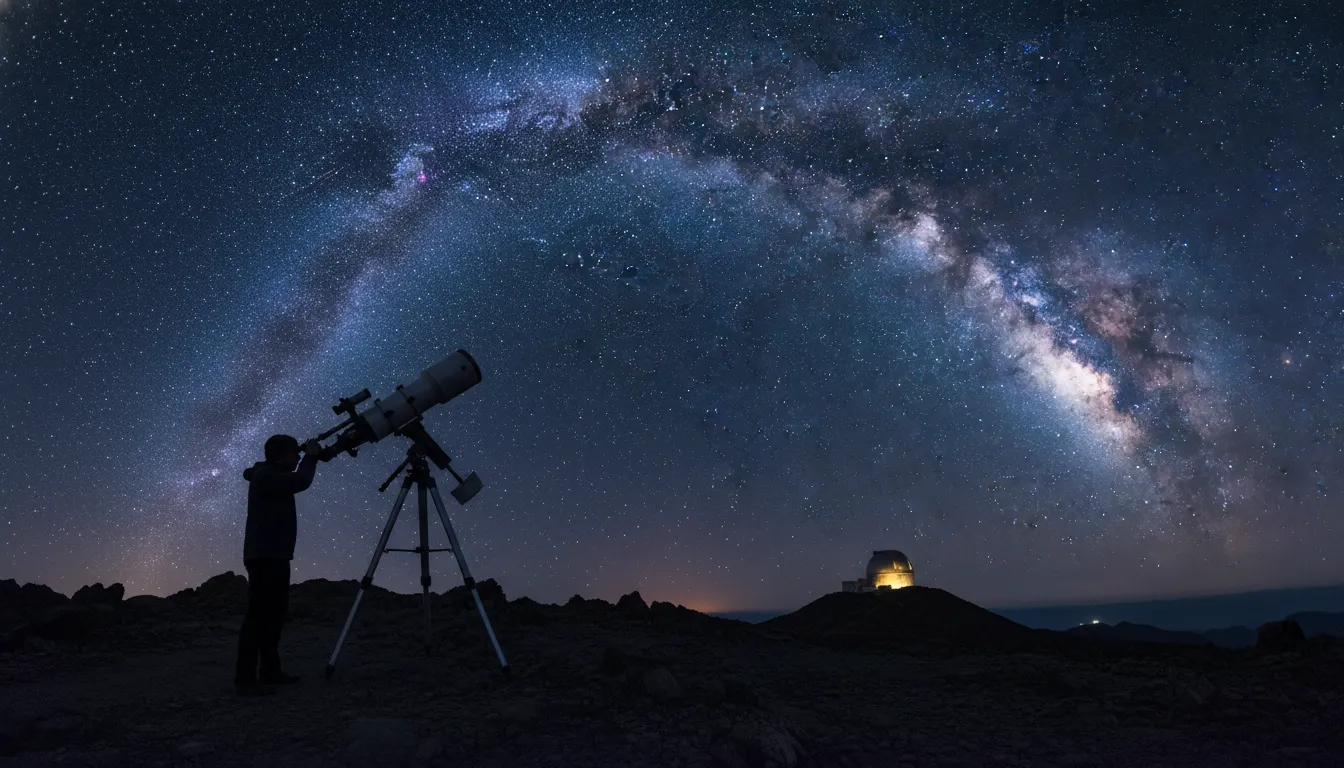
Space is not just a vast, dark stage where planets and stars float in silence. It is a cosmic-scale laboratory where the laws of physics are tested at the extremes, where time and space bend, where matter takes forms that defy any everyday intuition.
Each new discovery — whether the image of a black hole, the detection of gravitational waves, or the observation of a primordial galaxy — reinforces something fundamental: the universe is much richer, stranger, and more surprising than any previous generation could have imagined. And the fact that there is still so much to learn is not frustrating; it is, in fact, the greatest invitation to curiosity that exists.
In a world full of not always reliable information, it is always worth seeking solid and verifiable sources — just as we do when talking about science. If you want to develop this habit also in consuming daily news, it is worth reading how to identify a fake news story on the internet.
The universe invites us to look up, to ask more, to accept not knowing as a starting point. And that, in itself, is extraordinary.
- Jupiter has at least 95 confirmed moons, according to recent astronomical data. The largest, Ganymede, is larger than the planet Mercury.


