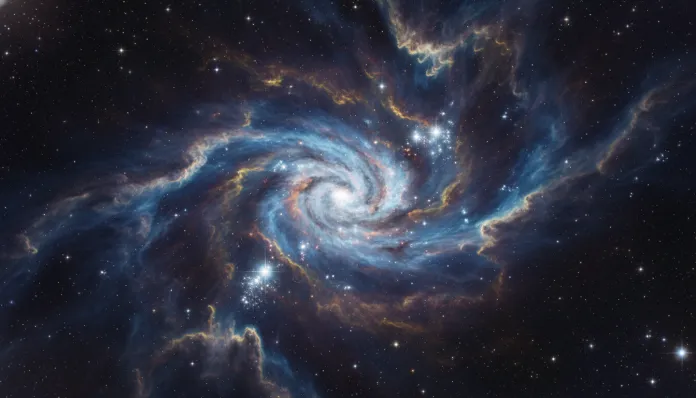
You look up at the starry sky on a clear night and feel that the universe is vast, silent, and orderly. Billions of stars, distant galaxies, a majestic cosmos following fixed rules. But modern science tells a very different—and much more disturbing—story. The universe that physicists and cosmologists describe today is a place where time can twist, matter behaves in ways impossible to visualize, and the very concept of “reality” begins to slip through our fingers.
In recent decades, especially with accumulated advances from the 1990s to the 2020s, physics has revealed layers of strangeness that defy any human intuition. This is not science fiction. These are tested equations, repeated experiments, and observations confirmed by telescopes, particle accelerators, and gravitational wave detectors around the world. The universe obeys rules, yes—but these rules are radically different from what common sense suggests.
Prepare yourself: what you are about to read is 100% real.
Space Is Not Empty—It’s Boiling
The first thing to abandon is the idea that a vacuum is an absence. According to quantum physics—specifically Heisenberg’s uncertainty principle—a perfect vacuum is impossible. “Empty” space is in constant turmoil with virtual particles that appear and disappear in absurdly small fractions of a second.
This phenomenon has a name: quantum vacuum fluctuations. And it is not theoretical in the sense of “hypothetical.” The Casimir effect, first experimentally demonstrated with sufficient precision in 1997 by Steven Lamoreaux, shows that two metal plates placed very close in a vacuum are attracted to each other because of these fluctuations. The vacuum exerts measurable force.
More than that: it is believed that vacuum energy is responsible for the so-called dark energy—the mysterious force that is accelerating the expansion of the universe. The problem is that theoretical calculations of this energy disagree with observation by a factor of approximately 10 to the power of 120—the largest discrepancy between theory and experiment in the history of science.
Time Does Not Flow the Same for Everyone
Einstein had already realized this in the early 20th century, but it’s hard for the human brain to really feel the weight of the information: time passes at different rates depending on gravity and speed.
This is not a metaphor. The satellites of the GPS system need to constantly correct their clock rates—because they orbit far from Earth (less gravity = faster time) and at high speed (speed = slower time). Without these corrections based on Einstein’s theory of relativity, GPS would err in its location by kilometers per day.
The phenomenon is called time dilation. The stronger the gravitational field, the slower time passes. On the surface of a neutron star—an object so dense that a teaspoon of its matter would weigh billions of tons—time advances noticeably slower compared to a distant observer. And in a black hole singularity? Mathematically, time simply stops.
This raises one of the most disturbing questions in physics: does time have a direction? The fundamental equations of physics are mostly time-symmetric—they work equally well in the past and future directions. The “arrow of time” we feel seems to emerge from thermodynamic considerations, not a fundamental law. The past and future may be more alike than we imagine.
Particles That Communicate Instantly (Or Almost)
In 1964, physicist John Bell formulated a mathematical theorem. In 1982, Alain Aspect conducted the experiment that tested this theorem. The result was so disturbing that many physicists preferred not to talk much about it for years. Aspect, incidentally, received the Nobel Prize in Physics in 2022 precisely for this contribution.
What Aspect demonstrated was quantum entanglement in action. When two particles interact and become “entangled,” measuring one of them instantly affects the state of the other—regardless of the distance separating them. This has been experimentally verified with particles separated by distances of hundreds of kilometers.
To be clear about what this does not mean: it is not possible to use this phenomenon to send information faster than light. The results of individual measurements are random—only by comparing them (which requires regular communication, limited to the speed of light) can the correlation be seen. But the fact of entanglement itself challenges any classical notion of locality. Einstein called it “spooky action at a distance” and considered it impossible. Nature disagreed.
You Are Almost Completely Empty
The atom is the basic unit of matter. An atom consists of a nucleus (protons and neutrons) surrounded by electrons. The distance between the nucleus and the electrons, in proportion to the size of the nucleus, is enormous. If the nucleus of a hydrogen atom were enlarged to the size of an orange, the electron would be approximately 2.5 kilometers away.
This means that “solid” matter is, in proportion, almost entirely empty space. The chair you are sitting on, the floor under your feet, your own body—everything is predominantly empty with electromagnetic fields creating the illusion of solidity. You don’t pass through the chair because the electric fields of the atoms repel each other, not because there is “solid matter” blocking the way.
And there’s more: the protons and neutrons themselves are made of smaller particles called quarks, which in turn never exist isolated in nature—they are always confined within larger particles. And the mass of the quarks accounts for only about 1% of a proton’s mass. The rest comes from the interaction energy between them. We are, literally, condensed energy.
The Universe Has 95% Unknown Content
All visible matter—stars, planets, nebulae, galaxies, you, this article—accounts for approximately 5% of the total content of the universe. The other 95% is composed of dark matter (about 27%) and dark energy (about 68%).
Dark matter is inferred by the way galaxies rotate: stars at the edges of galaxies move too fast to be held together only by the gravity of visible matter. There must be something more, invisible and without electromagnetic interaction (hence it neither emits nor absorbs light). Numerous experiments have attempted to detect dark matter particles directly—until 2026, none have obtained definitive confirmation.
Dark energy is even more mysterious: it is the name given to the cause of the universe’s accelerating expansion, discovered in 1998 by the teams of Saul Perlmutter, Brian Schmidt, and Adam Riess (Nobel Prize in Physics in 2011). The universe not only expands—it expands faster and faster. Something is pushing everything away, and we don’t know what it is.
What We Know About What We Don’t Know
Dark matter interacts with gravity but not with light
Dark energy acts against gravity on cosmological scales
No candidate particle for dark matter has been directly detected so far
Alternative theories like MOND (Modified Newtonian Dynamics) try to explain phenomena without dark matter but do not explain all data
Black Holes: Where Physics Stops Working
A black hole is a region of space where gravity is so intense that nothing—not even light—can escape after crossing the so-called event horizon. They are not solid objects; they are extreme folds in the fabric of space-time.
In 2019, the Event Horizon Telescope collaboration released the first direct image of a black hole—the supermassive one at the center of galaxy M87, with a mass of about 6.5 billion suns. In 2022, the same project photographed the Sagittarius A* black hole, at the center of the Milky Way, with a mass of about 4 million suns.
At the center of a black hole is the singularity—a point where density tends to infinity and the equations of general relativity simply cease to make sense. Physicists interpret this as a sign that a more complete theory is needed: the great quest for quantum gravity, a theory that unifies quantum mechanics and general relativity. It does not yet exist.
Stephen Hawking proposed in 1974 that black holes slowly emit radiation (the so-called Hawking radiation) and eventually evaporate. This process raises the information paradox: would the information about what fell into the black hole be destroyed? Quantum mechanics says this is impossible. The debate remains open.
The Universe May Be Much Larger Than We Observe
The observable universe is about 93 billion light-years in diameter—a volume we can see with current instruments, limited by the speed of light and the age of the cosmos. But the total universe could be much, much larger. Possibly infinite.
Some cosmological theories, such as eternal inflation, suggest that the universe underwent a brief exponential expansion right after the Big Bang, generating causally disconnected regions—bubble universes that can never interact with each other. This is the multiverse in its cosmological version. It is not science fiction, but serious scientific speculation, debated by physicists like Alan Guth and Andrei Linde.
The universe is not strange for the sake of it. Each phenomenon described here was discovered because someone asked a simple question and took the answers seriously, no matter how uncomfortable they were. The boiling vacuum, the bending time, the entangled particles, the 95% invisible cosmos—all these are open doors, not closed walls.
Modern physics is in a rare moment: it knows enough to know how much it doesn’t know. Quantum theory and general relativity work magnificently in their domains, but they contradict each other when confronted together. A larger, more complete theory is yet to come.
And when it comes, it will likely make the universe even stranger. What a wonder.
Para fornecer as melhores experiências, usamos tecnologias como cookies para armazenar e/ou acessar informações do dispositivo. O consentimento para essas tecnologias nos permitirá processar dados como comportamento de navegação ou IDs exclusivos neste site. Não consentir ou retirar o consentimento pode afetar negativamente certos recursos e funções.
Funcional
Always active
O armazenamento ou acesso técnico é estritamente necessário para a finalidade legítima de permitir a utilização de um serviço específico explicitamente solicitado pelo assinante ou utilizador, ou com a finalidade exclusiva de efetuar a transmissão de uma comunicação através de uma rede de comunicações eletrónicas.
Preferências
O armazenamento ou acesso técnico é necessário para o propósito legítimo de armazenar preferências que não são solicitadas pelo assinante ou usuário.
Estatísticas
O armazenamento ou acesso técnico que é usado exclusivamente para fins estatísticos.O armazenamento técnico ou acesso que é usado exclusivamente para fins estatísticos anônimos. Sem uma intimação, conformidade voluntária por parte de seu provedor de serviços de Internet ou registros adicionais de terceiros, as informações armazenadas ou recuperadas apenas para esse fim geralmente não podem ser usadas para identificá-lo.
Marketing
O armazenamento ou acesso técnico é necessário para criar perfis de usuário para enviar publicidade ou para rastrear o usuário em um site ou em vários sites para fins de marketing semelhantes.