
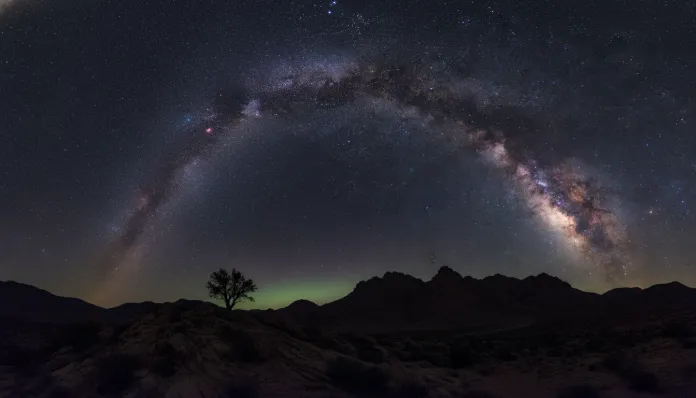
Look at the starry sky on a clear night and try to imagine what exists beyond what your eyes can reach. Difficult, isn’t it? The human mind was shaped to deal with distances that fit within a football field, a city, a continent. The cosmos, however, operates on scales so absurd that any everyday comparison seems like a joke. And the most impressive thing is that the more science advances, the more the universe seems to grow — not because it’s getting bigger, but because our ability to see it keeps expanding.
The good news is that understanding the size of the universe doesn’t require an astrophysics degree. All it takes is a good dose of curiosity and the willingness to have your mind blown (metaphorically) a few times during this reading. Get ready: the numbers you’ll see here are real, verified by the scientific community, and yet they seem completely impossible.
In this article, we’ll embark on a journey that starts in our cosmic backyard — the Solar System — and goes to the edges of the observable universe, passing through galaxies, intergalactic voids, and the limits of what science can see today.
The Solar System: our small backyard
To start getting a sense of scale, you need to start from home. The Solar System centers on the Sun, a medium-sized star with a diameter of approximately 1.39 million kilometers. To give you an idea, you could line up about 109 Earths side by side along the Sun’s diameter.
The distance from Earth to the Sun is about 150 million kilometers, a measurement so commonly used in astronomy that it has its own name: the Astronomical Unit (AU). Light, which travels at approximately 300,000 kilometers per second, takes about 8 minutes to traverse this distance.
But the Solar System extends far beyond the planets we learned about in school. The region known as the Oort Cloud — a kind of spherical shell of ice and rock surrounding the system — extends up to 100,000 Astronomical Units from the Sun. This means light would take more than a year and a half to cross this entire region. And we’d still be within our Sun’s “backyard.”
The Milky Way: our galaxy, immeasurably vast
Leaving the Solar System, we enter the Milky Way — the spiral galaxy where we live. It has between 100,000 and 200,000 light-years in diameter. A light-year, remember, is the distance light travels in one year: approximately 9.46 trillion kilometers.
The Solar System is located in one of the Milky Way’s spiral arms, about 26,000 light-years from the galactic center. This means that if you could travel at the speed of light, it would take 26,000 years just to reach the nucleus of our own galaxy.
The Milky Way contains between 100 billion and 400 billion stars. Many of them have planets orbiting around them. Some of these stars are much larger and brighter than the Sun; others are tiny red dwarfs that shine faintly for trillions of years. All this diversity exists within a single galaxy — ours.
Beyond the Milky Way: an ocean of galaxies
If the Milky Way already seems absurdly large, the next scale will leave you speechless. The observable universe is estimated to contain between 200 billion and 2 trillion galaxies. This number was revised upward in studies published from 2016 onwards, when researchers used data from the Hubble Space Telescope to conclude that previous estimates vastly underestimated the number of existing galaxies.
The closest galaxy to the Milky Way is Andromeda (also called M31), located about 2.537 million light-years away. It’s visible to the naked eye on dark nights — a milky smudge in the sky — but it’s so far away that the light you see today left there more than 2.5 million years ago, when our ancestors were still Homo habilis walking through Africa.
The Milky Way and Andromeda are part of a group of galaxies called the Local Group, which in turn is part of a larger structure called the Virgo Supercluster (or Laniakea), discovered and mapped in 2014 by a team led by astronomer Brent Tully. Laniakea contains about 100,000 galaxies and extends 520 million light-years.
The observable universe: the limit of what we can see
There is a practical frontier to what humanity can observe: the observable universe. It doesn’t exist because the universe ends there, but because light from more distant regions simply hasn’t had time to reach us since the Big Bang — which occurred approximately 13.8 billion years ago.
The radius of the observable universe is estimated at about 46.5 billion light-years. This may seem contradictory: if the universe is 13.8 billion years old, how did light from 46.5 billion light-years away reach us? The answer lies in the expansion of the universe: space itself expands, so regions that emitted this light were much closer in the past but have been moving away while the light was traveling.
This expansion was discovered by Edwin Hubble in the 1920s and was later found to be accelerating — a discovery that earned the 2011 Nobel Prize in Physics for Saul Perlmutter, Brian P. Schmidt, and Adam Riess. The force responsible for this acceleration is called dark energy, and we still don’t know exactly what it is.
What exists beyond the observable universe?
This is, perhaps, the most dizzying question in modern cosmology. The observable universe is only the portion of the cosmos that we can, in principle, detect. But the total universe — what exists beyond that horizon — may be orders of magnitude larger.
Some theories, such as cosmic inflation, suggest that shortly after the Big Bang the universe underwent extremely rapid expansion, creating a cosmos much larger than the part we can observe. If these theories are correct, the total universe may be practically infinite — or at least so large that the difference from infinity is irrelevant in practice.
There are also scientific speculations, such as the multiverse theory, which proposes the existence of multiple universes beyond ours. This is, for now, a hypothesis still without direct observational confirmation, but it is taken seriously by part of the scientific community as a consequence of certain interpretations of quantum mechanics and inflationary cosmology.
Curiosities that put everything in perspective
Sometimes, more than numbers, it’s comparisons that help you feel the size of the universe. Look at some:
- If the Sun were reduced to the size of an orange, Earth would be a grain of sand about 10 meters away.
- On that same scale, the star closest to the Sun, Proxima Centauri (4.24 light-years away), would be about 2,700 kilometers away — roughly the distance from Rio de Janeiro to Buenos Aires.
- The supermassive black hole at the center of the Milky Way, called Sagittarius A*, has a mass equivalent to about 4 million suns.
- The Voyager 1 probe, launched in 1977 and still operating, is the most distant human object from Earth — but it’s still within the Sun’s sphere of influence. It has been traveling for almost 50 years and we’ve barely scratched the surface of the cosmos.
- If you tried to count all the stars in the observable universe aloud, one per second, it would take more than 3,000 times the current age of the universe to finish.
Why does this matter to us here on Earth?
It may seem that understanding the size of the universe is a purely abstract exercise with no practical application. But there are very concrete reasons why this understanding matters.
First, astronomical research has generated technologies we use in everyday life: GPS, wireless networks, digital cameras, and medical imaging diagnostics have roots in space science developments. Second, understanding the cosmos helps us understand the origin of the elements that make up our bodies — the carbon, oxygen, and iron flowing through your blood were forged in stars that exploded billions of years before the Sun existed.
Third, and perhaps more profoundly: knowing that we live on a pale blue dot, orbiting a common star, in a galaxy among trillions of others, reframes our perspective on what is important — and invites us to take better care of the only home that, so far, we know we have.
Conclusion: curiosity as a compass
The universe is, by any reasonable measure, incomprehensibly large. Our Solar System is dust within the Milky Way, which is dust within the observable universe, which may be dust within something larger that we still don’t have words to describe. And all of this is real — not science fiction, not vague speculation, but science built over centuries by brilliant minds using telescopes, mathematics, and a heroic amount of patience.
The vastness of the cosmos doesn’t need to cause anguish. It can cause, instead, wonder — that feeling that the world is much richer and stranger than routine allows us to see. Every time we look at the starry sky, we’re looking at the past: the light from the stars we see today left there years, decades, centuries, or millennia ago. We are, in a sense, archaeologists of time whenever we look up.
If this article sparked curiosity about other fascinating topics of everyday life and technology, you might also enjoy learning how to keep your phone photos safe — because, after all, recording the moments of our small life here on Earth also has its immense value.