
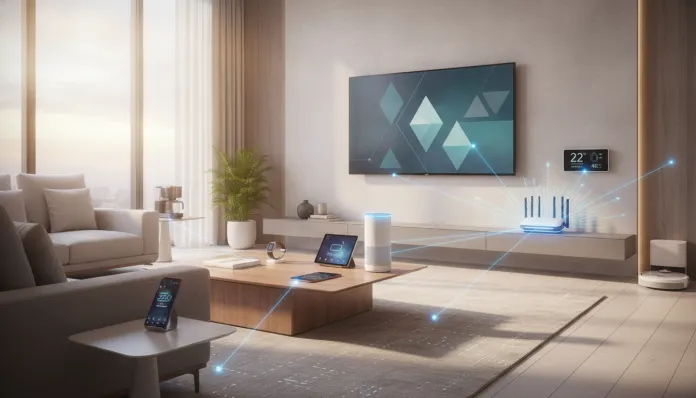
Why is Your Fridge “Talking” to Your Phone?
Imagine waking up in the morning to find that your fridge has already sent a message notifying you that the milk is running low. Or that your watch detected an irregularity in your heartbeat and automatically scheduled a medical appointment. This might sound like science fiction, but it’s the reality of the Internet of Things — or IoT — a technology that, by 2026, has become part of the daily lives of billions of people worldwide, often without them realizing it.
The core idea is simple: connect everyday objects to the internet, allowing them to collect data, communicate with each other and users, and make autonomous or semi-autonomous decisions. The term was popularized by British engineer Kevin Ashton, who first used it in 1999 to describe a network of connected physical objects. Since then, technology has evolved rapidly, driven by the reduction in sensor costs, the expansion of wireless networks, and advances in cloud computing.
Today, cars, appliances, industrial systems, cities, hospitals, and even agricultural fields are integrated into this vast digital web. Understanding what IoT is, how it works, and its practical impacts is increasingly essential for anyone wanting to navigate the contemporary world consciously.
What Exactly is the Internet of Things?
The Internet of Things can be defined as an ecosystem of physical devices connected to the internet, capable of collecting and exchanging data without the need for direct human interaction. The “object” can be anything: a light bulb, a sports shoe, a temperature sensor in a factory, or an electricity meter.
What differentiates a “common” object from a “smart” object is the presence of three main components:
- Sensors and actuators: capture environmental information (temperature, motion, light, pressure) and can perform physical actions, such as turning on a motor or opening a valve.
- Connectivity: the device needs a means to transmit data — it can be Wi-Fi, Bluetooth, cellular networks (like 4G and 5G), or specific IoT protocols like Zigbee and LoRaWAN.
- Processing and platform: the collected data is sent to a server (in the cloud or locally) where it is analyzed and generates responses or alerts.
The result is a continuous cycle of collection → transmission → analysis → action, which can occur in fractions of a second.
How It Works in Practice: A Daily Example
To make this more concrete, think of a smart thermostat — one of the most classic examples of residential IoT. Products like the Google Nest Learning Thermostat learn the resident’s habits over time and automatically adjust the home’s temperature, saving energy.
Here’s how the cycle works in this case:
- Sensors measure the ambient temperature and detect if someone is home (via motion or phone location).
- The data is transmitted via Wi-Fi to a server in the cloud.
- Algorithms analyze the preference history and current conditions.
- The thermostat receives an instruction and adjusts the heating or cooling automatically.
- The user can monitor and control everything through the smartphone app.
This same principle is repeated in very different contexts — from a power plant to a hospital, from a smart farm to a container port.
IoT in Industry: The So-Called “Industry 4.0”
In the industrial sector, the Internet of Things has gained its own name: IIoT, or Industrial Internet of Things. It is one of the pillars of what is conventionally called Industry 4.0 — the fourth industrial revolution, marked by the digitization of production processes.
In practice, this means factories with machines that monitor their own wear and request maintenance before they break down (so-called predictive maintenance), production lines that automatically adjust to demand variations, and logistics systems that track each part in real-time.
Companies like Siemens, Bosch, and General Electric have been investing for years in industrial solutions based on IoT. The impact is significant: waste reduction, increased efficiency, and greater safety for workers, as sensors can identify hazardous conditions before accidents occur.
Smart Cities: IoT in Urban Spaces
Another fascinating field of application is smart cities. Municipalities around the world use sensors and connected networks to manage their resources and services more efficiently.
Some real and verifiable examples:
- Smart public lighting: streetlights that adjust brightness according to the movement of people and vehicles, reducing energy consumption.
- Waste management: bins with sensors that notify when they are full, optimizing collection routes.
- Traffic monitoring: cameras and sensors on roads that feed real-time traffic light control systems.
- Air quality: networks of sensors distributed throughout the city that measure pollutants and generate exposure maps for the population.
Cities like Singapore, Barcelona, and Amsterdam are often cited as global references in implementing urban IoT solutions. In Brazil, initiatives in cities like Curitiba and São Paulo are also advancing in this direction, with environmental monitoring and smart mobility projects.
IoT and Health: Devices That Care for You
In healthcare, the Internet of Things has transformative potential. Wearable devices like smartwatches and monitoring bracelets can already measure heart rate, blood oxygen saturation, sleep quality, and physical activity levels continuously.
Hospitals use IoT to track medical equipment in real-time, remotely monitor chronic patients, and automate medication stock control. At home, connected devices can alert family members or healthcare professionals if an elderly person falls or shows abnormal vital signs.
> Note: Information generated by IoT health devices is for informational and general monitoring purposes. Any symptoms, changes, or concerning data should be evaluated by a qualified healthcare professional. These devices do not replace medical consultations.
Security and Privacy: The Side That Requires Attention
With so many devices collecting data all the time, legitimate questions arise about security and privacy. This is indeed one of the biggest challenges of IoT.
Poorly configured devices or those with outdated software can become entry points for cyberattacks. In 2016, the Mirai botnet attack — one of the largest in internet history at the time — was executed precisely through thousands of compromised IoT devices, such as security cameras and home routers.
Moreover, the massive data collection raises questions about who has access to this information and how it is used. Regulations like the European GDPR (General Data Protection Regulation) and the Brazilian LGPD (General Data Protection Law) seek to establish clear rules on the collection, storage, and use of personal data — including that generated by IoT devices.
Best Practices for Using Smart Devices at Home
- Always update the firmware of devices when new versions are available.
- Change the default factory passwords immediately after installation.
- Prefer devices from recognized manufacturers with clear privacy policies.
- If possible, create a separate Wi-Fi network (guest network) for IoT devices, isolating them from computers and phones with sensitive data.
- Disable features you don’t use, like remote access or microphones, when not needed.
The Future of IoT: What to Expect in the Coming Years
The expansion of the 5G network has been one of the major accelerators of IoT. With very low latency and the ability to connect a much larger number of devices simultaneously, 5G paves the way for applications that were previously unfeasible — such as autonomous vehicles communicating in real-time with urban infrastructure or surgeries performed remotely with internet-controlled instruments.
Conclusion
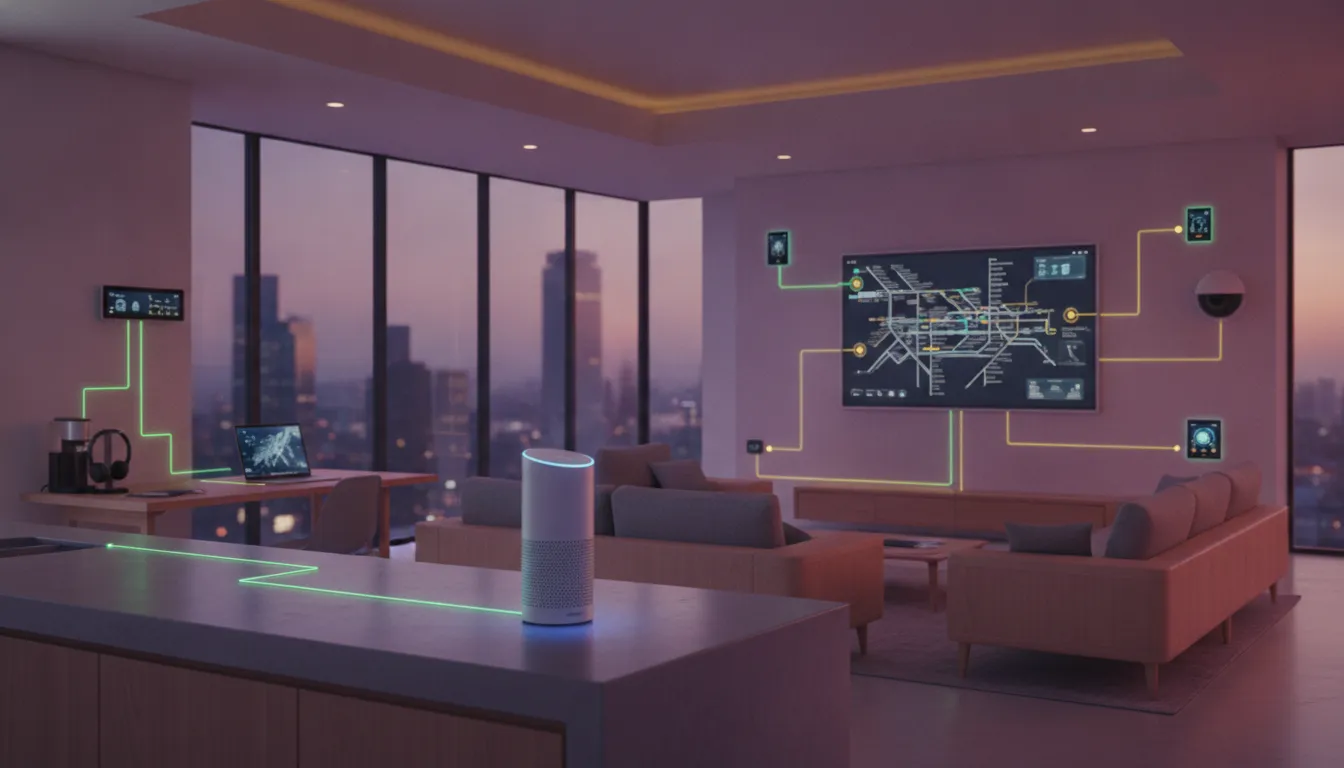
The Internet of Things is not a future technology — it is already present, quietly shaping how cities operate, how industries produce, how we care for health, and how we manage our homes. Understanding its fundamentals helps not only to better use the available devices but also to make more conscious choices about privacy, security, and consumption.
The collective challenge is to ensure that this growing connectivity is accompanied by responsibility: clear regulations, good security practices, and an open debate about the limits of data collection. When well implemented, IoT has the potential to make our lives more efficient, safe, and sustainable. When neglected, it can open doors that are better left closed.
In an increasingly connected world, understanding how things “talk” to each other is increasingly a form of digital citizenship.
- Change the default factory passwords immediately after installation.
- Waste management: bins with sensors that notify when they are full, optimizing collection routes.
- The data is transmitted via Wi-Fi to a server in the cloud.
- Connectivity: the device needs a means to transmit data — it can be Wi-Fi, Bluetooth, cellular networks (like 4G and 5G), or specific IoT protocols like Zigbee and LoRaWAN.


