
The Earth Never Stops: Understanding What Causes Earthquakes
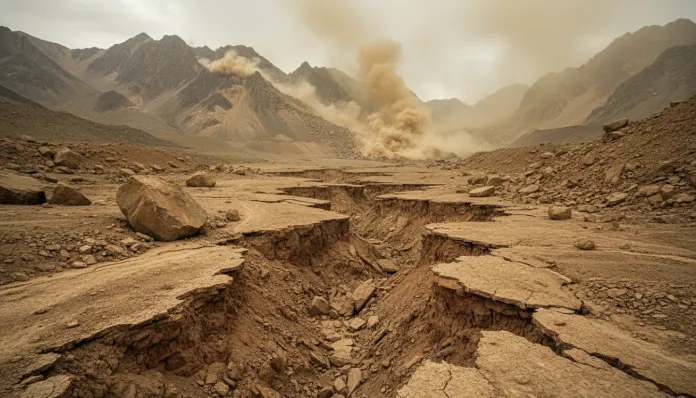
Imagine waking up in the middle of the night with the ground shaking beneath your feet, pictures falling off the walls, and a muffled noise coming from beneath the earth. For millions of people around the world, this is not fiction — it’s a reality that can happen at any moment. Earthquakes are among the most powerful and unpredictable natural phenomena on the planet, capable of reshaping entire landscapes in a matter of seconds.
But what exactly makes the Earth shake? The answer lies deep within our planet, in geological processes that began billions of years ago and continue to this very moment. Far from being a solid, static block, the Earth is a dynamic machine, constantly in motion — and earthquakes are one of the most dramatic expressions of this internal energy.
Understanding the origin of tremors is not just scientific curiosity: it is essential knowledge for anyone who wants to understand the world they live in, and especially important for populations living in risk areas. Let’s dive into this story that starts in the planet’s fiery core and reaches the surface where we live.
The Earth’s Internal Structure: It All Starts Here
To understand earthquakes, you first need to know what’s down there. The Earth has four main layers:
- Crust: the outermost layer where we live. It can be between 5 km (at the ocean floor) and about 70 km thick (in mountainous regions).
- Mantle: the largest layer, about 2,900 km thick. It is composed of solid rock but behaves like an extremely viscous fluid over millions of years.
- Outer core: liquid, mainly composed of iron and nickel, with temperatures reaching about 5,000 °C.
- Inner core: solid, despite the high temperatures, due to the enormous pressure.
The heat generated in the core creates convection currents in the mantle — a slow and continuous movement of hot material rising and cooler material sinking. This movement is the engine that drives the tectonic plates, the large “blocks” that form the Earth’s crust.
Tectonic Plates: The Giants in Motion
The Earth’s surface is not a single piece. It is divided into approximately 15 to 20 large tectonic plates (and several smaller ones) that fit together like a giant puzzle and are in constant motion — although extremely slow, usually a few centimeters per year.
These plates move over the mantle and interact with each other in three main ways:
- Convergence: two plates collide. When this happens, one can dive under the other (subduction) or both can compress, forming mountain ranges. The Himalayas, for example, were formed by the collision between the Indian and Eurasian plates.
- Divergence: two plates move apart, creating fractures and allowing mantle material to rise. This occurs at the Mid-Atlantic Ridge, at the bottom of the Atlantic Ocean.
- Transform: two plates slide horizontally past each other. The famous San Andreas Fault in California (USA) is a classic example.
It is precisely at the edges of these plates that most earthquakes occur. Friction, accumulated pressure, and sudden movements between them are the main cause of tremors.
The Earthquake Mechanism: From Focus to Surface
When two plates are stuck to each other due to friction, the energy generated by tectonic movement accumulates over time. When it reaches a critical point, this energy is released suddenly — that’s when the earthquake occurs.
Key Terms to Understand
- Focus (or hypocenter): the point inside the Earth where the earthquake originates. It can be a few kilometers deep or hundreds of kilometers below the surface.
- Epicenter: the point on the Earth’s surface directly above the focus. It is usually where the effects are most felt.
- Seismic waves: waves of energy that propagate from the focus in all directions, like waves in water. There are different types — P waves (primary, which compress the material) and S waves (secondary, which cause lateral movement) are the most studied.
The intensity with which the earthquake is felt depends on several factors: the amount of energy released, the depth of the focus, the distance from the epicenter, and the type of soil in the affected region.
How Earthquakes Are Measured
You have certainly heard of the Richter scale, but did you know that it is gradually being replaced by more accurate methods? Created by seismologist Charles Richter in 1935, this logarithmic scale measured the amplitude of seismic waves. Today, scientists prefer to use the moment magnitude scale (Mw), which calculates the total energy released and is more suitable for large earthquakes.
In practice, what matters to know is:
- Earthquakes below magnitude 2.0: generally imperceptible to humans.
- Between 2.0 and 4.0: mild, felt by people near the epicenter.
- Between 4.0 and 6.0: moderate, can cause damage to fragile constructions.
- Between 6.0 and 7.0: strong, with potential for significant damage.
- Above 7.0: large earthquakes, capable of widespread destruction.
- Above 8.0: rare and catastrophic.
In addition to magnitude, there is the Mercalli intensity scale, which assesses the effects felt by people and the damage caused — and can vary within the same affected region.
The World’s Most Seismic Regions
The distribution of earthquakes on the planet is not random: it follows, almost to the letter, the boundaries of tectonic plates. The region known as the Pacific Ring of Fire concentrates about 90% of all the world’s earthquakes and approximately 75% of active volcanoes. This “ring” surrounds the edges of the Pacific Ocean, passing through Chile, Peru, Central America, the west coast of the United States, Alaska, Japan, the Philippines, and New Zealand.
Japan, in particular, is one of the most seismic countries in the world: it records tens of thousands of tremors per year, the vast majority imperceptible, but with historically devastating occurrences. The Tohoku earthquake in March 2011 reached a magnitude of 9.0 and triggered a tragically proportioned tsunami.
Other highly seismic regions include the Mediterranean and the Middle East (where the African, Arabian, and Eurasian plates meet) and Central Asia.
Brazil, being in the interior of the South American plate, is considered a country of low seismicity — but it is not completely free of tremors. Regions such as the interior of Ceará, Rio Grande do Norte, and Minas Gerais record seismic activity with some frequency, although rarely of significant magnitude.
Other Types of Earthquakes: Beyond the Plates
Although the movement of tectonic plates is the most common cause, there are other factors capable of generating tremors:
- Volcanic earthquakes: caused by the movement of magma inside volcanoes. They are usually smaller in magnitude but can be precursors to eruptions.
- Collapse earthquakes: occur when underground caves or mines collapse.
- Human-induced seismicity: the so-called induced seismicity is a growing area of study. Activities such as oil and gas extraction, fluid injection into the subsurface (as in geothermal energy generation), and the filling of large hydroelectric reservoirs can, under certain geological conditions, trigger tremors. This is a topic still under active research and scientific debate.
Is It Possible to Predict Earthquakes?
This is one of the oldest — and most frustrating — questions in geoscience. To date, there is no reliable scientific method to accurately predict when and where an earthquake will occur. Scientists can identify regions of higher risk based on seismic history and geological characteristics, but predicting an earthquake days or hours in advance remains beyond the reach of current science.
What exists, and has saved lives, are early seismic warning systems: sensors that detect P waves (less destructive and faster) and issue automatic alerts before S waves (more destructive) reach the surface. Japan has one of the most advanced systems in the world in this regard, with alerts broadcast on televisions, cell phones, and public loudspeakers a few seconds in advance — enough time to stop trains, open emergency doors, and take cover.
For the National Parks of Brazil to Explore Nature and other conservation areas, understanding local geology is equally essential for safety planning and environmental conservation.
Conclusion: Living on a Living Planet

Earthquakes remind us, sometimes brutally, that we live on a planet in constant transformation. The same internal energy that shaped mountains, opened oceans, and created the conditions for life on Earth is also responsible for the tremors that frighten and destroy.
Understanding the mechanisms of earthquakes — from tectonic plates to seismic waves, from deep foci to surface epicenters — is a fundamental part of our relationship with the planet. Scientific knowledge does not eliminate risk, but it allows societies to better prepare, build safer structures, and develop more effective response systems.
The Earth is about 4.5 billion years old and will continue to move for much longer. It is up to us to learn to live with this dynamism — with respect, preparation, and curiosity.


