
Brazil is a country of continental dimensions, with over 200 million inhabitants and a sports culture that goes far beyond football. While the round ball holds an almost sacred place in the hearts of Brazilians, a broad survey across the national territory reveals a much more diverse and surprising panorama. From beaches crowded with volleyball players to gyms full of bodybuilding enthusiasts, sports are part of the daily life of millions of people — whether for leisure, health, or competition.
Understanding which sports are most practiced in Brazil is relevant not only for the curious but also for those who want to start a physical activity, understand the local culture, or simply learn more about the country itself. After all, sports practice is directly linked to quality of life, public health, and even national identity. And when we talk about Brazil, we are talking about a nation that has produced Olympic, world, and historical champions in various sports.
In this article, we will explore the main sports practiced by Brazilians — inside and outside the courts, pools, and fields — understand what makes them so popular, and discover data and curiosities that don’t always appear in sports news.
Football: The Sport of the Brazilian Soul
There’s no way to start this list with any other sport. Football is, without a doubt, the most popular and most practiced sport in Brazil. Introduced at the end of the 19th century, student Charles Miller is credited with bringing the first ball and the first rules to the country in 1894. Since then, football has ceased to be a pastime of the elite to become a cultural heritage of the Brazilian people.
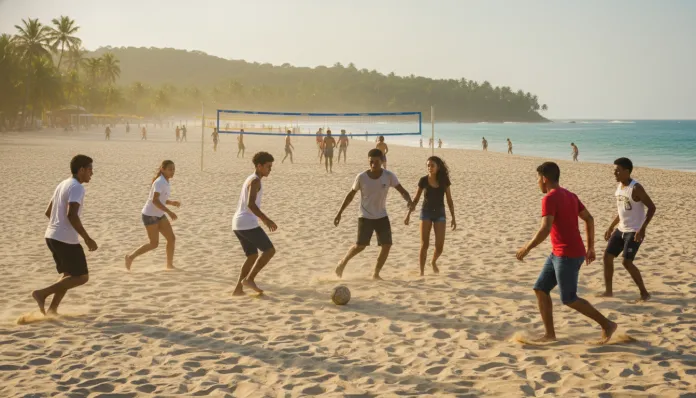
Brazil is the only country in the world to have won five FIFA World Cup titles (1958, 1962, 1970, 1994, and 2002), which has cemented its reputation as the greatest football power in the world. But beyond professional football, what is impressive is the reach of the sport: dirt fields in peripheral communities, beach kickabouts, grassroots schools in inland cities — football is everywhere.
According to surveys conducted by the Brazilian Football Confederation (CBF) over the years, tens of millions of Brazilians play football regularly, whether amateur or semi-professional. Futsal — a version of football played on indoor courts with teams of five players — is also extremely popular and has competitions in all states of the country.
Volleyball: From Sand to Olympic Podium
Volleyball is, by far, the second most popular sport in Brazil. The sport has a passionate fan base and a victorious tradition that few countries can match. The Brazilian men’s and women’s volleyball teams have accumulated world and Olympic titles over the past decades, creating idols that have transcended the sport.
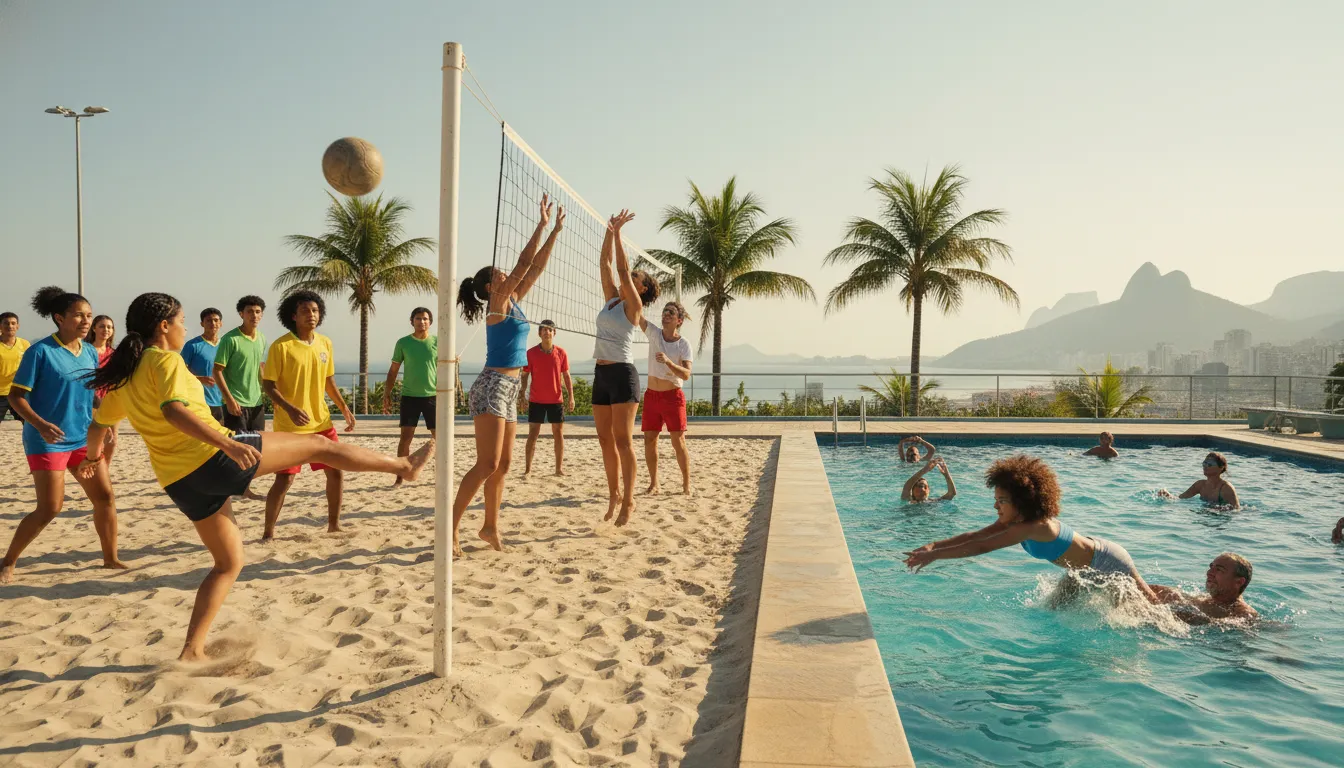
Beach volleyball, created precisely on the sands of Rio, became an Olympic sport and continues to be one of the most practiced sports on the Brazilian coastlines. Amateur player pairs can be found on practically every beach in Rio de Janeiro, São Paulo, Florianópolis, and Salvador, among other coastal cities.
The popularity of volleyball is also fueled by its strong presence in schools and universities, where interclass and inter-neighborhood championships engage young people from all over Brazil. It is an accessible sport — all you need is a net, a ball, and a group of friends — which contributes to its spread across all regions of the country.
American Football and Basketball: Consistent Growth
Although not historical sports in Brazil, American football and basketball have experienced consistent growth in recent decades. Basketball, in particular, has older roots in the country and has a relevant national league, the NBB (Novo Basquete Brasil), created in 2008, which helped professionalize and popularize the sport.
American football, in turn, gained strength from the 2010s, driven by the growth of the Super Bowl as a television event and the popularization of amateur leagues across Brazil. Today, there are hundreds of amateur teams spread across the national territory, with an active federation and consolidated state and national championships.
Both sports have a strong presence in universities and among the urban youth audience, indicating that their base of practitioners should continue to grow in the coming years.
Martial Arts and Fighting: Brazil at the Center of the World
Brazil occupies a unique position in the global martial arts scene. Brazilian jiu-jitsu — developed from Japanese judo and adapted by figures like Carlos and Hélio Gracie in the early 20th century — is now practiced in over 150 countries and has Brazil as its main cradle and reference.
MMA (Mixed Martial Arts) also has a strong Brazilian tradition, with athletes like Anderson Silva, José Aldo, and Amanda Nunes among the greatest in UFC history. This inspires a legion of practitioners in gyms across the country.
Besides these modalities, judo and karate have thousands of practitioners in Brazil, especially among children and teenagers. And we cannot forget to mention capoeira, a genuinely Brazilian martial art, created by enslaved Africans during the colonial period, which mixes fighting, dance, and music. Capoeira was recognized by UNESCO as an Intangible Cultural Heritage of Humanity in 2014 and is practiced worldwide.
Swimming, Running, and Individual Sports
Among individual sports, road running has established itself as a mass phenomenon in Brazil. Marathons, 5 km and 10 km races, mountain races, and crossings fill the sports calendars of large and small cities. Brazil has been, in different surveys over the 2010s and 2020s, one of the largest road running markets in the world, with millions of runners registered in federations and events.
Swimming is also widely practiced, especially by children. Besides being an essential skill for a country with so many rivers, lakes, and beaches, swimming is recommended by health professionals for various age groups — from babies to the elderly. Brazil has produced world champions like César Cielo, world record holder in the 50-meter freestyle for several consecutive years.
Cycling grew significantly after the Covid-19 pandemic, when many people adopted bicycles as a means of transport and leisure. Today, cycling tourism events and urban bike paths are a reality in several Brazilian capitals.
Bodybuilding and Gyms: A Health and Aesthetic Phenomenon
When it comes to regular sports practice, gyms cannot be ignored. Brazil consistently ranks among the countries with the highest number of gyms per capita in the world. Bodybuilding, combined with modalities such as crossfit, pilates, and spinning, attracts millions of Brazilians seeking health, physical conditioning, and aesthetics.
According to data from the Brazilian fitness sector, the country has over 30,000 registered gyms, distributed in practically all municipalities with a population above 20,000 inhabitants. This market moves billions of reais annually and employs hundreds of thousands of physical education professionals.
It is worth remembering that the practice of bodybuilding and physical activities, in general, should be guided by a qualified professional. Each person has different needs and physical conditions, and individual assessment is essential to ensure safety and results — especially for those with pre-existing health conditions.
Tennis, Surfing, and Niche Sports with Great Impact
Brazil also has a tradition in sports that, although not mass, have significant cultural and sports impact. Surfing is one of them: with over 7,000 km of coastline, the country has produced world champions like Gabriel Medina and Italo Ferreira, the latter a gold medalist at the Tokyo 2020 Olympic Games (held in 2021). Brazilian surfing is internationally recognized as one of the strongest on the world circuit.
Tennis, although still seen by many as an elitist sport, has been gaining ground. Names like Gustavo Kuerten (Guga), three-time Roland Garros champion, helped popularize the sport in Brazil in the 2000s. Today, public and private initiatives seek to expand access to tennis for different social classes.
Indoor volleyball, handball, and water polo are other sports with active federations, regular competitions, and a dedicated base of practitioners, especially in schools and sports clubs.
An Overview: The Most Practiced Sports in Brazil
To organize this panorama, here is a summary of the main modalities:
- Football and futsal — By far the most popular, present in all regions
- Volleyball and beach volleyball — Second most popular sport, with a great Olympic tradition
- Road running — Mass phenomenon among adults aged 25 to 55
- Swimming — Widely practiced across all age groups
- Bodybuilding and fitness — Constant growth, driven by health culture
- Jiu-jitsu and martial arts — Brazil as a world reference
- Capoeira — Sport and culture, practiced in Brazil and abroad
- Surfing — World power, favored by the extensive coastline
- Basketball and American football — Consistent growth among youth
- Cycling — Recent expansion, especially in cities
Conclusion
Brazil is, above all, a sporting country. Far beyond football — which will continue to be the national passion for generations — there is a rich and diverse ecosystem of sports that move bodies, communities, and economies. From capoeira to MMA, from beach volleyball to urban marathons, Brazilians demonstrate that the country’s sports culture is one of the most vibrant in the world.
For those who want to learn more about Brazilian culture and identity, understanding its sports is a powerful path. Just as the historical cities of Brazil that deserve your visit reveal the soul of the country through architecture and memory, sports show who we are through movement, grit, and collective celebration.
If you don’t practice any sport regularly yet, why not choose one from this list and take the first step? Find a sport that makes sense for your lifestyle, consult a health professional when necessary, and discover that sports are not just about competition — they are about belonging, well-being, and joy.
- Volleyball and beach volleyball — Second most popular sport, with a great Olympic tradition