
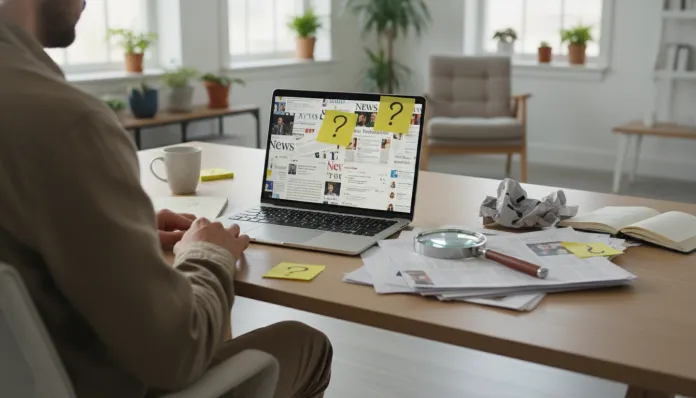
Disinformation in the Digital Age: Can You Recognize a Lie?
Have you ever shared a news story only to find out later that it was fake? If so, you’re not alone. This happens to millions of people every day around the world. The speed at which information spreads on social media and messaging apps is astounding—and unfortunately, lies often travel faster than the truth.
The phenomenon of so-called fake news—false, fabricated, or distorted news—is not new, but it has reached an industrial scale with the internet. What used to take days to spread now circles the globe in minutes. The impact goes far beyond temporary confusion: fake news has influenced public health decisions, fueled social conflicts, and caused real harm to ordinary people and institutions.
The good news is that there are simple tools and habits anyone can adopt to protect themselves. You don’t need to be a journalist or a tech expert. You just need to know what to look for—and develop the habit of questioning before sharing.
What Exactly Is Fake News?
Before you can identify it, it’s important to understand what’s at stake. The term “fake news” has become generic, but communication experts typically divide the problem into distinct categories:
- Disinformation: False content created with the deliberate intention to deceive.
- Misinformation: Incorrect information shared by someone who believes it to be true, without intent to harm.
- Malinformation: True information used out of context to cause harm.
This distinction matters because not every mistake is ill-intentioned. Many people spread falsehoods simply because they didn’t check before hitting the share button. Understanding this helps you be more careful with your own behavior—and less judgmental of others.
Why Is It So Difficult to Identify What’s False?
The answer involves both technology and psychology. On the technical side, image and video editing tools are becoming increasingly sophisticated and accessible. Anyone with a smartphone can create content that looks professional. The so-called deepfakes—videos manipulated by artificial intelligence to place faces or voices in situations that never happened—have made this challenge even more complex in recent years.
On the human side, we are naturally vulnerable to certain triggers. Content that evokes anger, fear, or outrage tends to be shared more quickly—and these are exactly the triggers that creators of disinformation often exploit. Additionally, there is the so-called confirmation bias: the tendency to accept as true what confirms what we already believe, without questioning.
Moreover, the social media environment is designed to prioritize engagement—and shocking or controversial content generates more engagement. The result is that algorithms often give more visibility to the sensational rather than the accurate.
How to Identify Fake News: Step by Step
Here is a practical guide that can be applied to any suspicious content you receive or find on the internet:
- Pause before sharing. The first and most important step is simply to pause. The urgency to pass something on “before it disappears” is almost always a warning sign.
- Check the source. What is the outlet that published the information? Is it a portal you know? Does it have an address, editorial team, publication history? Sites with names that mimic well-known outlets (with small spelling variations) are a classic warning sign.
- Look for the news elsewhere. If something important happened, other reliable outlets will also be reporting it. If you found the information in just one obscure place, be suspicious.
- Read beyond the headline. Sensational headlines are often used to attract clicks. The content of the text may tell a completely different story—or not exist consistently at all.
- Check the date. Old news is often recycled out of context. A photo from an event years ago can circulate as if it were from yesterday.
- Analyze images and videos carefully. Images can be taken out of context. Use tools like Google Images (reverse search) to discover the real origin of a photo. Just right-click on the image and select “Search image.”
- Check quotes and experts mentioned. If the news cites a study or a statement from an expert, try to find the original source. Often, what was said was distorted or taken out of context.
- Ask yourself how the news makes you feel. If the content generates a very intense emotional reaction—anger, fear, euphoria—it may be an intentional trigger. Take a deep breath before acting.
Tools That Help with Verification
In addition to common sense, there are free and reliable resources that can help with fact-checking:
- Agência Lupa (lupa.uol.com.br): A pioneer in fact-checking in Brazil, it verifies statements from public figures and circulating news.
- Aos Fatos (aosfatos.org): Another established Brazilian fact-checking agency with a clear and transparent methodology.
- E-Farsas (e-farsas.com): Specializes in debunking rumors circulating on the Brazilian internet for years.
- Snopes (snopes.com): An international reference, in English, for verifying rumors and digital urban legends.
- Google Fact Check Explorer: A Google tool that aggregates checks from various agencies worldwide, available at factcheck.google.com.
- TinEye and Google Images: To trace the origin of photos and check if they were used out of context.
These agencies perform serious and free journalistic work. It’s worth bookmarking them in your browser.
The Role of Digital Platforms
Major social networks—like Meta (owner of Facebook and Instagram), X (formerly Twitter), and YouTube—have invested, to varying degrees, in content moderation systems and partnerships with fact-checking agencies. In Brazil, these platforms maintain agreements with independent verifiers to flag or reduce the reach of content identified as false.
However, it’s important to have realistic expectations. The volume of content produced every second is enormous, and no automatic system or human team can review everything. Moreover, moderation policies vary between platforms and change frequently. The ultimate responsibility for what we consume and share remains ours.
Good practices related to digital communication and the informational environment can greatly improve the quality of exchanges in daily life—just like healthy habits in other contexts, as described in Communication at Work: Habits That Make a Difference.
WhatsApp Groups and the Closed Circuit of Disinformation
One of the most fertile environments for spreading fake news in Brazil is messaging app groups, especially WhatsApp. Unlike open social networks, these groups operate in a closed circuit: content circulates among people who already know and trust each other, reducing natural skepticism.
This trust factor is powerful—and that’s precisely why fake news spreads so well in these environments. When we receive information from a close family member or friend, we tend to accept it without question.
Some practical attitudes for these environments:
- Do not forward messages with phrases like “share urgently” or “before they delete.”
- If someone in the group shares something false, correct it gently, without attacking the person—the intention was probably not malicious.
- Evaluate whether the content is from an identifiable source before forwarding.
- Use the “forwarded many times” feature (indicated by WhatsApp with a double arrow icon) as a warning sign.
Conclusion: The Antidote Is Habit

There is no definitive vaccine against disinformation, but there is a set of habits that, practiced regularly, greatly reduce the risk of being deceived—and of unintentionally deceiving others.
The logic is simple: question before sharing. Check the source. Look for confirmation in other reliable outlets. Use the available tools. And above all, recognize that everyone—absolutely everyone—is susceptible to believing something false when that content speaks to our emotions.
We live in 2026 in an information ecosystem that is both richer and more dangerous than at any other time in history. We’ve never had such easy access to so much knowledge—and lies have never circulated so quickly. The difference between contributing to this problem or being part of the solution is often just a few seconds of pause before hitting “share.”
Quality information is a collective good. Protecting it starts with each of us.
- Aos Fatos (aosfatos.org): Another established Brazilian fact-checking agency with a clear and transparent methodology.
- Agência Lupa (lupa.uol.com.br): A pioneer in fact-checking in Brazil, it verifies statements from public figures and circulating news.
- Ask yourself how the news makes you feel. If the content generates a very intense emotional reaction—anger, fear, euphoria—it may be an intentional trigger. Take a deep breath before acting.
- Check quotes and experts mentioned. If the news cites a study or a statement from an expert, try to find the original source. Often, what was said was distorted or taken out of context.
- Analyze images and videos carefully. Images can be taken out of context. Use tools like Google Images (reverse search) to discover the real origin of a photo. Just right-click on the image and select “Search image.”
- Check the date. Old news is often recycled out of context. A photo from an event years ago can circulate as if it were from yesterday.
- Read beyond the headline. Sensational headlines are often used to attract clicks. The content of the text may tell a completely different story—or not exist consistently at all.
- Look for the news elsewhere. If something important happened, other reliable outlets will also be reporting it. If you found the information in just one obscure place, be suspicious.
- Check the source. What is the outlet that published the information? Is it a portal you know? Does it have an address, editorial team, publication history? Sites with names that mimic well-known outlets (with small spelling variations) are a classic warning sign.
- Misinformation: Incorrect information shared by someone who believes it to be true, without intent to harm.


