

Every night, as we close our eyes, the human brain enters a mysterious state that has fascinated scientists, philosophers, and the curious for millennia. Vivid dreams, disturbing nightmares, absurd daydreams, or almost prophetic visions — these experiences feel so real at the moment that upon waking, we often wonder: what was that? Where do these stories that our mind creates while we sleep come from?
The science of dreams, known as oneirology, has advanced significantly in recent decades. With the help of brain imaging equipment, polysomnography, and sleep laboratory studies, researchers have begun to better understand what happens in the brain during dreaming — and why this phenomenon seems to be universal among humans. Every culture recorded in history has documented dreams, which speaks volumes about their importance to our species.
Yet, many questions remain unanswered. Why do we dream of certain people and not others? Do dreams have any real function for the body and mind? Is it possible to control them? In this article, we compile what science already knows — based on real and verifiable research — to help you better understand this phenomenon that occupies about two years of an average person’s life.
What Happens in the Brain While We Dream
To understand dreams, one must first understand sleep. Each night, the brain goes through cycles of approximately 90 minutes, alternating between light sleep, deep sleep, and the so-called REM phase (Rapid Eye Movement). It is mainly during the REM phase that the most intense and narrative dreams occur.
During REM, the brain exhibits electrical activity surprisingly similar to that of the waking state. Regions linked to emotion, such as the amygdala and the limbic cortex, become extremely active. Meanwhile, the prefrontal cortex — the area responsible for logical reasoning and critical judgment — has its activity reduced. This explains why dreams are often emotionally intense but frequently illogical: the part of the brain that would “check” if it makes sense is, in a way, in the background.
Another remarkable phenomenon during REM is muscle atonia: the voluntary muscles of the body become temporarily paralyzed. It is believed that this mechanism exists precisely to prevent people from physically “acting out” what they are dreaming — an important evolutionary protection. When this system fails, the so-called REM Sleep Behavior Disorder occurs, where the person may move, shout, or even injure themselves during dreams.
Why Do We Dream? The Main Scientific Theories
This is perhaps the most debated question in sleep science. There is still no definitive answer, but there are well-founded hypotheses:
- Memory Consolidation Theory: Proposed and extensively studied by researchers like Matthew Walker from the University of California, Berkeley, it suggests that REM sleep helps the brain process and consolidate memories of the day, discarding the irrelevant and fixing the important.
- Threat Simulation Theory: Developed by Finnish neuroscientist Antti Revonsuo, it proposes that dreams — especially nightmares — function as simulations of dangerous situations, allowing the brain to “train” emotional and behavioral responses without real risk.
- Emotional Regulation Theory: Argues that dreaming, especially during REM, helps the brain process difficult emotions. Brain imaging studies have shown that after a night with adequate REM sleep, people exhibit more balanced emotional reactions to negative stimuli.
- Random Noise Theory: A more skeptical view, originally proposed by researchers J. Allan Hobson and Robert McCarley in the 1970s, suggests that dreams are simply the result of the cortex trying to make sense of random electrical signals generated by the brainstem during REM.
Probably, the reality involves a combination of several of these functions. Sleep is a complex state, and dreams may serve multiple roles simultaneously.
What We Usually Dream About — And What It Reveals
Research on dream content shows curious patterns that repeat across different cultures and people. Some of the most common themes include:
- Being chased or attacked
- Falling from a height
- Arriving late to something important
- Losing teeth
- Flying freely
- Appearing naked in public
- Meeting people from the past
These universal themes reinforce the hypothesis that dreams have roots in mental and emotional processes common to human experience, such as anxiety, a sense of vulnerability, and affective memories.
As for the meaning of specific dreams, science is more cautious than common sense suggests. Contrary to Freudian theories — which attributed a fixed and universal meaning to each dream symbol — contemporary research indicates that dream content is highly personal and influenced by the dreamer’s recent experiences, emotional state, and concerns. To learn more about different interpretations of the topic, also check out Why We Dream and What Dreams Mean.
Lucid Dreams: When You Know You’re Dreaming
An especially fascinating phenomenon is the lucid dream: one in which the dreamer is aware that they are inside a dream and, in some cases, can even control what happens in it.
This state was scientifically confirmed in 1975 by British psychologist Keith Hearne and, more widely recognized, by American researcher Stephen LaBerge from Stanford, who developed protocols to induce and study lucid dreams in the laboratory. LaBerge demonstrated that dreamers could communicate with researchers through pre-arranged eye movements while in the lucid state within REM.
It is estimated that about 55% of people have had at least one lucid dream in their lifetime, although frequent lucid dreams are less common. Techniques to induce lucidity include:
- Reality checks during the day: Regularly asking oneself “Am I dreaming?” and testing reality (such as trying to push a finger through the opposite palm).
- MILD Technique (Mnemonic Induction of Lucid Dreams): Mentally repeating the intention to recognize that one is dreaming before sleeping.
- WILD Technique (Wake-Initiated Lucid Dream): Keeping the mind active while the body enters the sleep state.
- Waking after 5-6 hours of sleep and then trying to sleep again, taking advantage of increased REM in the final hours of the night.
Recent research explores therapeutic applications of lucid dreams, especially in treating recurring nightmares associated with Post-Traumatic Stress Disorder (PTSD).
Nightmares and Sleep Disorders: When Dreams Disturb
Not every dream is pleasant. Nightmares are disturbing dreams that usually wake the person and leave an intense feeling of fear, anguish, or sadness. While common and occasional in anyone’s life, frequent nightmares can be a sign that something needs attention.
Some sleep disorders related to dreams include:
- Nightmare Disorder: Recurrent nightmares causing significant distress or impairing daily functioning.
- Night Terror: Unlike common nightmares, occurs in deep sleep (not REM), and the person usually does not remember the episode.
- Sleep Paralysis: Occurs in the transition between sleep and wakefulness; the person is conscious but unable to move — often accompanied by vivid and frightening hallucinations.
- REM Sleep Behavior Disorder: Previously mentioned, involves physical movement during dreams.
If you or someone close to you suffers from frequent and intense sleep disorders, it is essential to seek specialized medical evaluation. The information in this article is general and educational and does not replace consultation with a health professional.
What Dreams Do for Our Health
Increasingly, research points to a deep relationship between sleep quality — including the REM phase and dreams — and physical and mental health.
Benefits associated with healthy REM sleep:
- Better consolidation of long-term memories
- Mood and emotion regulation
- Processing of traumatic or stressful experiences
- Creativity and problem-solving (various historical accounts, like chemist August Kekulé’s insight into the benzene structure, attribute creative insights to dreams)
- Strengthening of neural connections related to learning
On the other hand, REM sleep deprivation is associated with irritability, memory difficulties, reduced emotional regulation capacity, and even an increased risk of certain long-term health problems. Good sleep hygiene — regular routines, suitable environment, limiting screens before sleeping — promotes complete cycles and, therefore, a healthier dream life.
Conclusion: Dreams as a Window to the Mind
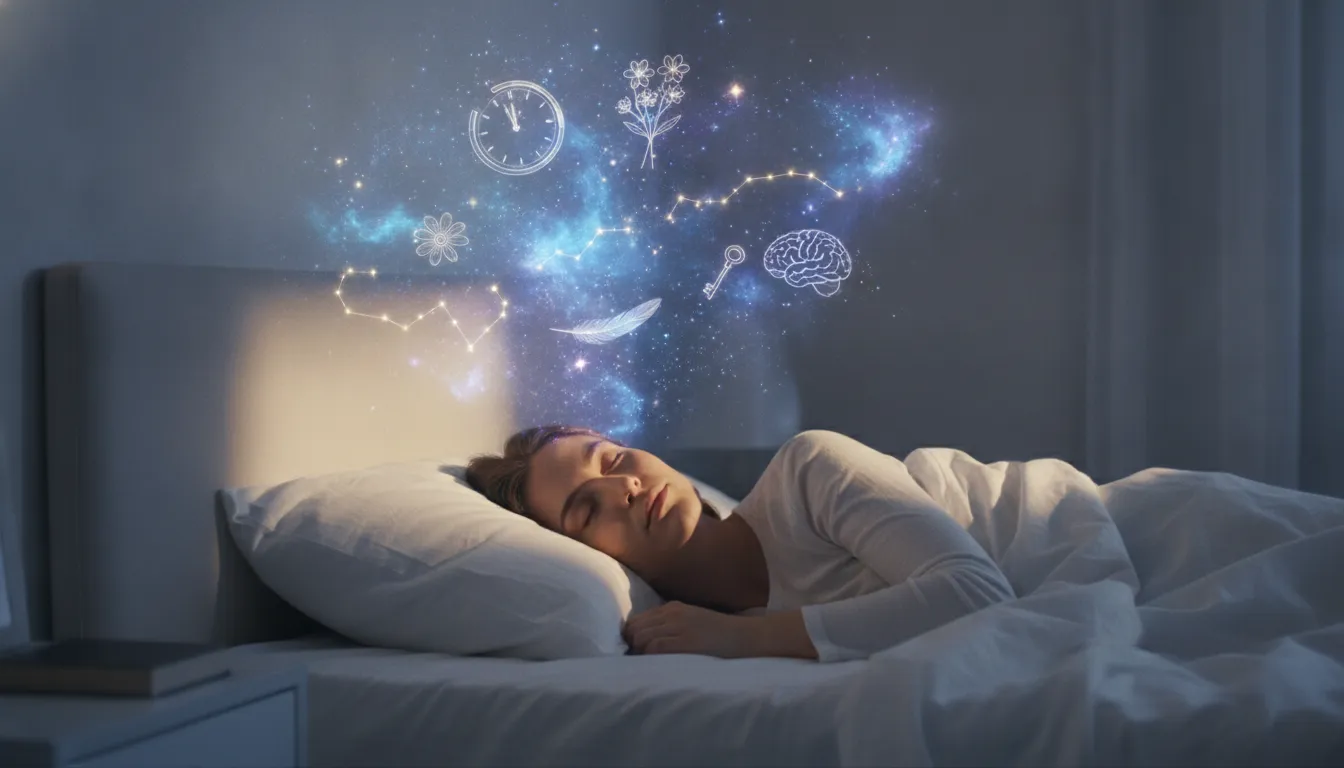
Science has made great strides in understanding dreams, but they remain, in part, one of the great mysteries of human biology. We know they occur mainly during REM, involve highly active emotional regions of the brain, and likely serve important functions for memory, emotions, and perhaps even survival. We also know they can be disturbing, healing, creative, and sometimes utterly nonsensical.
What dreams “mean” to each person is a question that blends neuroscience, psychology, and individual experience — and the answer is rarely simple or universal. The most important thing, perhaps, is to understand that taking care of sleep is taking care of all this rich mental activity that happens when we turn off the lights.
If you are interested in habits and routines that impact your health and productivity, you might also be interested in Personal Organization: Simple Methods That Really Work. After all, a more organized mind during the day can be the first step toward more peaceful nights — and dreams.
- Night Terror: Unlike common nightmares, occurs in deep sleep (not REM), and the person usually does not remember the episode.
- MILD Technique (Mnemonic Induction of Lucid Dreams): Mentally repeating the intention to recognize that one is dreaming before sleeping.
- Reality checks during the day: Regularly asking oneself “Am I dreaming?” and testing reality (such as trying to push a finger through the opposite palm).
- Random Noise Theory: A more skeptical view, originally proposed by researchers J. Allan Hobson and Robert McCarley in the 1970s, suggests that dreams are simply the result of the cortex trying to make sense of random electrical signals generated by the brainstem during REM.
- Emotional Regulation Theory: Argues that dreaming, especially during REM, helps the brain process difficult emotions. Brain imaging studies have shown that after a night with adequate REM sleep, people exhibit more balanced emotional reactions to negative stimuli.
- Threat Simulation Theory: Developed by Finnish neuroscientist Antti Revonsuo, it proposes that dreams — especially nightmares — function as simulations of dangerous situations, allowing the brain to “train” emotional and behavioral responses without real risk.


