
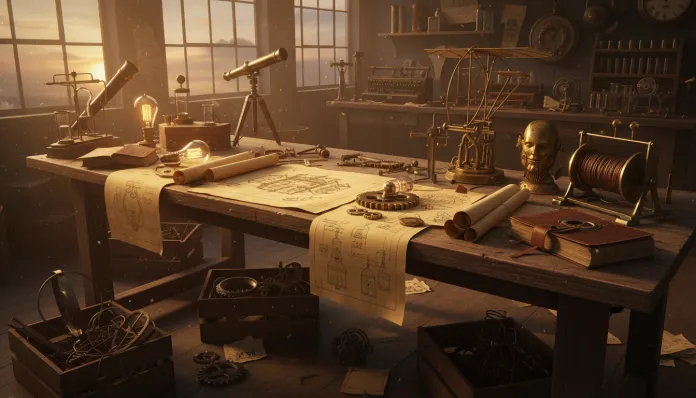
The Fascinating History of Inventions That Transformed Humanity
Imagine waking up without an alarm clock, walking to a non-existent tap, lighting a candle because electric light hasn’t been invented yet—all before breakfast. It seems impossible, but this was exactly how most of humanity lived for millennia. What separates that world from ours is a series of inventions that often came about by chance, urgent necessity, or the determination of a single person who refused to accept the impossible.
The history of great inventions is largely a human story: of curiosity, failure, perseverance, and often, luck. Many technologies we consider mundane today—the wheel, paper, vaccines, the internet—were absolute revolutions in their time, capable of reorganizing entire societies and forever changing the course of civilization.
In this article, you’ll learn about how some of the most important inventions in history came about, what motivated their creators, and why certain ideas, even simple ones, took centuries to appear.
The Wheel: Simple, Yet Not So Obvious
When thinking of revolutionary inventions, the wheel is almost always at the top of the list. But what surprises many is how long it took to appear. The oldest records of wheels used for transportation date back to around 3500 BC in the region of Mesopotamia—modern-day Iraq. Before that, people around the world moved heavy objects using tree trunks as rollers, but no one had taken the next step: fixing an axle and creating continuous motion.
Curiously, the first wheels were not used for carts. They were potter’s wheels—tools for shaping ceramics. Only later was the technology adapted for transportation. This shows something fundamental about inventions: they rarely emerge exactly for the use they become famous for.
The wheel is also an example of how geography influences innovation. In pre-Columbian Americas, civilizations like the Aztecs and Incas knew the principle of the wheel—there are wheeled toys in Mesoamerican archaeological sites—but never adopted it widely for transportation. Why? Because they lacked suitable draft animals and lived in terrains where other methods worked better.
Paper and the Printing Press: When Knowledge Took Flight
For most of human history, knowledge was a scarce commodity. Texts were hand-copied by scribes, available only to the elite. Two separate inventions, emerging in different continents and eras, changed this radically.
Paper was invented in China around the 2nd century BC from plant fibers. Before it, the Chinese wrote on bamboo and silk—expensive and heavy materials. Paper made the recording of information cheaper and more accessible, gradually spreading through Central Asia and reaching Europe around the 12th century AD.
But it was the movable type press, developed by Johannes Gutenberg in Germany around 1450, that caused a true explosion of knowledge in the West. Gutenberg didn’t invent printing—the Chinese had been using movable type since the 11th century—but he perfected the system with a durable metal alloy and an efficient press, making it possible to produce books on a large scale.
The impact was immense: in a few decades, books went from being extremely rare objects to accessible products. The Protestant Reformation, the Enlightenment, and the Scientific Revolution would have been difficult to conceive without Gutenberg’s press. A mechanical invention transformed the intellectual map of the world.
Domestic Electricity: From Spark to Socket
Electricity as a natural phenomenon was known for centuries—the ancient Greeks knew that rubbed amber attracted small objects. But turning this phenomenon into something useful at home took much longer and involved intense historical disputes.
Thomas Edison inaugurated the first commercial electric power plant in New York in 1882, bringing electric light to homes and businesses. But Edison advocated direct current (DC), while his rival Nikola Tesla, working with businessman George Westinghouse, championed alternating current (AC)—the system still used in sockets worldwide.
The so-called “War of Currents” was one of the most intense technological disputes of the 19th century, with Edison even conducting public demonstrations to discredit Tesla’s system. In the end, alternating current won for practical reasons: it can be transmitted over long distances with much less energy loss.
What makes this story fascinating is that the most important invention wasn’t necessarily the light bulb or the power plant, but the distribution system—the infrastructure that brings energy to your home. Transformative technologies rarely work alone; they depend on entire ecosystems.
The Vaccine: When Observation Saved Millions
In 1796, British physician Edward Jenner made an observation that would change medicine forever: cowpox-infected milkmaids seemed immune to smallpox, a disease that killed masses. Jenner tested the hypothesis by inoculating material from cowpox into an eight-year-old boy named James Phipps and then exposing him to smallpox. The boy did not get sick.
The method was called vaccination—from the Latin vacca, cow. The idea of using one infectious agent to protect against another was revolutionary and initially faced enormous resistance. Many doctors and religious figures of the time fiercely opposed the procedure.
But the numbers spoke louder. Vaccination expanded, and smallpox—which had killed an estimated hundreds of millions throughout history—was declared eradicated by the World Health Organization in 1980, the only case of a human infectious disease completely eliminated through global vaccination.
> Important: Information about vaccines and health in this article is historical and educational. Individual health and immunization decisions should always be discussed with a healthcare professional.
The Internet: A Network Born to Survive Wars
Few imagine that the internet has military roots. At the height of the Cold War, the United States Department of Defense funded a project called ARPANET, launched in 1969, with a specific goal: to create a communication network that would continue functioning even if part of it was destroyed in a nuclear attack. The idea was to decentralize information, without a single vulnerable point.
In the following decades, the network grew within universities and research centers. The leap to everyday use happened in 1991, when British scientist Tim Berners-Lee created the World Wide Web—the system of pages and links we know as “browsing the internet.” Berners-Lee worked at CERN, the particle physics laboratory in Switzerland, and wanted to facilitate document sharing among researchers.
Berners-Lee made a decision that changed history: he did not patent the World Wide Web. His choice to make it open and free is widely credited as the reason why the internet expanded so rapidly worldwide.
Common Patterns: How Great Inventions Arise
Looking at all these stories, some patterns repeat with surprising frequency:
- Real need: almost every great invention solves a concrete problem—transporting loads, recording knowledge, lighting homes, curing diseases, communicating over distances.
- Accumulation of knowledge: rarely does an invention emerge from nowhere. Gutenberg relied on centuries of experience with wine presses. Edison worked with the studies of dozens of previous physicists.
- Chance favors the prepared mind: Jenner observed something other doctors could have seen, but it was he who made the connection and had the courage to test it.
- Initial resistance: almost every disruptive innovation faced skepticism, ridicule, or active opposition before being accepted.
- The popularized version matters more than the original: in many cases—like the wheel, the press, or the internet—it wasn’t who had the idea first, but who made it accessible, that truly changed the world.
The Present as a Starting Point

We live in 2026 surrounded by inventions that, a hundred years from now, may seem as primitive as the first wooden wheels seem to us today. Artificial intelligence, large-scale renewable energy, genetic editing—all these areas are in full development, with their own disputes, resistances, and eureka moments happening now.
Understanding how the great inventions of the past came about is not just an exercise in historical curiosity. It’s a way to realize that innovation has always been—and will continue to be—a mix of method, accident, daring, and above all, the willingness to see the world as it could be, not just as it is.
Just as traveling can broaden one’s worldview and stimulate new mental connections, as you can discover in How to Travel Cheaply Without Sacrificing Comfort, engaging with stories of innovation reminds us that profound changes rarely ask for permission—they simply happen, starting from an idea someone refused to abandon. And if you’re interested in real stories that changed the world, it’s also worth checking out Must-Watch Movies Based on True Stories, where cinema tells some of these chapters with all the emotion they deserve.