
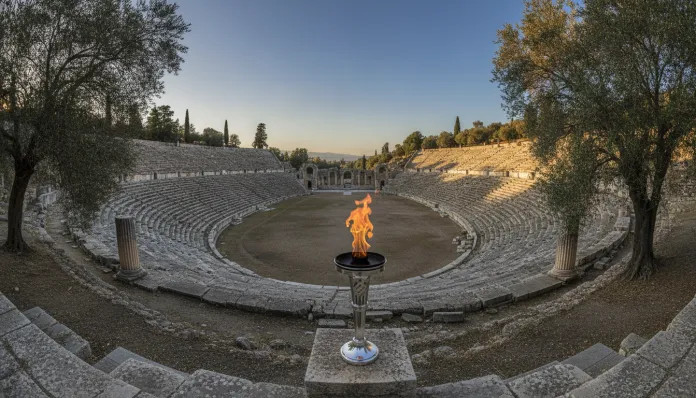
Imagine a world without live broadcasts, electronic timers, or professional athletes training in high-performance centers — yet with thousands of people gathering every four years to celebrate human excellence. This was the spirit of the Ancient Olympic Games, and surprisingly, this same spirit still pulses in events that mobilize billions of people worldwide today.
The history of the Olympic Games is one of the longest and most fascinating in human civilization. Nearly three thousand years of tradition, interruptions, revivals, and radical transformations. From the plains of Olympia in ancient Greece to the modern metropolises that compete for the right to host the world’s most-watched event, this journey reveals much about how societies evolve, what they value, and how they use sports as a mirror of their times.
If you think you know everything about the Olympics, prepare to be surprised. There’s much more to this story than podiums and gold medals.
The Origins: Ancient Greece and the Sanctuary of Zeus
The first records of the Ancient Olympic Games date back to 776 BC, although researchers believe that athletic competitions in Olympia may have occurred before that date. The chosen location was not a city but a religious sanctuary dedicated to Zeus, the supreme god of the Greek pantheon, located in the Peloponnese region.
The origin of the games is deeply linked to religion. The competitions were held in honor of Zeus and were part of a sacred four-year cycle — the so-called “Olympiad” — which served as a time reference for the Greeks. Participating in the games was, above all, an act of devotion.
The original events were quite different from those we know today:
- Stadium race (stade): a race of approximately 192 meters, the oldest and most prestigious event
- Pentathlon: a combination of running, long jump, discus throw, javelin throw, and wrestling
- Pugilism: an ancient form of boxing, without rounds or weight categories
- Pankration: a mix of wrestling and boxing, extremely violent, with virtually no rules
- Chariot races: an event for the wealthy, as it required expensive horses and equipment
Only free men of Greek origin could compete — and watching, in the case of women, was forbidden under penalty of death. Winners received a crown of wild olive branches, but the social prestige gained was immense.
The End of the Ancient Games and Centuries of Silence
The games continued for over a thousand years, even after the Roman conquest of Greece. However, with the rise of the Roman Empire and later with the adoption of Christianity as the official religion, pagan festivals quickly lost ground.
In 393 AD, Roman Emperor Theodosius I decreed the end of the Olympic Games, considering them a ritual incompatible with Christian values. The sanctuary of Olympia was gradually abandoned and destroyed by earthquakes and floods over the following centuries. For nearly 1,500 years, the games simply ceased to exist.
The site only regained attention with archaeological excavations initiated by German researchers in 1875, revealing to the world the ruins of the imposing temple of Zeus and the original stadium.
The Revival: Pierre de Coubertin and the Modern Games
The man responsible for reigniting the Olympic flame was the French educator and historian Pierre de Coubertin (1863–1937). Passionate about sports as a tool for character building and the idea of peace among nations, Coubertin dedicated years to building political and institutional support for the creation of an international competition modeled on Greek tradition.
In 1894, he founded the International Olympic Committee (IOC) during a congress held at the University of Paris. Two years later, in 1896, Athens hosted the first Olympic Games of the modern era, with around 280 athletes from 12 countries — all men.
Those first modern Olympics were modest by today’s standards but marked the beginning of something historic. Greek Spyridon Louis won the marathon and became an instant national hero. The competitions were held in the rebuilt Panathenaic Stadium, a white marble structure that still exists in Athens today.
The Olympics in the 20th Century: Growth, Wars, and Politics
The 20th century witnessed the greatest transformations of the games. The competition grew exponentially but was also marked by dark episodes reflecting the world’s tensions outside the arenas.
The Wars and the Canceled Games
Three editions were canceled due to world conflicts:
- 1916 — canceled due to World War I
- 1940 and 1944 — canceled due to World War II
Berlin 1936 and Nazi Propaganda
The Berlin 1936 Games are often cited as the most notorious example of the political use of the Olympics. Adolf Hitler’s Nazi regime attempted to transform the event into a showcase of supposed Aryan superiority. The plan, however, was memorably thwarted by American athlete Jesse Owens, who won four gold medals in sprinting and long jump events.
Munich 1972: The Terrorist Attack
In Munich, West Germany, the games were marked by an unprecedented tragedy: a Palestinian terrorist group kidnapped and murdered 11 members of the Israeli delegation. The incident forced the world to rethink security at major sporting events.
The Era of Boycotts
During the Cold War, the Olympics became a stage for political disputes. In 1980, the United States led a boycott of the Moscow Games in protest of the Soviet invasion of Afghanistan. Four years later, in Los Angeles 1984, the Soviet Union retaliated with its own boycott.
Women’s Inclusion and the Evolution of Events
Women’s participation in the modern games was a gradual and historically significant achievement. In the early editions, women were completely excluded. In Paris 1900, they participated for the first time — in only a few events, such as tennis and golf.
Throughout the 20th century, the number of women’s events increased progressively. In Atlanta 1996, considered a milestone for inclusion, women represented about a third of all athletes. In Paris 2024, the most recent edition so far, the games achieved gender parity for the first time: exactly 5,250 spots for male and 5,250 for female athletes.
Olympic events have also undergone constant revisions. Sports have been included and excluded throughout history. Baseball and softball, for example, have been out of the Olympic program and returned. Skateboarding, sport climbing, and surfing were included in the Tokyo 2020 Games (held in 2021, postponed due to the Covid-19 pandemic), reflecting an IOC strategy to attract younger audiences.
The Winter Games: A Parallel Tradition
It is often forgotten that the Olympics have a version dedicated to sports practiced on ice and snow. The Winter Olympic Games were first held in Chamonix, France, in 1924, with events such as figure skating, ice hockey, and ski jumping.
For decades, summer and winter games were held in the same year. In 1994, with the Winter Games in Lillehammer, Norway, the cycle was adjusted so that both versions occur in alternating years, ensuring that every two years the world has an Olympic edition.
The Next Chapters: Los Angeles 2028
With Paris 2024 still fresh in memory, the sports world is already looking to the future. The next Summer Games are confirmed for Los Angeles, in 2028 — a city that has already hosted the Olympics in 1932 and 1984. It will be the third time Los Angeles hosts the event, a feat achieved by very few cities.
For those who want to physically prepare to closely follow or even participate in races and events inspired by the Olympics, starting with a home exercise routine can be an excellent starting point. Check out accessible tips at Simple exercises to do at home without needing a gym.
Little-Known Facts
- The Olympic torch and flame relay, now a universal symbol of the games, were only introduced in the Berlin 1936 Games
- Athletics is the sport with the most events in all Summer Games of the modern era
- Brazil debuted in the Olympics in Stockholm 1912 and won its first individual gold medal with Adhemar Ferreira da Silva, in the triple jump, in Helsinki 1952
- The word “Olympics” technically refers to the four-year period between games, not the games themselves — although popular usage associates it with the event
- The Paralympic Games, for athletes with disabilities, were first held in Rome 1960 and now occur immediately after the Olympic Games in the same host city
Conclusion: A Mirror of Humanity
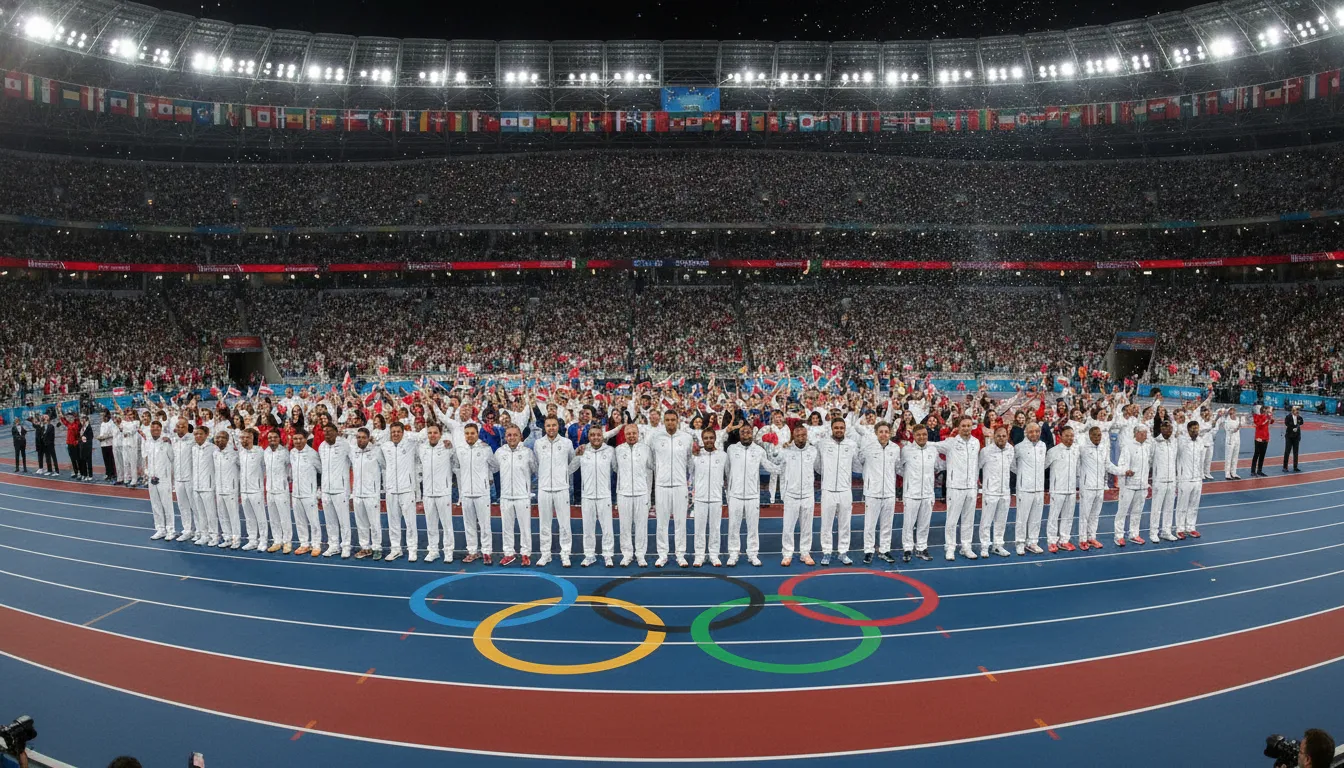
From a sacred Greek plain to stadiums with a capacity for a hundred thousand people; from 280 athletes to over ten thousand; from events in honor of Zeus to live broadcasts for billions of people on every continent — the trajectory of the Olympic Games is, at the same time, the history of sport and the history of civilization itself.
The Olympics have never been just about who runs fastest or jumps highest. They reflect what each era values: the physical strength of ancient Greeks, the nationalism of the 20th century, the pursuit of inclusion and diversity in the 21st century. Each edition leaves marks that go beyond medals.
In a world often divided, the games continue to be one of the few moments when entire nations suspend their differences — at least for a few weeks — to celebrate something that all humans recognize as beautiful: effort, overcoming, and the pursuit of one’s best.
- Athletics is the sport with the most events in all Summer Games of the modern era
- 1940 and 1944 — canceled due to World War II
- Pentathlon: a combination of running, long jump, discus throw, javelin throw, and wrestling