Nature never ceases to amaze. With every new study published and every scientific expedition completed, researchers worldwide encounter behaviors, abilities, and biological structures that challenge everything we thought we knew about animals. Octopuses that “see” colors despite being colorblind, birds that navigate using Earth’s magnetic field, ants that form superorganisms capable of solving complex problems — the list of impressive discoveries grows each year.
What makes these cases even more fascinating is that many of these animals have lived alongside us for millennia, yet their secrets are only now being uncovered with advances in observation technologies, genetic sequencing, and behavioral analysis. Modern science has tools that 19th-century naturalists could never have dreamed of — and yet, with each answer found, new questions arise.
In this article, we dive into some of the most extraordinary cases in the animal kingdom: creatures that defy the “rules” of biology, exhibit intelligence where least expected, and reveal, above all, how much we still have to learn about the planet we inhabit.
The Octopus and the Mystery of Colors It Shouldn’t See
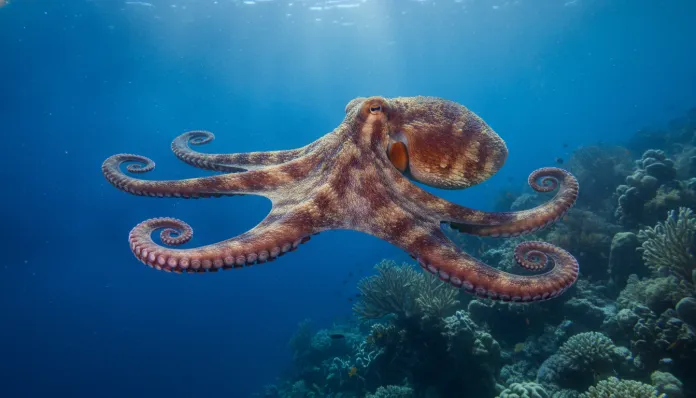
The octopus is undoubtedly one of the most studied animals in recent decades — and yet it continues to surprise. One of the most intriguing aspects involves its relationship with colors. Octopuses are monochromats, meaning they have only one type of photoreceptor in their eyes, which would make them completely colorblind by conventional logic. And yet, they are famous for their ability to mimic the colors and patterns of their surroundings with impressive precision.
How is this possible? A hypothesis that has gained traction from studies published in the last decade suggests that octopuses use their irregularly shaped pupils — wavy and U-shaped — to capture light at different angles, taking advantage of an optical phenomenon called chromatic aberration. This would allow the animal to “decode” color information even without multiple types of cones. It’s as if they see the world in a completely different way from us — but equally efficiently.
Furthermore, research indicates that the octopus’s skin has its own photoreceptors, independent of the eyes. This suggests that they may somehow “sense” light directly through their skin — a concept still being investigated but which opens layers of biological complexity that we are just beginning to explore.
Birds That See Magnetic Fields
Have you ever wondered how migratory birds travel thousands of kilometers and arrive at the exact same point year after year, with a precision that puts any GPS to shame? The answer lies in something that, until recently, seemed like science fiction: they see Earth’s magnetic field.
Research on pigeons, sparrows, and especially the European robin (Erithacus rubecula) suggests that certain birds have proteins called cryptochromes in their eyes, which react to blue light and are sensitive to the magnetic field. This would generate a kind of “image” of magnetic orientation superimposed on the animal’s visual field — something like seeing a compass built into their own field of vision.
This mechanism, called magnetoreception, is being studied with growing enthusiasm by physicists and biologists, as it involves principles of quantum mechanics — specifically the entanglement of electrons in radical pairs. It is one of the rare situations where quantum phenomena seem to have a functional role in living beings, representing an exciting frontier between biophysics and evolutionary biology.
The Surprising Intelligence of Unexpected Animals
When we think of intelligent animals, the mind automatically goes to chimpanzees, dolphins, or crows. But recent science has greatly expanded the circle of intellectuals in the animal kingdom.
Octopuses, Again
We’ve already mentioned vision, but the general intelligence of the octopus deserves its own spotlight. They solve mazes, open jars, recognize individual human faces, and even demonstrate something akin to personality — some are shy, others exploratory and curious. All this with a radically different nervous system from ours: two-thirds of an octopus’s neurons are distributed throughout its tentacles, not in the central brain.
Octopuses Aren’t the Only Ones
Bees have been shown, in controlled experiments, to understand the concept of zero — a mathematical abstraction that many animals (and young children) struggle to grasp.
Sand octopuses and squids demonstrate memory of specific episodes, something previously thought to be exclusive to mammals and birds.
Rats have demonstrated, in neuroscience studies, the ability of metacognition — knowing that they don’t know, asking for help in tasks when uncertain.
Crows from the Corvidae family not only use tools but also make composite tools, combining pieces to achieve goals — a skill once attributed only to humans and great apes.
Animals That Defy the Limits of Biology
The Tardigrade: Nearly Immortal
Few animals inspire as much admiration — and amazement — as the tardigrade, a micro-animal less than 1 millimeter long that inhabits virtually every environment on Earth: from the ocean depths to extreme mountain altitudes, from hot deserts to polar regions.
In a state of cryptobiosis, the tardigrade can:
Survive temperatures of -272°C (almost absolute zero)
Withstand more than 300 times the lethal radiation dose for humans
Go without water for decades and rehydrate normally
Survive in the vacuum of space, as demonstrated in satellite experiments
Its ability to “shut down” metabolism almost completely and protect DNA with specific proteins is the subject of intense research, with potential applications in medicine, tissue conservation, and even space exploration.
The Immortal Jellyfish
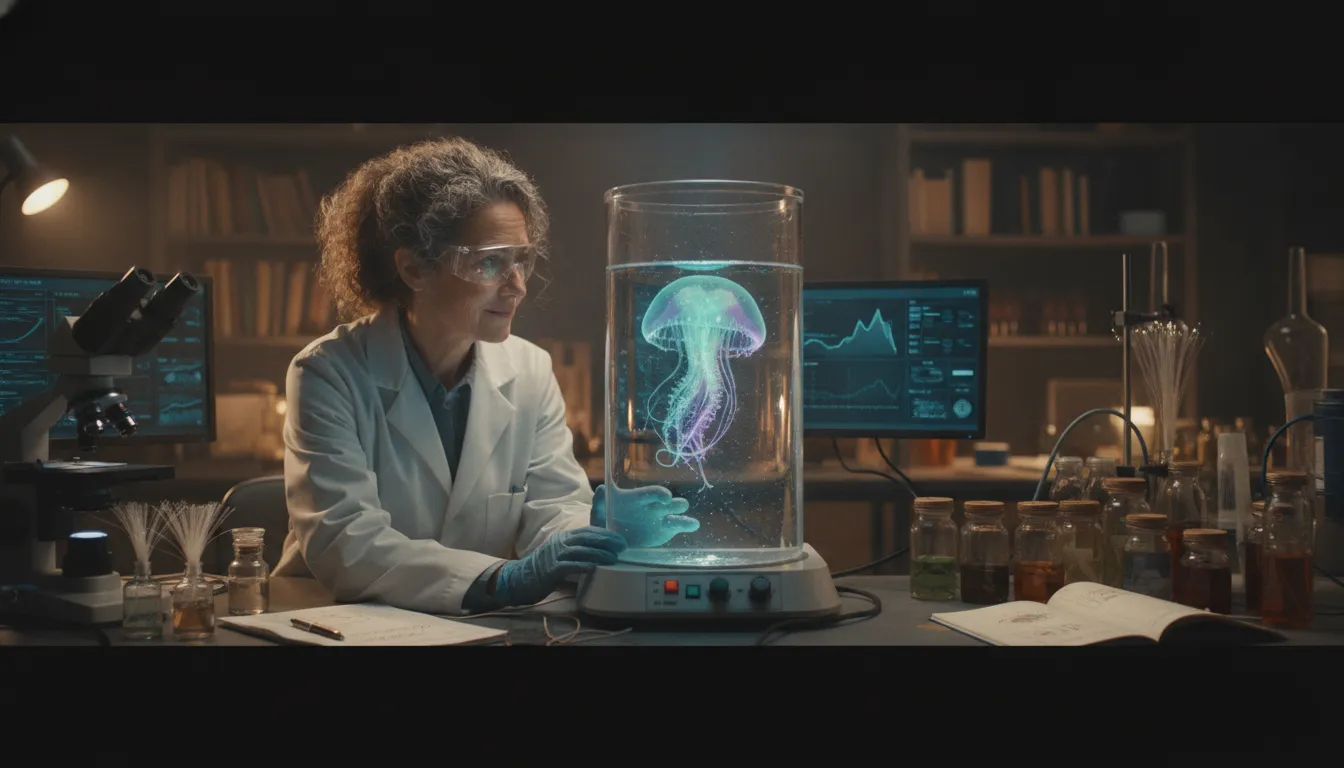
The Turritopsis dohrnii, popularly known as the immortal jellyfish, possesses an unparalleled ability in the animal kingdom: upon reaching sexual maturity or facing environmental stress, it can revert to the juvenile polyp stage and restart its life cycle from the beginning. In theory, this process can repeat indefinitely.
This does not mean the jellyfish cannot die — it can be eaten, fall ill, or be physically destroyed. But from an intrinsic biological standpoint, it seems to have no fixed life limit. Scientists study the molecular mechanisms of this process in hopes of better understanding cellular aging in other organisms, including humans.
Social Behaviors That Mimic Human Structures
Comparing animal societies to human ones has important limits — projecting human emotions or intentions onto animals is a methodological error called anthropomorphism. Nonetheless, certain animal social behaviors are so complex that they deserve serious scientific attention.
Elephants demonstrate elaborate rituals in front of the carcasses of companions, returning to the bones of individuals they lived with. Behavioral studies indicate they recognize dead individuals from their own group with greater interest than bones of other species or unknown elephants — suggesting some form of recognition beyond immediate instinct.
Humpback whales have been documented “protecting” other species from orca attacks — including seals and even other cetaceans — in behaviors researchers still debate whether they constitute interspecies altruism or reflexive responses to common predators.
Chimpanzees and bonobos, our closest relatives, demonstrate marked differences in social organization that reflect different “cultures” — distinct groups have their own traditions of tool use, communication, and conflict resolution, transmitted through social learning, not genetics.
Why This Matters Beyond Curiosity
Understanding the mechanisms behind these extraordinary animal capabilities is not just a matter of admiration for nature — although that component is valuable in itself. The practical implications are enormous:
Medicine and biotechnology: proteins from tardigrades that protect DNA are being studied for preserving vaccines and medicines without refrigeration.
Navigation and robotics: the magnetoreception system of birds inspires more efficient autonomous navigation projects.
Artificial intelligence: the decentralized neural architecture of the octopus offers alternative models for distributed AI systems.
Gerontology: the rejuvenation mechanisms of the immortal jellyfish are studied for insights into human cellular aging.
Environmental conservation: understanding the cognitive and social complexity of endangered species reinforces ethical and scientific arguments for their protection.
Conclusion: Science Is Still Learning to Ask the Right Questions
What modern biology teaches us, above all, is that the concept of “inferior animal” is an outdated construct. Each species has evolved in response to specific environmental pressures, developing solutions that often surpass what human engineering can replicate. The octopus’s eye is not “worse” than the human eye — it is different, and as sophisticated as the problem it needed to solve.
As scientific tools advance — from next-generation genetic sequencing to ultra-high-resolution cameras and miniaturized biometric sensors — the list of surprises is likely to grow. More and more, science realizes it was asking the wrong questions or lacked the instruments to hear the answers nature has always provided.
Para fornecer as melhores experiências, usamos tecnologias como cookies para armazenar e/ou acessar informações do dispositivo. O consentimento para essas tecnologias nos permitirá processar dados como comportamento de navegação ou IDs exclusivos neste site. Não consentir ou retirar o consentimento pode afetar negativamente certos recursos e funções.
Funcional
Always active
O armazenamento ou acesso técnico é estritamente necessário para a finalidade legítima de permitir a utilização de um serviço específico explicitamente solicitado pelo assinante ou utilizador, ou com a finalidade exclusiva de efetuar a transmissão de uma comunicação através de uma rede de comunicações eletrónicas.
Preferências
O armazenamento ou acesso técnico é necessário para o propósito legítimo de armazenar preferências que não são solicitadas pelo assinante ou usuário.
Estatísticas
O armazenamento ou acesso técnico que é usado exclusivamente para fins estatísticos.O armazenamento técnico ou acesso que é usado exclusivamente para fins estatísticos anônimos. Sem uma intimação, conformidade voluntária por parte de seu provedor de serviços de Internet ou registros adicionais de terceiros, as informações armazenadas ou recuperadas apenas para esse fim geralmente não podem ser usadas para identificá-lo.
Marketing
O armazenamento ou acesso técnico é necessário para criar perfis de usuário para enviar publicidade ou para rastrear o usuário em um site ou em vários sites para fins de marketing semelhantes.