
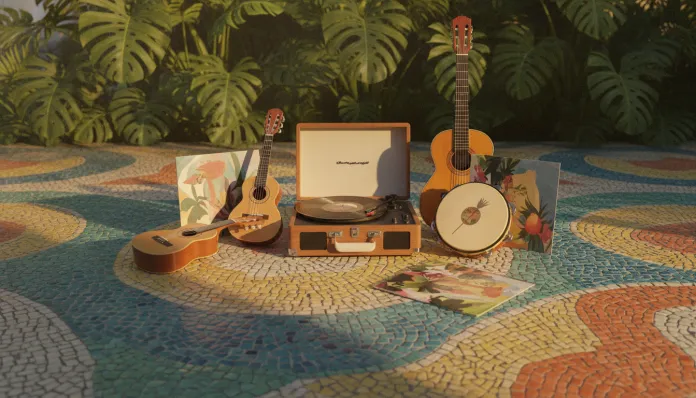
There are songs that transport us back to a summer, a party, or a life phase that seemed endless. Brazilian popular music has this almost magical power to encapsulate entire moments in three minutes of melody and lyrics. More than just entertainment, it serves as a kind of collective emotional archive—a sonic record of who we were, what we felt, and the world we lived in.
Over the decades, Brazil has produced songs that transcended mere commercial success to become undeniable cultural landmarks. These songs not only defined the taste of an era but also shaped identities, influenced social movements, and created bonds among people from completely different backgrounds. They are compositions that age without aging—and decades after their release, they still make audiences sing along from the first to the last verse.
In this article, we revisit some of the Brazilian songs that have marked different generations, understanding the context in which they were born and why they continue to resonate so strongly even in 2026.
The 1960s and 1970s: When Music Became Resistance
Bossa Nova and Tropicalismo
Bossa Nova emerged in the late 1950s in Rio de Janeiro and quickly became a worldwide phenomenon. With sophisticated harmonies, intimate lyrics, and a new way of playing guitar, the movement was led by names like João Gilberto, Tom Jobim, and Vinícius de Moraes. The song “The Girl from Ipanema”, composed in 1962 by Tom Jobim and Vinícius de Moraes, remains one of the most recorded and recognized songs globally—an extraordinary feat for a Brazilian composition.
Tropicalismo, which erupted in 1967 and 1968, mixed rock, baião, classical music, and everyday Brazilian references in a provocative way. Caetano Veloso and Gilberto Gil were the main leaders of the movement, accompanied by Os Mutantes, Gal Costa, and other artists. The song “Tropicália”, by Caetano Veloso (1967), named the movement and served as a cultural manifesto in the form of music—a sonic collage of a real, contradictory, and vibrant Brazil.
During this same period, the context of the military dictatorship (1964–1985) turned popular music into one of the main spaces of resistance. Composers used metaphors and allegories to bypass censorship and communicate political messages to the public. Songs like “Cálice”, by Chico Buarque and Gilberto Gil (1973), were banned by censors—which, paradoxically, increased their symbolic weight over the years.
The 1980s: The Explosion of Brazilian Rock
If there is a generation with the most evident soundtrack in recent Brazilian music history, it is the youth of the 1980s. With the country’s redemocratization and political opening, a new spirit of freedom invaded stages and studios.
Brazilian Rock gained strength with bands that became true national icons. Legião Urbana, led by Renato Russo, brought songs that touched on the open wounds of youth: loneliness, love, faith, politics. “Geração Coca-Cola” (1985) and “Faroeste Caboclo” (1987) are examples of compositions that function almost as sociological documents of their time.
Titãs bet on a more aggressive rock and lyrics that confronted conservatism, with songs like “Comida” (1987)—one of the most cited compositions when talking about critical consciousness embedded in Brazilian pop-rock. Cazuza, at the helm of Barão Vermelho and later in his solo career, left an intense legacy with “O Tempo Não Para” (1988), a song that gained even more drama given the tragic trajectory of the artist, who died in 1990.
This period was also marked by the overwhelming success of pop artists like Roberto Carlos, who had been around for previous decades but maintained absolute relevance, and the rise of Xuxa, whose children’s songs created an entire generation of passionate fans.
The 1990s: A Plural Brazil in Full Volume
The 1990s were a musical party in Brazil—and a noisy one. The country discovered that it could embrace many things at once: axé, pagode, funk, pop sertanejo, and electronic music shared the charts and hearts.
Axé Music, born in Bahia, took names like Daniela Mercury, Ivete Sangalo, Chiclete com Banana, and the group É o Tchan to the top of national preferences. The song “O Canto da Cidade”, by Daniela Mercury (1992), became an anthem of diversity and Bahian identity with undeniable national reach.
In pagode, Fundo de Quintal, Zeca Pagodinho, and Jorge Aragão consolidated a style that drew from the roots of samba but gained a more accessible form. And Mamonas Assassinas, in 1995, starred in a lightning phenomenon: the band’s debut album sold more than two million copies in a short time before the tragedy that claimed the band the same year.
Sertanejo universitário was still in its infancy, but artists like Leandro & Leonardo and Chitãozinho & Xororó already showed the size of the countryside market waiting to explode in the following decade.
The 2000s: The Internet Changes Everything (Including Who Listens to What)
The turn of the millennium brought with it dial-up internet, MP3s, and, with them, a silent revolution in how Brazilians consumed music. The charts continued to exist, but control over what “everyone listened to” began to fragment.
Romantic pagode was at its peak with bands like Revelação and artists like Alexandre Pires. Carioca funk, which had existed since the 1980s, gained new momentum and began to occupy increasingly larger spaces in popular culture, with MCs like Bonde do Tigrão achieving national success.
At the same time, contemporary MPB found in artists like Maria Bethânia, Milton Nascimento, and Djavan a loyal base that spanned generations. New names emerged: Marisa Monte, Carlinhos Brown, and the collective Tribalistas—formed by Marisa Monte, Arnaldo Antunes, and Carlinhos Brown—released a self-titled album in 2002 that became a milestone in Brazilian music of the time, with songs like “Já Sei Namorar” and “Velha Infância”.
From the 2010s Onward: Funk, Sertanejo, and the New Brazilian Pop
The second decade of the 21st century witnessed some of the greatest transformations ever seen in Brazilian music. Sertanejo universitário became the most listened-to genre in the country, with artists like Gusttavo Lima, Luan Santana, and the duo Zé Neto & Cristiano dominating streaming platforms.
Funk transitioned from a peripheral niche to a global phenomenon. Anitta built a career that crossed geographical borders and took Brazil to international charts. MC Kevinho, Ludmilla, and dozens of other artists consolidated funk as a central language of national pop culture.
Meanwhile, Brazilian rap and trap gained prominence with names like Emicida, Criolo, Djonga, and Baco Exu do Blues, artists who combine lyrical excellence with well-defined political and cultural positions. “AmarElo”, by Emicida (2019), featuring Majur and Pabllo Vittar, became a generational anthem by reinterpreting the sample of “Sujeito de Sorte”, by Belchior.
Why Do These Songs Stand the Test of Time?
There is a combination of factors that makes certain songs endure through decades without losing strength:
- Universal lyrics: songs about love, loss, freedom, and identity touch on human points that never age.
- Memorable melody: the ease of singing along is, literally, a mechanism of emotional memorization.
- Significant historical context: songs linked to moments of political or cultural transformation carry extra symbolic weight.
- Reinterpretations and re-recordings: when new artists reinterpret an old song, it reaches new generations.
- Media presence: soundtracks of soap operas, movies, and series resurrect songs that were dormant in collective memory.
Just as the backstage of major cultural productions hides layers of meaning that the public doesn’t see on the surface—as explored in this article about cinema backstage: secrets the screen doesn’t show—great songs also carry stories of creation, censorship, chance, and genius that rarely appear when we hit play.
Brazilian Music as a Living Heritage
What makes Brazilian music production so unique is its ability to absorb external influences and transform them into something genuinely new. From the American jazz that fueled Bossa Nova to the American funk that became carioca funk, to the English rock that turned into national rock, Brazil has always been a territory of creative synthesis.
This process hasn’t stopped. In 2026, new artists continue to reinvent the wheel while looking back with reverence. Music festivals, streaming platforms, and social networks keep the conversation between what was and what is being created now alive. A song released in 1967 can appear in a viral reel tomorrow and move someone who wasn’t even born when it was composed.
Conclusion: The Soundtrack of a Nation
Mapping the songs that defined generations in Brazil is, ultimately, telling the country’s own history from another angle. Each song carries a snapshot of its time: the fears, joys, contradictions, and dreams of those who lived that moment.
From “The Girl from Ipanema” to “AmarElo”, from Legião Urbana to contemporary funk, what unites all this diversity is an invisible thread of Brazilian identity—a particular way of feeling and expressing that no other culture in the world can replicate with fidelity.
The next generation is already composing its own soundtracks. And in twenty or thirty years, someone will write about today’s music with the same emotion we look back on, in 2026, at the classics that shaped who we are.
- Memorable melody: the ease of singing along is, literally, a mechanism of emotional memorization.


