
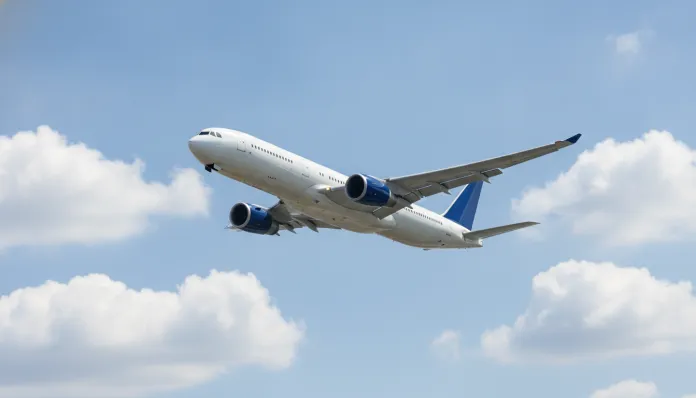
Every time an airplane takes off, many people at the window still ask themselves the same silent question: how does this gigantic object, weighing hundreds of tons of metal, fuel, and baggage, simply… rise? For those who never studied physics or engineering, the answer might seem almost magical. But it’s not. Behind every flight are elegant and well-established scientific principles that, once explained clearly, make perfect sense.
The good news is that you don’t need a degree in aeronautics to understand the basics. With a few everyday analogies and the right concepts, anyone can understand why planes fly — and even start looking at the sky differently. If the universe around us is already full of surprising phenomena (as we showed in The universe is bigger than you imagine: see why), commercial flight is undoubtedly one of the most spectacular events that happens right here on Earth.
In this article, we’ll explore the forces acting on an airplane, explain how the wing works, talk about engines, and debunk some misconceptions circulating about the subject. Prepare yourself to never see a flight the same way again.
The four forces that govern flight
Before anything else, you need to understand that an airplane’s flight results from a balance between four physical forces acting simultaneously on the aircraft:
- Lift: the force that pushes the airplane upward.
- Weight: the force of gravity, which pulls the airplane downward.
- Thrust: the force generated by the engines, pushing the airplane forward.
- Drag: air resistance, which slows movement.
For an airplane to climb, lift must be greater than weight. For it to move forward, thrust must overcome drag. In cruising flight — when the airplane flies at constant altitude and stable speed — these four forces are in balance: lift equals weight, thrust equals drag.
It seems simple, but generating enough lift to raise a 400-ton aircraft, like an Airbus A380, is an engineering feat. And the secret lies mainly in the wings.
The role of the wing: why shape matters
An airplane wing has a very specific shape called an airfoil or aerodynamic profile. Viewed from the side, it’s not flat: the top is more curved than the bottom. This seemingly simple detail changes everything.
When air meets a moving wing, it splits: part flows along the upper surface (more curved) and part along the lower (flatter). The air traveling the longer path — the top — needs to “move faster” to reach the wing’s end at the same time as the air below.
Here enters Bernoulli’s Principle, formulated by Swiss mathematician Daniel Bernoulli in the 18th century: in a moving fluid, the greater the velocity, the lower the pressure. This means the faster-moving air on top of the wing creates a zone of lower pressure, while the slower air below maintains higher pressure. This pressure difference generates an upward net force — lift.
But does Bernoulli explain everything?
Not exactly. Bernoulli’s explanation is real and important, but physicists know it alone doesn’t account for all the lift generated by a wing. The other part of the story involves Newton’s Third Law: for every action, there is an equal and opposite reaction.
When the wing deflects air downward, the air “pushes” the wing upward with equal force. Aerobatic aircraft, for example, which fly upside down with symmetric wings, sustain themselves almost exclusively by this principle — tilting the wing so air is forced downward even without the traditional asymmetric profile.
In practice, flight results from the combination of both effects: Bernoulli’s pressure difference and Newtonian deflection of air. Engineers work with both when designing every millimeter of a wing.
How engines create thrust
Without speed, there’s no air flow over the wing. Without air flow, there’s no lift. That’s why engines are so fundamental: they generate the thrust that gets the airplane moving until the wings can do their job.
Modern commercial airplanes use turbofan engines — an evolution of the old turbojets from the 1950s. They operate in stages:
- A large front fan sucks in enormous volumes of air.
- Part of this air goes to the engine’s core, where it’s compressed, mixed with aviation fuel (kerosene), and burned.
- The hot gases expand rapidly and exit the engine’s rear at extremely high speed, generating forward thrust.
- Most of the air, however, bypasses the core and is expelled directly by the fan — this is called the bypass stream, responsible for much of the thrust and for making modern engines much quieter and more efficient than older ones.
Engines like the GE9X, which power the Boeing 777X, and the Rolls-Royce Trent XWB, used on the Airbus A350, are examples of high-bypass turbofans. They combine fuel efficiency with enormous thrust power.
Angle of attack and airplane controls
The amount of lift generated by a wing depends not only on its shape. It also depends on the angle of attack — the angle between the wing and the air flow meeting it. Increasing this angle (tilting the airplane’s nose upward) increases lift… up to a point.
If the angle of attack is excessive, the air flow over the wing becomes turbulent and stops “gripping” the surface. When this happens, lift drops sharply. This phenomenon is called a stall and is one of the situations pilots are extensively trained to recognize and correct.
To control flight, the airplane has movable surfaces on the wings and tail:
- Ailerons (at the wing tips): control rolling, making the airplane bank left or right in turns.
- Rudder (on the vertical tail): controls yaw, moving the nose left or right.
- Elevator (on the horizontal tail): controls pitch, raising or lowering the nose.
- Flaps and slats: surfaces that extend during takeoff and landing to increase lift at low speeds, allowing the airplane to operate on shorter runways and land more slowly.
Why doesn’t the airplane fall when engines fail?
A question many people ask — especially those afraid of flying. The answer is surprising: an airplane glides even without engines.
Without thrust, the airplane starts to lose speed and altitude — but in a controlled manner. The relationship between the horizontal distance traveled and the altitude lost during a glide is called the glide ratio. Modern commercial aircraft have impressive glide ratios: an Airbus A320, for example, can advance approximately 17 to 20 kilometers for each kilometer of altitude lost while gliding.
This means an airplane at 10,000 meters altitude with all engines stopped would potentially have over 150 kilometers of range to find a landing site. It’s not a guarantee of salvation in every scenario, but it explains why multiple engine failures, while extremely rare, aren’t automatically fatal.
Cruising altitude: why fly so high?
Commercial airplanes typically fly between 9,000 and 12,500 meters altitude — the so-called cruising airspace. But why so high?
- Thinner air means less drag: with fewer air molecules in the way, the airplane faces less resistance and uses less fuel to maintain the same speed.
- Away from atmospheric turbulence: most weather — clouds, storms, convective turbulence — occurs in the troposphere, below about 12,000 meters. Commercial airplanes fly in the upper part of this layer or in the stratosphere, where air is more stable.
- Engine efficiency: modern turbofans were designed to operate at maximum efficiency at these altitudes and temperatures.
The downside is that the air is too thin for humans to breathe normally — which is why the cabin is pressurized, maintaining pressure equivalent to an altitude between 1,800 and 2,400 meters even when the airplane flies at 11,000 meters.
Common myths about flight
Time to debunk some incorrect ideas that persist:
- “The airplane flies because the air above and below need to arrive at the same time”: this myth, called equal transit time, has no physical basis. Air passing over a wing’s upper surface reaches the trailing edge before, not at the same time as, the air below. The higher speed isn’t caused by a need to “meet up,” but by the wing’s geometry and fluid flow.
- “Engines suck the airplane forward”: turbofan engines expel air backward, and it’s the reaction to this expulsion that pushes the airplane forward. There’s no “suction” of air in the direction of motion.
- “Turbulence can crash an airplane”: turbulence is uncomfortable and can be dangerous for those without seat belts, but commercial airplanes are designed and tested to withstand forces far beyond what any real turbulence can generate.
Conclusion
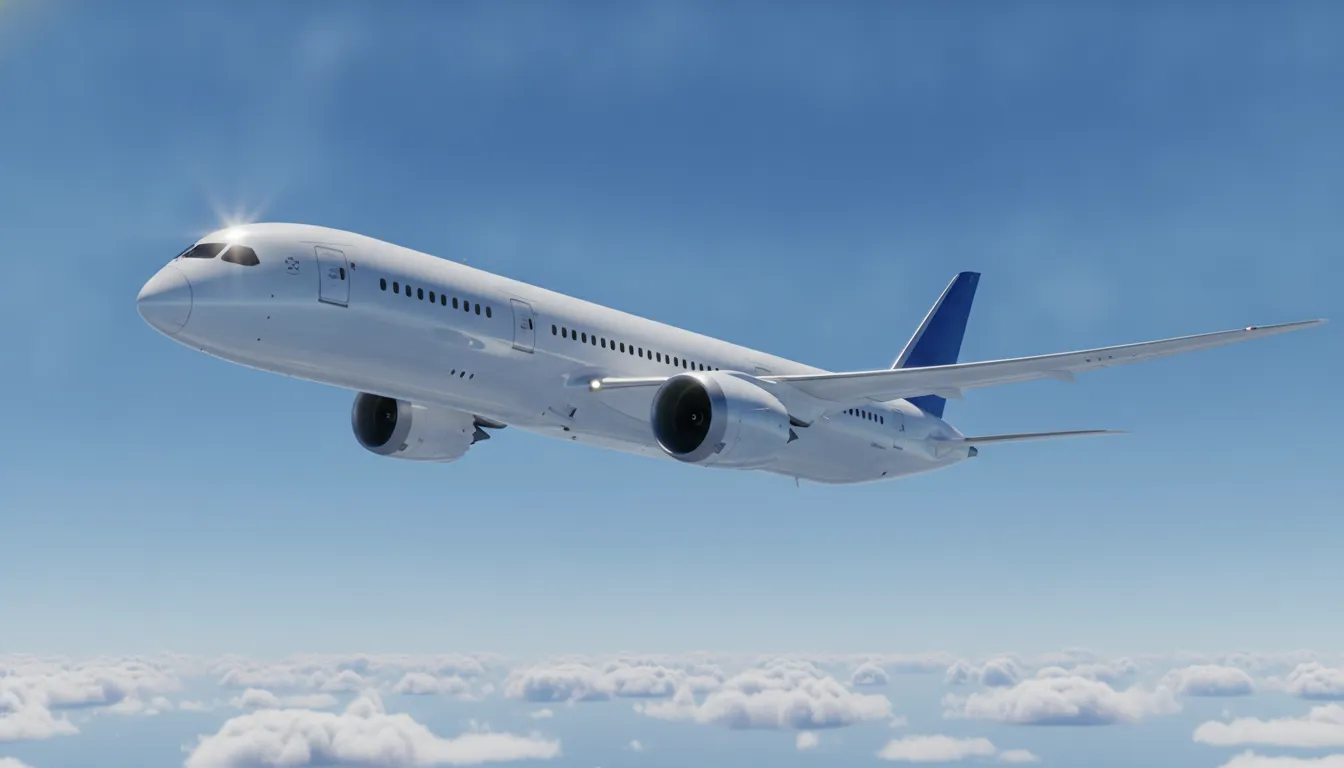
An airplane’s flight is, at its core, a precise dance between physics, engineering, and mathematics. The lift created by the wing, the thrust generated by the engines, the control of aerodynamic surfaces, and the cruising altitude chosen — every element was designed to work in harmony. Just as understanding how the human body works makes us more aware of our daily choices, understanding the principles of flight helps us appreciate what happens at every takeoff.
From the Wright brothers’ first aircraft, which flew for only 12 seconds in 1903, to modern giants that cross oceans with hundreds of passengers, aviation has evolved extraordinarily — but the fundamental physical principles remain the same. Bernoulli and Newton continue, silently, present in every flight.
Next time you board, look out the window during the takeoff run. Watch when the wings start to “bite” the air. And when the airplane takes flight, you’ll know exactly what’s happening.


