
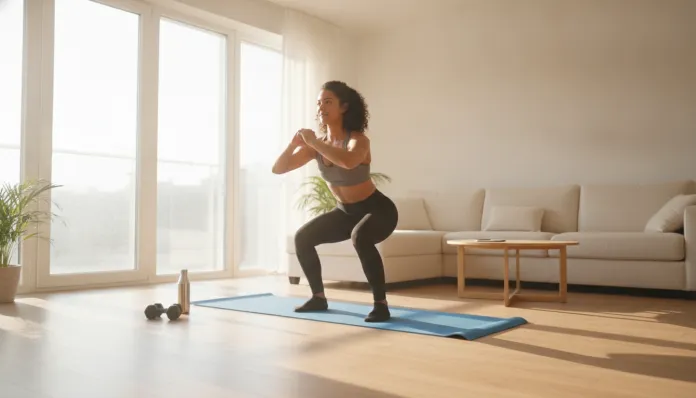
Why Exercising at Home Really Works
The nearest gym might be kilometers away, the day might be too busy, or the budget might not allow for a membership fee. Even so, keeping the body active is a necessity that most people recognize — and the home environment, often underestimated, offers everything needed to build an efficient and sustainable exercise routine.
In recent years, interest in home workouts has grown significantly. The movement is not limited to a passing moment: simple equipment like yoga mats, resistance bands, and adjustable dumbbells have become common items in apartments and homes throughout Brazil. More than that, research in exercise physiology has established the understanding that body weight, when used well in movements like squats, push-ups, and planks, is sufficient to develop strength, endurance, and even flexibility.
This guide was created to help you understand how to structure a daily home exercise routine — from warm-up to recovery — regardless of your fitness level. Attention: the information here is of a general and educational nature. People with pre-existing health conditions, chronic pain, or a history of injuries should consult a doctor or physical educator before starting any training program.
Before You Start: Assess Your Starting Point
A common mistake for those who decide to exercise at home is jumping straight into workouts without any planning. The result is usually excitement in the first few days, followed by excessive fatigue, minor injuries, or simply abandoning the routine.
The first step is honest: assess your current level. Ask yourself:
- How long has it been since you exercised regularly?
- Is there any joint pain or movement limitation?
- How much time per day can you realistically dedicate to training?
- What is your main goal — weight loss, muscle gain, improved cardiovascular fitness, general well-being?
There is no wrong answer. What exists is the need to align expectations with the reality of your body and routine. An absolute beginner doesn’t need to train every day right away — three times a week with rest between sessions is already a solid start and scientifically supported for body adaptation.
Setting Up Your Space: The Bare Minimum
The good news is that you don’t need to transform an entire room into a gym. A yoga mat or good-quality exercise mat, a space equivalent to a double bed, and comfortable clothing are already enough to get started.
As the routine becomes established, you can consider acquiring:
- Resistance bands — versatile, cheap, and easy to store
- Adjustable dumbbells — an economical option compared to buying several individual weights
- Jump rope — excellent for the cardiovascular component in minimal space
- Door pull-up bar — useful for working back muscles
If you live in an apartment, pay attention to the timing of more impactful exercises (jumping jacks, jumps) out of respect for neighbors. Floor movements on a mat are practically silent and equally effective.
Structure of a Complete Session
A well-structured home workout session has three distinct phases. Ignoring any of them increases the risk of injury and reduces long-term results.
1. Warm-up (5 to 10 minutes)
The warm-up prepares the cardiovascular system, muscles, and joints for effort. It doesn’t need to be complicated:
- Marching in place with knee lifts — 2 minutes
- Shoulder and neck rotations — 30 seconds each
- Free squats without weight, at a slow pace — 10 to 15 repetitions
- Hip mobility circles — 10 repetitions each side
- Light jumping jacks — 1 to 2 minutes
2. Main Workout (20 to 40 minutes)
This is where the real work happens. The structure varies depending on your goal, but a functional model for beginners and intermediate levels is the circuit training: you perform a series of exercises in sequence with little rest between them, which combines muscle stimulation with cardiovascular benefit.
Example of basic circuit (3 rounds, 40 seconds of work and 20 seconds of rest per exercise):
- Sumo squat (works thighs and glutes)
- Push-ups (chest, shoulders, and triceps) — can be done with knees on the ground initially
- Front plank (core — trunk and abdominal muscles)
- Alternating lunges (legs and balance)
- Lying hip lift, the so-called glute bridge (back of thigh and glute)
- Row with resistance band or, in its absence, “imaginary row” with water bottles
3. Cool-down and Stretching (5 to 10 minutes)
Cool-down is often skipped due to lack of time or patience, but it helps the body gradually return to a resting state and contributes to reducing muscle fatigue the next day.
Dedicate this time to static stretches: hold each position for 20 to 30 seconds without forcing beyond a comfortable limit.
Building Your Week: Frequency and Division
The ideal training frequency depends on your goal and fitness level, but there is general consensus among fitness educators: more important than the intensity of a single session is consistency over weeks.
A functional distribution for those starting or returning to activity:
| Day | Focus |
|---|---|
| Monday | Full-body workout (circuit) |
| Tuesday | Active recovery (light walk, stretching) |
| Wednesday | Full-body workout or lower body focus |
| Thursday | Rest |
| Friday | Full-body workout or upper body and core focus |
| Saturday | Free activity (dancing, walking, yoga video) |
| Sunday | Complete rest |
For those with more conditioning, it’s possible to increase to four or five sessions per week, dividing muscle groups more specifically.
Maintaining Consistency: The Real Challenge
Setting up the routine is the simplest part. The real challenge is maintaining it. Behavioral studies on habit formation indicate that consistent repetition over several weeks is what transforms an effortful action into something almost automatic.
Some strategies that work in practice:
- Anchor the workout to something already in your routine — right after waking, before a shower, or after lunch. This reduces mental resistance.
- Start smaller than you think necessary — ten minutes of real exercise is worth more than nothing. Don’t wait to have a full hour available to start.
- Use playlists — songs with accelerated rhythm have a proven effect on motivation during exercise.
- Track your progress — a simple notebook or app where you record completed sessions creates a sense of accomplishment.
- Invite someone — training with a friend, even virtually by video call, increases commitment.
The Pomodoro Technique — dividing time into short focused blocks — can also be adapted for those who struggle to fit training into their day: 25-minute blocks of physical activity followed by a short break help make the session less intimidating.
Progression: How to Evolve Without Injury
One of the fundamental principles of physical training is progressive overload: for the body to continue adapting and evolving, you need to gradually increase the stimulus over time. At home, this can be done in several ways without necessarily buying more equipment:
- Increase the number of repetitions or sets
- Reduce rest time between exercises
- Execute movements at a slower pace (which intensifies muscle effort)
- Progress to more challenging versions of the movement — for example, moving from push-ups with knees supported to full push-ups, or from static plank to plank with arm alternation
A practical and safe rule: don’t increase more than 10% of load or training volume per week. This pace allows muscles, tendons, and joints to adapt without overload.
If you’re also interested in outdoor activities and want to complement home training with running, the Guide to starting running from zero without injuries provides detailed guidance on how to take this step safely.
Conclusion: Your Home as a Health Ally

Exercising at home is, above all, a matter of decision and organization. You don’t need expensive equipment, much space, or hours available per day to build a routine that brings real results. What you need is an honest plan, adapted to your current moment, and the willingness to start — even if slowly.
Every squat done in the living room, every plank held on the mat, every set completed before breakfast is another brick in building a habit that has the potential to transform your health in the long run. Consistency over months and years beats any single intense workout.
Review your routine every four to six weeks, adjust exercises according to your progress, and if you have questions about specific physical limitations, seek guidance from a physical educator or doctor. The body responds to care — and the best time to start is now.