
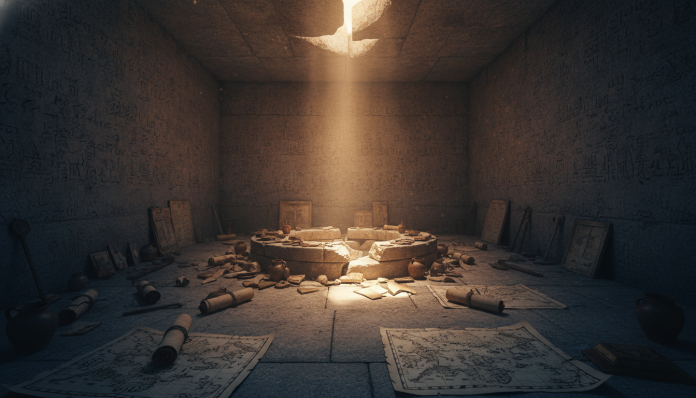
The history of mankind is filled with brilliant pages, extraordinary conquests and scientific advances that transformed the world. But among these pages there is also a shadow zone — episodes, constructions, disappearances and enigmas that, even after centuries of investigation, still have no definitive answer. These are mysteries that challenge historians, archaeologists, scientists and curious minds throughout the world.
The fascination with these enigmas is not by chance. They remind us that, however advanced our technology or sophisticated our science, the past holds secrets that resist time. In some cases, the lack of written records prevents solid conclusions. In others, evidence exists, but contradicts itself. And there are still those mysteries where the most likely explanation simply seems too unlikely.
Below is a deep dive into the greatest historical mysteries that continue to intrigue researchers and enthusiasts today — and that will likely fuel decades of debate to come.
The Construction of the Pyramids of Giza
No list of historical mysteries would be complete without mentioning the Egyptian pyramids. The Great Pyramid of Khufu, built around 2560 B.C., remains one of the most impressive structures ever erected by mankind. Standing about 138 meters tall (originally 146 meters) and composed of approximately 2.3 million stone blocks, each weighing between 2.5 and 15 tons, the structure raises a question that still has no definitive answer: how did the Egyptians do it?
The most widely accepted theory today is that construction ramps were used to lift the blocks. Studies from 2017, based on marks found in limestone from Hatnub, suggest that the Egyptians used a system of sledges on wet rails to drag the stones. But the precise details of the process — such as how the heavier blocks were positioned at the top, for example — still generate debate among experts.
Another puzzling point is the alignment of the pyramids with the cardinal points, with a margin of error of less than 0.05 degrees. How did ancient builders achieve this precision without modern instruments? Hypotheses include the use of stars as an astronomical reference, but no explanation has been definitively proven.
The Disappearance of the Roanoke Civilization
In 1587, an English colony was established on the island of Roanoke, in what is now North Carolina, United States. Led by John White, the colony had around 115 people. White returned to England in search of supplies, but when he returned in 1590, he found the colony completely empty. There were no signs of struggle, bodies, or any obvious explanation.
The only clue left behind was the word “CROATOAN” carved into a wooden post. Croatoan was the name of a nearby island inhabited by an indigenous people. The most widely accepted theory today is that the colonists integrated into the native communities of the region — either by choice or out of necessity for survival. Genetic and archaeological studies in communities descended from the Lumbee have sought evidence of this mixture, but no conclusive proof has been established to date.
The Origin and Purpose of Stonehenge
In southwestern England, in Wiltshire, stands one of the world’s most enigmatic monuments: Stonehenge. Built in phases between approximately 3000 B.C. and 1500 B.C., the collection of giant stones continues to defy complete explanations.
The largest stones, called sarsens, weigh up to 25 tons each and were transported from a quarry about 25 kilometers away. The so-called bluestones came from a region in Wales, more than 200 kilometers away — an extraordinary logistical feat for the time.
As for its purpose, the theories are numerous:
- Astronomical observatory: the stones are aligned with the sunrise at the summer solstice and the sunset at the winter solstice, suggesting ritual use linked to the calendar.
- Healing site: archaeological findings indicate that people traveled from far away to the site, possibly seeking healing — many skeletons found nearby showed signs of illness or injury.
- Monumental cemetery: human remains were found at the site, indicating funerary use over centuries.
Most likely, Stonehenge served multiple purposes over its centuries of use, but the definitive answer remains a mystery.
The Voynich Manuscript
Discovered (or rediscovered) in the early twentieth century by bookseller Wilfrid Voynich, the Voynich Manuscript is an illustrated document of about 240 pages, dated by radiocarbon between 1404 and 1438. The problem? No one knows what it says.
The text is written in a writing system to date not deciphered, which does not correspond to any known language or code. The illustrations show plants that do not exist in nature, human figures in strange poses, astronomical diagrams and sequences of bathtubs. Various cryptographers, linguists and intelligence experts over the centuries — including during World War II — attempted to decipher it without success.
Some hypotheses suggest that the manuscript is an elaborate hoax, a meaningless text created to seem mysterious. Others argue that it is a genuine code not yet broken. In 2019, a researcher from the University of Bristol claimed to have deciphered part of the text, identifying words in phonetic Latin, but the theory was not widely accepted by the academic community.
The Lost City of Atlantis
Few stories capture human imagination like that of Atlantis. Described by Greek philosopher Plato around 360 B.C., Atlantis would have been a powerful island-nation that was swallowed by the sea in a single day and night. Plato presented the story as a historical account transmitted by Egyptian priests.
The central problem is that no concrete archaeological evidence of Atlantis has been found to date. Theories about its location have spread across the globe: from the Mediterranean (including Greek islands such as Santorini, whose Minoan civilization was destroyed by a volcanic eruption around 1600 B.C.) to the Atlantic Ocean, Antarctica and even South America.
Most historians and archaeologists tend to interpret Atlantis as a philosophical allegory created by Plato to illustrate the dangers of hubris (arrogance) of a civilization. But the debate continues, and underwater and geological research continues to be carried out in different parts of the world motivated by this possibility.
The Fate of Amelia Earhart
In July 1937, American aviator Amelia Earhart and her navigator Fred Noonan disappeared over the Pacific Ocean during an attempt to circumnavigate the globe. Earhart was at the time the world’s most famous aviator, having been the first woman to cross the Atlantic in solo flight in 1932.
Despite one of the largest maritime search operations in American history up to that point, no wreckage of the plane was found. The official U.S. government version concluded that the aircraft ran out of fuel and crashed into the ocean, and Earhart and Noonan were declared dead in 1939.
But some alternative theories persist:
- Nikumaroro Island: an organization called TIGHAR (The International Group for Historic Aircraft Recovery) has researched Nikumaroro Island since the 1980s, finding fragments that could belong to the aircraft and possibly human remains — although analyses have not been conclusive.
- Japanese capture: a popular, but unsupported, theory suggests that Earhart would have been captured by the Japanese upon landing on an island controlled by them.
The mystery remains officially unsolved, and expeditions continue to be conducted in the Pacific region.
What These Mysteries Have in Common
What unites such different enigmas — from Egyptian pyramids to the disappeared aviator — is precisely the gap between evidence and explanation. In each case, there are clues, but not enough to close the circle with absolute certainty.
This says much about the limits of human knowledge. Just as there are everyday phenomena that science is still studying and debating — such as why we yawn and why yawning is contagious — there are historical questions that resist simple answers.
Among the elements common to these great mysteries, the following stand out:
- Absence or scarcity of written records contemporary to the event
- Degradation of physical evidence over centuries or millennia
- Cultural contexts radically different from ours, making interpretation difficult
- Political, religious or commercial interests that throughout history influenced the preservation (or destruction) of evidence
- Confirmation bias in investigations, which leads researchers to favor pre-existing theories
Conclusion

The greatest mysteries of history are not merely museum curiosities. They speak to us about the limits of what we know, about the complexity of the civilizations that preceded us, and about the humility necessary in the face of the past. The search for answers — even if incomplete — continues to drive archaeologists, historians, geneticists and enthusiasts around the world.
In 2026, with technologies such as ancient DNA analysis, satellite remote sensing and artificial intelligence applied to cryptography, new pieces of these puzzles continue to be found. But perhaps part of the fascination lies precisely in the open question — in the space between what we know and what we still cannot prove. After all, a humanity that has no more mysteries would be a humanity that has stopped surprising itself.


