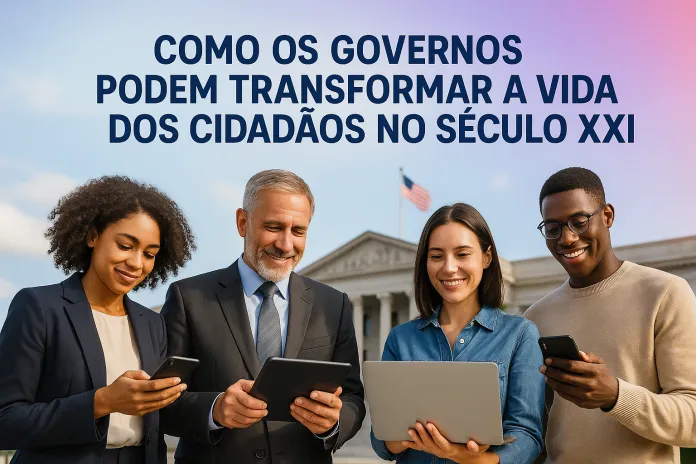
# How Governments Can Transform Citizens’ Lives in the 21st Century
The 21st century presents unprecedented challenges for public governance, but it also offers extraordinary opportunities to radically transform citizens’ lives. With technological advances, new understandings of social well-being, and innovative public management models, governments have powerful tools at their disposal to create more just, prosperous, and sustainable societies. This article explores the fundamental strategies that can enable modern governments to achieve this necessary and urgent transformation.
Digitalization and E-Government: The Gateway to Transformation
The digitalization of government services represents one of the most immediate and impactful transformations that governments can implement. Transitioning from traditional, paper-based, and in-person bureaucratic processes to accessible digital platforms can revolutionize citizens’ experience with the State.
E-government goes beyond merely making forms available online. It involves redesigning entire processes, eliminating redundancies, and placing the citizen at the center of service design. Integrated platforms allow information to be shared between different government departments, preventing citizens from having to provide the same data repeatedly.
Effective implementation of e-government requires investment in digital infrastructure, training of public servants, and, crucially, robust cybersecurity measures. Citizens’ trust depends on the assurance that their personal data will be protected. Governments must adopt international information security standards and be transparent about how data is collected, stored, and used.
Civic Participation and Digital Democracy
Technology not only facilitates the delivery of government services but can also deepen democracy by enabling new levels of civic participation. Digital participation platforms allow governments to consult citizens on public policies, gather suggestions and ideas, and make the decision-making process more inclusive.
However, digital democracy also presents challenges. It is crucial to ensure that these platforms are accessible to all segments of the population, including the elderly, people with disabilities, and communities with less access to technology. Digital exclusion can paradoxically increase inequalities if not adequately addressed.
Investment in Quality Education and Lifelong Learning
No social transformation is more profound and lasting than that provided by education. Governments that prioritize quality, accessible educational systems aligned with the needs of the 21st century are essentially investing in the human potential of their nations.
Beyond formal education, 21st-century governments must facilitate lifelong learning. In a world where technical skills quickly become obsolete, professional retraining programs and continuing education are essential to maintain employability and enable career transitions.
Singapore implemented the SkillsFuture program, which provides educational credits to all citizens to be invested in professional update courses. This initiative recognizes that education does not end with the completion of school or university but is an ongoing process that the State must actively support.
Investment in education also needs to adapt to technological realities. Programming, digital literacy, computational thinking, and artificial intelligence are no longer niche skills but fundamental competencies that all citizens will need to develop at some level.
Universal and Preventive Public Health
Robust and accessible health systems are fundamental pillars of any prosperous society. Governments that ensure universal access to quality healthcare not only directly improve citizens’ lives but also strengthen the economy by reducing absenteeism, increasing productivity, and avoiding catastrophic spending on treatments.
Brazil’s Unified Health System (SUS), despite funding and management challenges, represents one of the largest public health systems in the world, offering universal coverage in a country of continental dimensions. Programs like the Family Health Strategy bring primary care to remote communities, exemplifying how governments can prioritize equity in health access.
The transformation in 21st-century public health must emphasize prevention as much as treatment. Investing in vaccination programs, public health campaigns, promoting healthy habits, and early disease detection is significantly more economical than treating conditions in advanced stages.
Technology offers revolutionary opportunities for public health. Telemedicine can bring specialists to remote regions, health apps can monitor chronic conditions, artificial intelligence can assist in accurate diagnoses, and population data analysis can identify epidemiological patterns before they become crises.
The COVID-19 pandemic demonstrated both the critical importance of resilient health systems and the potential of technology and international cooperation to address global health challenges. Governments that have learned these lessons will be better prepared for future crises.
Sustainable Infrastructure and Urban Mobility
Strategic investments in infrastructure radically transform the quality of urban and rural life. In the 21st century, these investments must prioritize sustainability, climate resilience, and universal accessibility.
Efficient, comfortable, and accessible public transportation systems reduce congestion, air pollution, and travel time, improving public health and economic productivity. Cities like Copenhagen have massively invested in cycling infrastructure, creating a culture where more than 60% of daily commutes are made by bicycle, with immeasurable benefits for public health and the environment.
Digital infrastructure, including universal broadband connectivity, is as essential in the 21st century as electricity and water were in the 20th. Governments must ensure that all citizens, regardless of geographic location or socioeconomic status, have access to quality internet.
Social Inclusion Policies and Combating Inequality
Economic and social inequality is one of the most pressing challenges of our time. Governments play a central role in creating policies that promote equity and ensure that economic growth benefits all segments of society.
Conditional cash transfer programs, like Brazil’s Bolsa Família, have demonstrated remarkable capacity to reduce extreme poverty while encouraging investment in education and health. When well-designed and implemented, these programs not only alleviate immediate suffering but break intergenerational cycles of poverty.
Gender equality policies, minority protection, and inclusion of people with disabilities are not only moral imperatives but also make economic sense. Inclusive societies harness the full potential of their
Para fornecer as melhores experiências, usamos tecnologias como cookies para armazenar e/ou acessar informações do dispositivo. O consentimento para essas tecnologias nos permitirá processar dados como comportamento de navegação ou IDs exclusivos neste site. Não consentir ou retirar o consentimento pode afetar negativamente certos recursos e funções.
Funcional
Always active
O armazenamento ou acesso técnico é estritamente necessário para a finalidade legítima de permitir a utilização de um serviço específico explicitamente solicitado pelo assinante ou utilizador, ou com a finalidade exclusiva de efetuar a transmissão de uma comunicação através de uma rede de comunicações eletrónicas.
Preferências
O armazenamento ou acesso técnico é necessário para o propósito legítimo de armazenar preferências que não são solicitadas pelo assinante ou usuário.
Estatísticas
O armazenamento ou acesso técnico que é usado exclusivamente para fins estatísticos.O armazenamento técnico ou acesso que é usado exclusivamente para fins estatísticos anônimos. Sem uma intimação, conformidade voluntária por parte de seu provedor de serviços de Internet ou registros adicionais de terceiros, as informações armazenadas ou recuperadas apenas para esse fim geralmente não podem ser usadas para identificá-lo.
Marketing
O armazenamento ou acesso técnico é necessário para criar perfis de usuário para enviar publicidade ou para rastrear o usuário em um site ou em vários sites para fins de marketing semelhantes.