
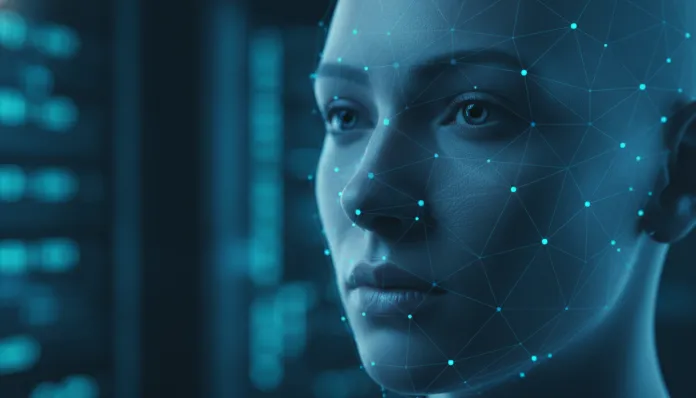
You pass through the subway turnstile, and the camera barely blinks. In seconds, the system knows who you are — no card, no password, not even needing to stop. Facial recognition has moved beyond science fiction films to become one of the most prevalent technologies in modern life, from unlocking phones to airport security, banking systems, and corporate access control. But how exactly does a camera “read” a face and turn it into an identity?
The answer lies in a sophisticated combination of geometry, mathematics, and artificial intelligence. The process involves much more than simply “taking a photo and comparing.” Behind each recognition are layers of algorithms trained with millions of images, calculations mapping millimetric distances between your eyes, nose, and mouth, and neural networks capable of distinguishing faces even under poor lighting, difficult angles, or partially covered faces. It’s impressive engineering — and also, as we will see, full of ethical debates that deserve attention.
If you’ve ever wondered what happens behind the scenes when your face is recognized, this article will explain it to you, step by step, clearly and without unnecessary jargon.
What is facial recognition, after all?
Facial recognition is a biometric technology — meaning it uses unique physical characteristics of humans for identification. Just like a fingerprint or iris pattern, the face acts as a “biological password.” The great advantage is that it can be read from a distance, without physical contact, and often without the person noticing.
Technically, the process is divided into two main functions:
- Verification: confirms if the person is who they claim to be (“Are you really João da Silva?”)
- Identification: discovers who the person is from a database, without prior information (“Who is this person on the camera?”)
Both use the same basic mechanisms, but identification is computationally much more demanding — after all, it needs to compare a face with potentially millions of stored records.
How the process works: from camera to result
Although implementations vary between companies and contexts, modern facial recognition generally follows the steps below.
1. Image capture
It all starts with a camera. It could be the front camera of your smartphone, a security camera at an airport, or an infrared sensor embedded in a subway turnstile. The system captures a static image or a video frame where there is a human face.
More advanced systems use depth cameras (like Apple’s Face ID, launched in 2017 and which became an industry standard) that project thousands of infrared points invisible to the human eye to create a three-dimensional map of the face — making it much harder to trick the system with printed photos or videos.
2. Face detection
Before analyzing the face, the system needs to find it in the image. Detection algorithms identify the presence of one or more faces in a frame, outlining them with a virtual box. This step uses techniques like convolutional neural networks (CNNs), which have been trained with countless images of faces in varied conditions — sideways, in different lighting, with glasses, with a beard.
3. Alignment and normalization
Once detected, the face is “normalized.” This means the system adjusts the image to a standard: centers the face, corrects the tilt, standardizes the size and orientation. This ensures that the same face photographed from slightly different angles produces comparable results.
4. Feature extraction (the heart of the system)
This is the most important step. The algorithm analyzes the face and extracts what is called a feature vector — a set of mathematical measurements that uniquely describe that face.
Older systems did this geometrically: measuring distances between reference points, such as the distance between the eyes, the width of the nose, the length of the jaw, and so on. These points are called facial landmarks, and a human face has dozens of them mapped.
Modern systems based on deep learning go further: instead of measuring predefined distances, neural networks train to find on their own which patterns are most useful for distinguishing faces. The result is a highly compact mathematical representation — called a facial embedding — that can have 128, 256, or even 512 numerical dimensions, depending on the model.
5. Comparison with database
The generated embedding is then compared with the embeddings stored in a database. Mathematically, this is equivalent to calculating the “distance” between two vectors in multidimensional space. The smaller the distance, the more similar the faces are.
If the distance is below a predefined threshold, the system declares a match. This threshold is configurable: a bank may require a very precise match (low threshold), while a suspect search system may accept larger margins not to discard candidates.
6. Decision and response
Based on the comparison, the system returns a result: identity confirmed, not recognized, or a list of possible matches with a confidence level. In real-time systems, this entire process takes fractions of a second.
The role of deep learning
The revolution in facial recognition happened with the popularization of deep neural networks, starting in the 2010s. Models like DeepFace, developed by Facebook (now Meta) and presented in 2014, and FaceNet, by Google, published in 2015, demonstrated for the first time that computers could surpass humans in accuracy for identifying faces in certain controlled conditions.
These models are trained with immense datasets — millions of face images with known identities. During training, the neural network internally adjusts its parameters to learn to produce similar embeddings for photos of the same individual and different ones for different people.
The result is a system that generalizes well: even if the verification photo is different (new angle, aging, hairstyle change), the embedding will still be close enough to generate a correct match.
Where this technology is already present
Facial recognition is no longer a futuristic promise — by 2026, it is real infrastructure in many countries and sectors:
- Smartphones: face unlocking is present in most mid-range and high-end devices
- Airports: paperless boarding systems (called biometric boarding) already operate in dozens of airports worldwide
- Banking systems: bank apps use facial recognition for transaction authentication
- Corporate access control: companies replace badges with biometric recognition
- Retail: some chains use the technology to identify frequent customers or detect theft history
- Public security: police forces in several countries use cameras integrated with criminal databases
Limitations and ethical debates
Despite advances, facial recognition has technical limitations and raises legitimate questions that deserve to be known.
Technical limitations
- Algorithmic bias: academic studies, such as the one conducted by the MIT Media Lab and published in 2018, showed that several commercial systems had higher error rates for black women’s faces than for white men’s — a reflection of poorly diverse training bases
- Adverse conditions: very low lighting, facial occlusions (masks, sunglasses), and extreme angles still challenge accuracy
- Identical twins: high-precision systems can differentiate twins, but lower-resolution ones may fail
Debates on privacy and use
Facial recognition in public spaces without consent is the most controversial point. Different countries adopt different approaches: the European Union, with the AI Act (legislation that came into force in phases starting in 2024), imposes strict restrictions on biometric use in public spaces. In the United States, regulation varies by state. In Brazil, the General Data Protection Law (LGPD) classifies biometric data as sensitive data, requiring explicit consent for its processing.
The debate is not about banning the technology — which has legitimate and useful applications — but about clearly defining where, how, and by whom it can be used, with what transparency, and with what safeguards against errors and abuses.
What to expect in the coming years
The trend is for facial recognition systems to become even more accurate, faster, and miniaturized. Cameras embedded in glasses, wearables, and IoT (Internet of Things) devices tend to expand capture points. At the same time, research on privacy by design — techniques that allow identity authentication without storing images or embeddings on centralized servers, reducing leakage risks — is growing.
Discussions on algorithmic transparency are also gaining strength: the right to know when and how your face is being analyzed, and to contest decisions made based on that analysis.
Conclusion
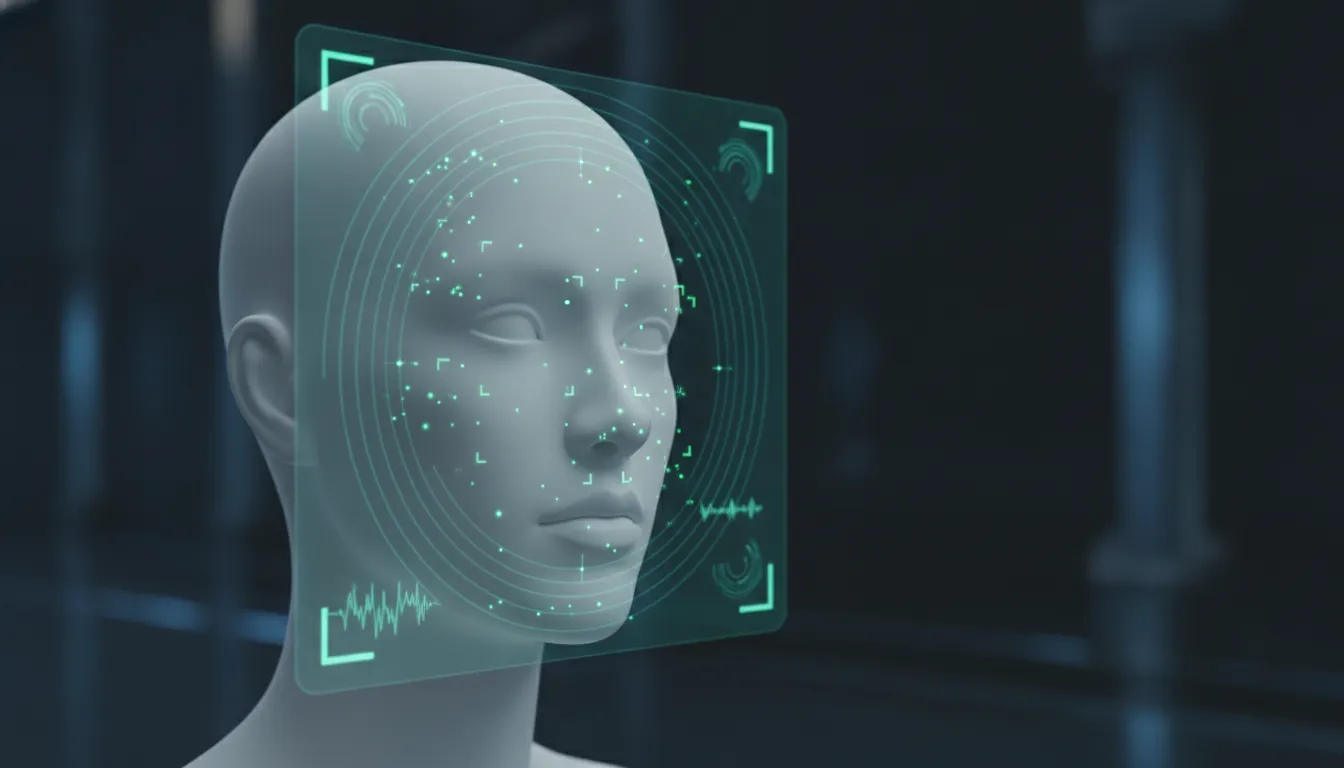
Facial recognition is, at its core, a mathematical translation of what our eyes naturally do: recognize familiar people. The technology has reached an impressive level of sophistication, combining geometry, statistics, and artificial intelligence to identify faces in fractions of a second with increasing accuracy.
Understanding how it works — from image capture to embedding calculation — is not just technical curiosity. It is also the first step to consciously participating in debates about where and how this technology should be used. After all, we, the societies that live with it, decide the rules of the game.
- Adverse conditions: very low lighting, facial occlusions (masks, sunglasses), and extreme angles still challenge accuracy
- Airports: paperless boarding systems (called biometric boarding) already operate in dozens of airports worldwide
- Identification: discovers who the person is from a database, without prior information (“Who is this person on the camera?”)