
You pass through the subway turnstile without touching anything. Unlock your phone with a glance. At the airport, a panel identifies you before you even present your passport. It seems like a scene from a sci-fi movie, but it’s the reality of 2026 — and the technology behind it all has a name: facial recognition.
Increasingly present in smartphones, banks, public security systems, and even supermarkets, facial recognition has moved from being a technological curiosity to one of the most widespread identification tools in the world. With this expansion, important questions have also arisen: how does this technology really work? Is it safe? What are the privacy risks?
In this article, we will break down how facial recognition works in a clear and accessible way — without unnecessary jargon — present its main applications and also the legitimate debates surrounding its use.
How a Face Becomes Data
The starting point of everything is a seemingly simple question: what is a face to a computer? For us humans, recognizing a face is almost automatic, done in fractions of a second by the brain. For a machine, the process is quite different — and much more mathematical.
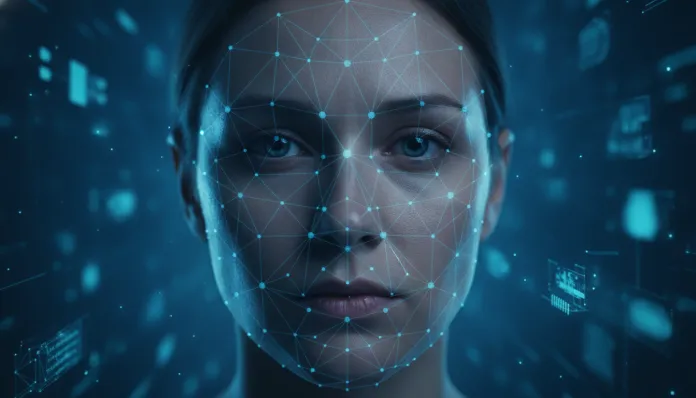
When a camera captures an image of your face, the facial recognition system begins to work. It identifies specific reference points, called facial landmarks: the distance between the eyes, the shape of the chin, the width of the nose, the position of the cheekbones, among dozens of others. These points are measured precisely and transformed into a set of numbers — a kind of geometric “fingerprint” of your face, called a face vector or faceprint.
This vector is then compared to other vectors stored in a database. If there is sufficient matching, the system concludes it has found the person. The speed and accuracy of this process depend directly on the quality of the algorithm and the computational power available.
The Role of Artificial Intelligence
The significant leap in facial recognition over the past decades was driven by the advancement of artificial neural networks, especially a type called convolutional neural networks (CNNs). Inspired by the functioning of the human brain, these networks learn to identify patterns in images from large volumes of examples.
In practice, a modern facial recognition system is trained with millions of face photos. The network learns, through trial and error, which visual features are most relevant to distinguish one person from another. Over time, it begins to do this with impressive accuracy — in ideal conditions, the accuracy rates of cutting-edge systems exceed 99%.
But training matters — a lot. If the image bank used to train the system is predominantly composed of faces from a specific demographic group, the algorithm will tend to work better for that group and worse for others. This is one of the most debated issues in the field: algorithmic bias.
Where This Technology Is Used Today
Facial recognition is already in more places than most people imagine. Here are some of the main applications:
- Device unlocking: the Face ID feature, popularized by Apple in 2017, has become standard in smartphones from various brands and works with infrared cameras that map the face in 3D, making fraud with flat photos difficult.
- Border and airport control: many countries use biometric portals that compare the traveler’s face with the photo stored in documents such as electronic passports.
- Bank security: banks use facial recognition to authenticate customers in apps and even ATMs, replacing passwords.
- Public security: police forces in various countries use facial recognition systems to identify suspects through surveillance cameras — a practice that generates intense debates about privacy and civil rights.
- Commerce and retail: some store chains experiment with the technology to identify frequent customers or detect suspicious behavior.
- Corporate access control: offices and industrial facilities replace badges and passwords with facial recognition at entrances.
Accuracy, Limitations, and the Problem of Bias
Although the most advanced systems show impressive results in the lab, performance in the real world is more variable. Some factors affecting accuracy include:
- Lighting: poorly lit environments or those with intense artificial light hinder the capture of details.
- Camera angle: profile images or those at oblique angles are more difficult to process.
- Use of accessories: glasses, masks, and hats can confuse the system.
- Aging: the face changes over time, and systems calibrated with old photos may struggle.
The problem of algorithmic bias deserves special attention. Research published by institutions like MIT and the National Institute of Standards and Technology (NIST) in the United States has shown that many facial recognition systems have significantly higher error rates for women, black people, and the elderly compared to middle-aged white men. This happens because training databases have historically been disproportionately composed of the latter group.
This imbalance has serious practical consequences, especially when the technology is used by public security agencies — situations where a misidentification can have severe impacts on innocent people.
Privacy, Legislation, and Rights
Facial recognition raises complex questions about privacy and mass surveillance. Unlike a password or a fingerprint, the face is a biometric data that you display publicly in virtually all the places you go. This means that, in theory, any camera connected to a facial recognition system can record your presence, habits, and movements — without you even knowing.
This scenario has prompted regulatory reactions in various parts of the world:
- European Union: the AI regulation approved by the bloc establishes restrictions on the use of facial recognition in public spaces in real-time, classifying it as a high-risk practice.
- United States: in the absence of federal law, several states and cities — like San Francisco and Boston — have adopted moratoriums or specific bans on the use of the technology by government agencies.
- Brazil: the General Data Protection Law (LGPD), in effect since 2020, classifies biometric data as sensitive data, requiring explicit consent for its processing. However, practical application is still developing, and debates about the use of cameras with facial recognition in public spaces continue in the country.
The discussion is not simple. On one side, there are legitimate arguments for security and efficiency. On the other, equally legitimate concerns about surveillance, discrimination, and the right to anonymity in public spaces.
How to Protect Yourself and What You Can Do
While it is impossible to completely “disappear” from cameras in public spaces, some practices help limit the exposure of your biometric data:
- Review app permissions: many apps request camera access without real necessity. Grant permission only when indispensable.
- Read the terms of service: when using services that require your face — like biometric authentication — check how the data is stored and for how long.
- Be aware of privacy policies of establishments: some places inform the use of cameras with facial recognition. You have the right to know.
- Follow local legislation: in many countries, including Brazil, regulations on the topic are evolving. Knowing your rights is the first step to exercising them.
- Prefer services that process data locally: systems like Apple’s Face ID process biometric data directly on the device, without sending it to external servers — which is generally safer from a privacy standpoint.
The Future of Facial Recognition
In 2026, facial recognition is already a mature technology, but its development is far from over. Researchers are working on systems capable of identifying people even with part of the face covered, in dense crowds, or from low-resolution cameras. At the same time, efforts are growing to make algorithms fairer and less susceptible to biases.
The technological counterpoint is also advancing: adversarial privacy tools — like makeups or visual patterns that confuse algorithms — are being studied as a form of resistance to automated surveillance. It is a kind of discreet arms race between those who want to identify and those who want to remain anonymous.
The central point is that facial recognition, like any powerful technology, is neither inherently good nor bad. What defines its impact is how it is used, by whom, with what safeguards, and under what oversight.
Conclusion
Facial recognition transforms faces into numbers, numbers into identities, and identities into decisions — all in fractions of a second. Understanding how this process works is essential not just out of curiosity, but because this technology already touches concrete parts of our lives: the bank, the airport, the phone in your pocket.
The promises are real: more convenience, more security, fewer passwords to remember. But the risks are also concrete: algorithmic bias, mass surveillance, and misuse of biometric data. Navigating these possibilities requires informed citizens and regulations that meet the challenge.
Technology will continue to advance. The question remains: will society advance alongside, with the rules and rights necessary to ensure this progress is fair?
- Read the terms of service: when using services that require your face — like biometric authentication — check how the data is stored and for how long.
- United States: in the absence of federal law, several states and cities — like San Francisco and Boston — have adopted moratoriums or specific bans on the use of the technology by government agencies.
- Camera angle: profile images or those at oblique angles are more difficult to process.
- Border and airport control: many countries use biometric portals that compare the traveler’s face with the photo stored in documents such as electronic passports.


