
Brazil is a country of celebration. There’s no denying it: every month, somewhere in this vast nation, a festival takes over the streets, yards, squares, and halls. From Carnival to the Círio de Nazaré, from Bumba Meu Boi to Cavalhadas, Brazilian popular festivals carry centuries of history in every drumbeat, every lit bonfire, and every hand-sewn costume. But where do all these traditions come from? Who were the peoples that created them? And why do they endure so strongly over time?
The answer lies in Brazil’s very formation: a territory shaped by the meeting — often violent, sometimes harmonious — of at least three major cultural matrices. The indigenous peoples who inhabited these lands for millennia, the European colonizers who arrived from 1500 onwards, and the Africans forcibly brought as slaves form the foundational core of Brazilian popular culture. Over the centuries, immigrants from dozens of countries have added their own celebrations, blending them with what already existed here. The result is a unique festive tapestry in the world.
Understanding the origins of Brazilian popular festivals is, therefore, understanding a bit of the country’s history — its contradictions, its pains, its resistances, and its joys. It’s realizing that every street game, every chant sung in procession, and every folk dance is also a living document of collective memory.
The Three Roots That Sustain Everything
Before discussing specific festivals, it’s important to understand the three major cultural sources that feed most Brazilian popular celebrations.
The Indigenous Heritage is the oldest and, unfortunately, the least visible in major urban festivals. The native peoples already held festive rituals related to harvests, seasons, youth initiation, and communication with the spiritual world. Dances like the toré, practiced by various ethnic groups in the Northeast, and elements present in Bumba Meu Boi — such as the symbolic worship of the ox, a totemic animal in some indigenous cultures — reveal this persistent presence.
The European Heritage arrived mainly through Portugal, but also from Spain, France, and the Netherlands, which contested territories in colonial Brazil. With the Europeans came Catholic processions, medieval theatrical plays, cavalcades inspired by battles between Moors and Christians, and festivals from the European agrarian calendar — like the June Festivals, which originally celebrated popular Catholic saints and coincided with the harvest season in the northern hemisphere.
The African Heritage is perhaps the most intense and has most significantly shaped Brazil’s festive character. Brought from different regions of Africa — especially West and Central Africa — enslaved peoples preserved their religions, music, and dances despite persecution. Samba, candomblé, maracatu, afoxé, and countless other expressions have directly African roots, transformed and reinterpreted in the Brazilian context.
Carnival: Beyond the Revelry
Carnival is probably Brazil’s most internationally renowned festival. But its origin is surprisingly European. The word comes from the Latin carnem levare, meaning “remove the meat” — a reference to the Christian Lent period of abstinence. Carnival festivities existed in medieval Europe and arrived in Brazil with Portuguese colonizers, in the form of a frolic called Entrudo: people threw water, flour, and other materials at each other in the streets, in a rather chaotic revelry.
Over time, Brazilian Carnival underwent radical transformation. In the 19th century, in the elite salons of Rio de Janeiro, the Venetian carnival emerged with masked balls. In the streets, carnival bands and ranches incorporated the music and dance of freed and enslaved blacks. In the early 20th century, samba emerged as the definitive musical expression of Rio’s Carnival, and samba schools began organizing from the 1920s.
Today, Brazilian Carnival takes radically different forms depending on the region: the Bahian electric trio with axé and Bahian pagode, the street blocks of Rio and São Paulo, the Pernambucan frevo — recognized as Intangible Cultural Heritage of Humanity by UNESCO since 2012 — and the bois-bumbás of the North form a mosaic of expressions sharing only the collective spirit of celebration.
June Festivals: From Europe to the Northeast
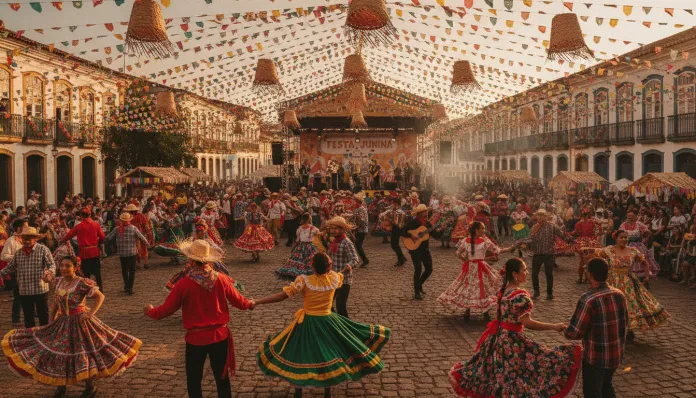
Anyone who sees a lively June festival with quadrilha, forró, bonfires, and colorful flags might not imagine that this celebration has roots in the European agricultural calendar. The June Festivals, or Saint John’s Festivals, celebrate three Catholic saints: Saint Anthony (June 13), Saint John (June 24), and Saint Peter (June 29). In Europe, especially in Portugal and Spain, these dates coincide with the summer solstice and were celebrated with bonfires, music, and folk dances.
In Brazil, the tradition arrived with the colonizers and gained strength mainly in the Northeast, where the June period coincides with the corn, cassava, and bean harvest. The quadrilha, for example, is an adaptation of the French contredanse — a European ballroom dance that arrived in Brazil in the 19th century and was completely reappropriated by popular culture, gaining exuberant choreographies and comic narratives depicting rural weddings.
The music we now call forró underwent several transformations. The term, whose origin is still debated by researchers, initially referred to popular open-air parties. Musician Luiz Gonzaga was crucial in popularizing forró, baião, and xote as musical expressions of the northeastern hinterland from the 1940s.
Bumba Meu Boi: The Play That Spans Brazil
Few manifestations of Brazilian popular culture are as complex and fascinating as Bumba Meu Boi — also known as Boi-Bumbá in the North. It’s a dramatic play, a festival that tells a story through dance, music, and theater. The central plot narrates the death and resurrection of an ox, the central character of a drama involving characters like Pai Francisco, Mãe Catirina, the ox owner, and figures from the spiritual world.
The origin of Bumba Meu Boi is a perfect example of cultural synthesis: researchers identify indigenous elements (worship of the ox as a sacred animal), African elements (rhythms, dances, and enslaved figures represented in the story), and European elements (medieval theatrical plays and religious dramas brought by missionaries).
The festival is present throughout Brazil, but it is in Maranhão that it has reached its most elaborate and recognized form. The Bumba Meu Boi festivals of Maranhão were inscribed in the Celebration Registry of Intangible Heritage by the National Institute of Historic and Artistic Heritage (Iphan) and recognized as Intangible Cultural Heritage of Humanity by UNESCO in 2019.
Círio de Nazaré and Religious Processions
Brazil is a country marked by popular religiosity, reflected in festivals that blend faith, devotion, and collective celebration. The Círio de Nazaré, held annually in Belém do Pará on the second Sunday of October, is one of the world’s largest religious processions. It’s estimated to gather, in recent years, between 1.5 and 2 million people in the streets of the Pará capital.
The festival originates from an early 18th-century episode: according to local tradition, a caboclo named Plácido José de Souza found an image of Our Lady of Nazaré on the banks of the Murucutu stream around 1700. The image was taken to the governor’s house and, the next morning, had mysteriously returned to the place where it was found. The episode, repeated several times, was interpreted as a miracle, and a hermitage was built on the site — the first of a series of chapels and churches marking devotion to the saint.
The Círio combines the European Catholic procession with Amazonian popular devotion, including elements from indigenous culture and riverine communities. In 2013, it was recognized as Intangible Cultural Heritage of Humanity by UNESCO.
Maracatu, Afoxé, and African-rooted Festivals
No discussion about Brazilian popular festivals would be complete without mentioning African-rooted manifestations that resisted slavery and religious persecution to become central expressions of the country’s culture. Maracatu, originating from Pernambuco, is one such manifestation. With its large royal courts, crowned queens, intense drumming, and the sacred figure of the calunga (a doll symbolizing the spirit of ancestors), maracatu carries a history of resistance and dignity.
Afoxé, especially present in Bahia, is another powerful example. Called the “Carnival of the Candomblés,” afoxé brings to the streets the rhythms, clothes, and music of African-rooted religions. The most famous is Filhos de Gandhy, founded in Salvador in 1949 by dockworkers inspired by Mahatma Gandhi and candomblé traditions.
Why These Festivals Survive
It’s legitimate to ask: why, in the 21st century, with all the pressure from mass culture and digital entertainment, do Brazilian popular festivals continue to thrive — and in many cases grow?
The answer lies in several key elements:
- Community Belonging: Popular festivals create bonds between people and places. Participating in the neighborhood’s Bumba Meu Boi or the school’s quadrilha is affirming a collective identity.
- Oral and Physical Transmission: These traditions aren’t learned from books but through the body — observing, imitating, participating. This creates a deeply human mode of learning.
- Adaptability: Popular festivals have never been static. They absorb new influences without losing their core. The electronic forró, contemporary street blocks, and maracatu reinventions show this capacity for renewal.
- Institutional Recognition: Registration as intangible heritage by Iphan and UNESCO has helped value and protect various manifestations at risk of disappearing.
- Cultural Resistance: For many indigenous, black, and peripheral communities, keeping the festival alive is also a political act of affirming their own existence.
Conclusion
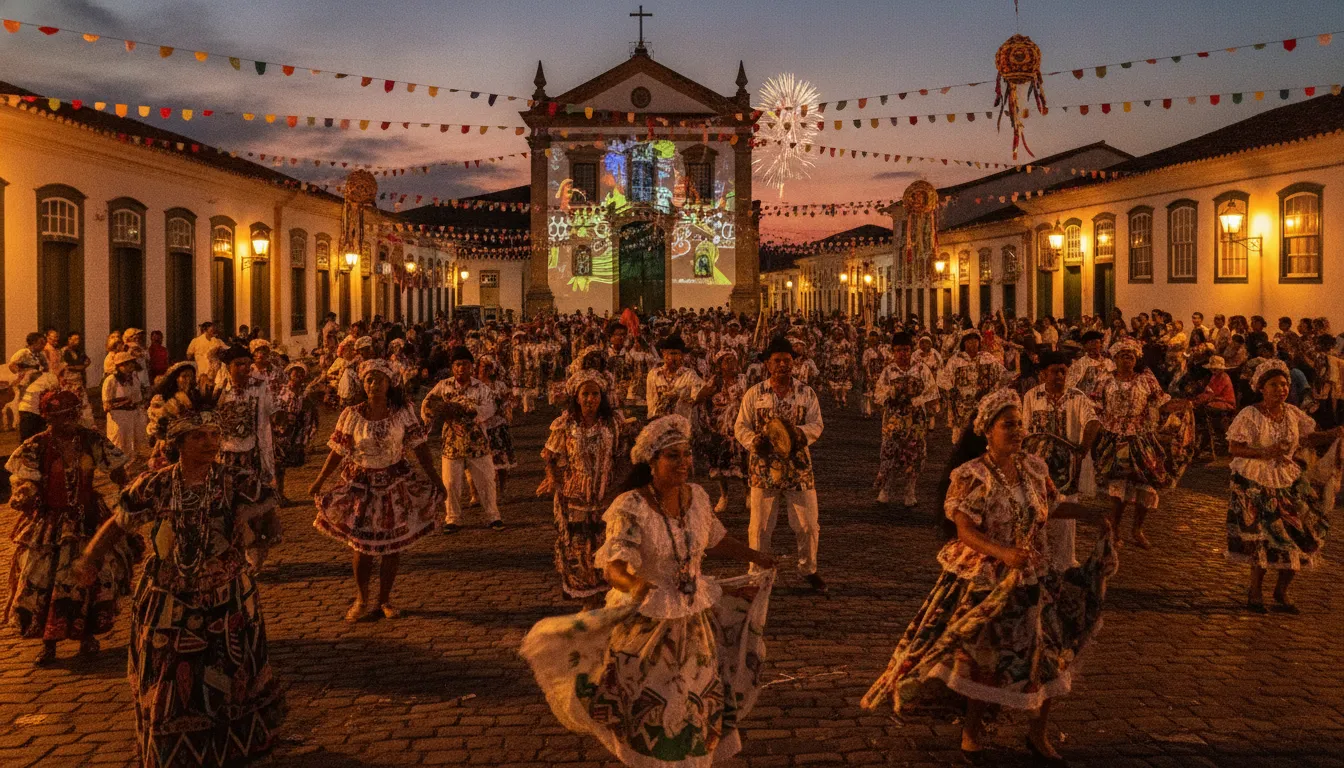
Brazilian popular festivals are not just entertainment. They are living archives of the country’s history, spaces where one can read, in movement and sound, the trajectory of peoples who met, clashed, and mixed over more than five centuries. Each maracatu drum echoes Africa. Each June bonfire recalls Europe. Each Bumba Meu Boi dance tells the story of the indigenous, blacks, and colonists who built, together and in conflict, the Brazil that exists today.
Understanding these origins is not just a historical curiosity: it is a way of respecting the peoples who created and preserved these traditions, often at great cost. It is also a way of looking to the future with more awareness of what we are as a nation — plural, contradictory, vibrant, and, above all, incurably festive.
- Oral and Physical Transmission: These traditions aren’t learned from books but through the body — observing, imitating, participating. This creates a deeply human mode of learning.