
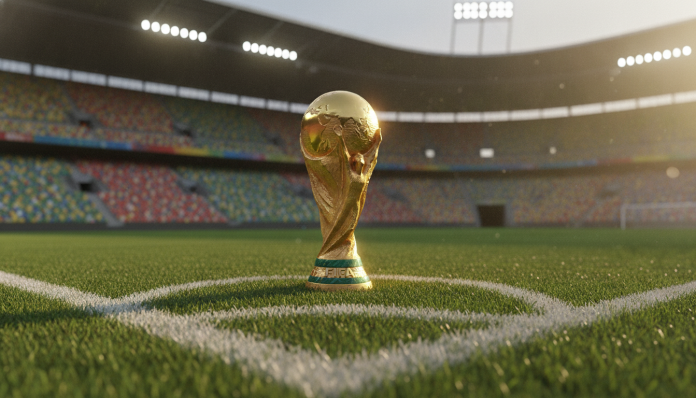
The FIFA World Cup is, without a doubt, the greatest sporting spectacle on the planet. Every four years, billions of people around the world stop everything to follow the matches, cheer for their countries, and be moved by the dramas that only football can provide. But behind the great finals and historic goals lies a rich history, full of curiosities, coincidences, and facts that most fans simply don’t know about.
Since its first edition, held in Uruguay in 1930, the tournament has gone through wars, boycotts, controversies, and profound transformations. Each edition left indelible marks not only in sports, but also in culture, politics, and the collective memory of entire generations. And it’s precisely in this less explored territory that the most fascinating stories tend to be hidden.
If you consider yourself a football enthusiast, prepare yourself to discover angles of the World Cup that have probably never been discussed in conversations after the games. This article goes beyond scores and famous scorers to dive into the backstage of one of the most extraordinary events in human history.
The origins: an idea that almost never came to fruition
The history of the World Cup begins long before 1930. Credit for creating the tournament is widely attributed to Jules Rimet, FIFA president between 1921 and 1954, and his ally Henri Delaunay. The idea of a world championship of national teams had been circulating since the early twentieth century, but it faced resistance from several federations, especially the British, who believed their football was superior and viewed the tournament with skepticism.
Uruguay was chosen as the host of the first edition for both a practical and symbolic reason: the country had won Olympic football in 1924 and 1928 and was celebrating, in 1930, the centennial of its independence. Furthermore, the Uruguayan government committed to financing the travel and accommodation of participating teams — a crucial detail, since many European federations hesitated to fund the long sea voyage to South America.
The result was an edition with only 13 participating teams, none of them British. The final was played between Uruguay and Argentina, and the hosts won 4-2, becoming the first world champions in history.
The original trophy: a story of war, theft, and recreation
Few sporting objects have had as turbulent a trajectory as the Jules Rimet Trophy, the original World Cup trophy. Sculpted in solid gold by French artist Abel Lafleur, the piece depicted the Greek goddess Nike and weighed approximately 3.8 kilograms.
During World War II, the trophy had to be hidden to prevent it from falling into the hands of Nazi forces. Italian official Ottorino Barassi, then FIFA vice-president, kept the trophy in a shoebox under his bed throughout the occupation — an act of courage that saved the object from being melted down or diverted.
But the story didn’t end well. In 1966, on the eve of England’s World Cup, the trophy was stolen during an exhibition in London. Days later, a dog named Pickles found the object wrapped in newspaper under a fence in a London neighborhood. The dog became a national celebrity. The episode is factual and widely documented in British press of the time.
The trophy was stolen again in 1983, this time in Brazil, and has never been recovered since. FIFA today guards only a replica of the original. The current trophy, simply called the FIFA World Cup Trophy, was created in 1974 by Italian sculptor Silvio Gazzaniga and is made of 18-carat solid gold.
Curious facts that few people know
Over the decades, the World Cup has accumulated a series of records, coincidences, and episodes that surprise even the most dedicated fans. Check out some:
- The most lopsided score in history was recorded in 1954, in Switzerland: Hungary 10 x 1 El Salvador — no, that’s not correct. The biggest score in World Cup history was Hungary 10 x 1 El Salvador, recorded at the 1982 World Cup in Spain.
- Pelé is the only player to have won three world titles: 1958, 1962, and 1970.
- The 1950 World Cup, held in Brazil, did not have a traditional final. The champion was determined by a final group, and Uruguay became champion by defeating Brazil at the Maracanã — a match known as the “Maracanazo”, which led to collective mourning in the country.
- Eusébio, a Portuguese star, was the top scorer of the 1966 World Cup with 9 goals — a record that stood for decades for players in a single edition.
- The 1934 and 1938 World Cups were the only ones in which the defending champion had to qualify through the playoffs, with the exception of the following edition.
- Brazil is the only country to have participated in all editions of the World Cup, without exception — from 1930 to the present day.
Editions marked by boycotts and historic absences
Not always have the world’s best teams been present at the World Cups. Throughout history, political boycotts and diplomatic disputes have left major gaps in the tournament.
The 1966 World Cup in England was marked by the absence of almost all of Africa, Asia, and Oceania. Federations in these regions boycotted the tournament in protest against the quota system, which they considered unfair and discriminatory. FIFA ended up revising the model of distributing places in subsequent editions.
Already in 1974 and 1978, African and Asian countries participated more expressively, reflecting a gradual opening of the tournament to football from the Southern Hemisphere.
A particularly curious case is that of the Soviet Union, which in 1974 refused to play a playoff game against Chile at the National Stadium of Santiago — a venue that had been used as a political prisoners’ camp after the 1973 coup. The USSR was eliminated without stepping on the field.
Records that withstand time
Some milestones established in the early decades of the World Cup remain unbroken, which says a lot about the technical and physical level of certain players and teams.
- Just Fontaine, French striker, scored 13 goals at the 1958 World Cup in Sweden — an absolute record for goals in a single edition that remains unbroken.
- Ronaldo Nazário is the all-time leading scorer in World Cup history with 15 goals, considering all editions in which he participated (1994, 1998, 2002, and 2006).
- Brazil is the country with the most titles: five wins (1958, 1962, 1970, 1994, and 2002).
- The match with the most goals in a World Cup was Austria 7 x 5 Switzerland in 1954 — 12 goals in a single game.
Tournament expansion: from 13 to 48 teams
Over the decades, the format of the World Cup underwent significant transformations. From the inaugural edition with 13 teams, the tournament grew to 16 teams in 1934, then to 24 in 1982, and to 32 in 1998 — a format that remained for nearly three decades.
Starting with the 2026 World Cup, which will be held in the United States, Canada, and Mexico, the tournament will feature 48 participating teams, the largest expansion in the event’s history. This represents a profound change in the structure of group stages and qualifying rounds, with new formats being introduced to accommodate the larger number of teams.
This expansion reflects the global growth of football, especially on continents like Africa, Asia, and CONCACAF (North America, Central America, and the Caribbean), which now have more places and, consequently, more visibility on the biggest stage in sports.
The World Cup as a cultural phenomenon beyond the field
It would be a mistake to reduce the World Cup to a strictly sporting event. Over the decades, the tournament has established itself as a global cultural phenomenon capable of paralyzing cities, uniting nations, and producing symbols that transcend football.
The official songs of each edition became soundtracks for generations. Mascots like Fuleco (Brazil 2014) and Zakumi (South Africa 2010) took on lives of their own in local cultures. National team jerseys became collector’s items and symbols of national identity.
Just as series that defined an era leave their mark on collective memory long after their original broadcast, World Cups build narratives that remain alive for decades — in family conversations, in history books, and in the tears of those who lived each moment firsthand.
Conclusion
The history of the World Cup is much more than a sequence of champions and top scorers. It is a living narrative, built over nearly a century, that mixes sports, politics, culture, and human emotion in proportions rarely seen in any other event.
From the behind-the-scenes creation of the tournament to the feats of immortal players, passing through scandals with the original trophy and transformations in the format of the competition, each edition added a new layer to this colossal story. Knowing these facts is a way to appreciate even more what happens within the four lines — and to understand why the World Cup continues to be, after so many decades, the greatest show on Earth.