
Why do certain animals seem to come from another planet?
Nature never ceases to amaze. In every corner of the planet, from tropical rainforests to deep oceans and arid deserts, there exists some living being that defies our understanding of what is possible. Animals that regenerate parts of their bodies, creatures that survive at extreme temperatures that would destroy any human equipment, species that see what we can’t even imagine perceiving. Earth’s biodiversity is an endless catalog of creative solutions to survival challenges.
But what exactly makes an animal “incredible”? The answer goes far beyond exotic appearance or impressive size. What really distinguishes the world’s most fascinating species are their unique biological abilities, their extraordinary evolutionary adaptations, and the way each one occupies an ecological niche in a practically perfect manner. It’s evolution’s engineering working at its highest level.
In this article, we’ll dive into the criteria that make certain animals truly exceptional and meet some of the most notable specimens ever studied by science.
The concept of adaptation: the basis of everything
Before presenting the animals, it’s fundamental to understand a central concept: evolutionary adaptation. It’s the process by which advantageous characteristics become more common in a population over generations, because they help individuals survive and reproduce more successfully.
When we say an animal is “incredible,” in most cases we’re admiring the result of millions of years of natural selection refining a specific ability to a level of efficiency that seems almost impossible. None of these characteristics appeared from nowhere — each is a response to a concrete survival problem.
Extreme resistance: the champions of survival
The tardigrade: the most resilient being on Earth
If there’s an animal that deserves the title of most resistant on the planet, it’s the tardigrade — a microanimal less than 1 millimeter, also popularly known as the “water bear”. This tiny invertebrate is capable of surviving conditions that would destroy practically any other known form of life:
- Temperatures of nearly -273°C (near absolute zero) and above 150°C
- Intense radiation, including X-rays in lethal doses for humans
- Extreme pressures, equivalent to the deepest ocean trenches
- The vacuum of outer space, without oxygen or atmospheric protection
This feat is possible thanks to a state called cryptobiosis: when the environment becomes hostile, the tardigrade retracts its limbs, loses almost all the water from its body, and enters suspended animation. In this state, its metabolism drops to less than 0.01% of normal. It can remain this way for decades and “revive” when conditions improve.
The Greenland shark: a centuries-old veteran
The Greenland shark (Somniosus microcephalus) is the vertebrate with the greatest known longevity. Studies published in Science magazine estimated that some individuals can live more than 400 years, with one analyzed specimen possibly being between 272 and 512 years old. It swims in Arctic glacial waters, at great depths, and grows only about 1 centimeter per year. The extreme slowness of metabolism appears to be one of the secrets to such longevity.
Intelligence and cognition: when the animal reasons
The octopus: the genius of invertebrates
The octopus defies everything we know about how intelligence can develop. With two-thirds of its neurons distributed in its tentacles — which function semi-autonomously — its neurological architecture is radically different from that of any vertebrate.
What octopuses can do impresses researchers worldwide:
- Solve mazes and puzzles to obtain food
- Use tools, such as carrying shells to use as shelter
- Demonstrate distinct individual personalities
- Open jar lids and escape from closed aquariums
- Learn by observing other individuals
Furthermore, despite being colorblind, they manage to camouflage themselves with chromatic precision thanks to special cells in the skin called chromatophores. How exactly they do this is still the subject of active study.
The raven: the bird that plans the future
Ravens (family Corvidae) are among the non-primate animals with the greatest documented cognitive capacity. Scientific experiments have demonstrated that they can plan future actions, store food in secret locations, and even deceive other ravens that are watching them — a behavior that implies understanding what the other knows or doesn’t know, something that was previously believed to be exclusive to great primates.
Senses beyond human understanding
Some animals perceive the world in ways that simply have no equivalent in human experience.
The shark and electroreception
Sharks possess organs called ampullae of Lorenzini, which detect extremely weak electrical fields generated by the muscles and nerves of other animals. This allows a shark to locate prey hidden under sand without seeing it, hearing it, or feeling it.
The python and infrared vision
Snakes of the python and boa groups possess loreal pits, organs capable of detecting infrared radiation — that is, heat. This functions like a biological thermal camera, allowing them to hunt in total darkness based solely on the body heat of their prey.
The mantis shrimp and hypercomplex vision
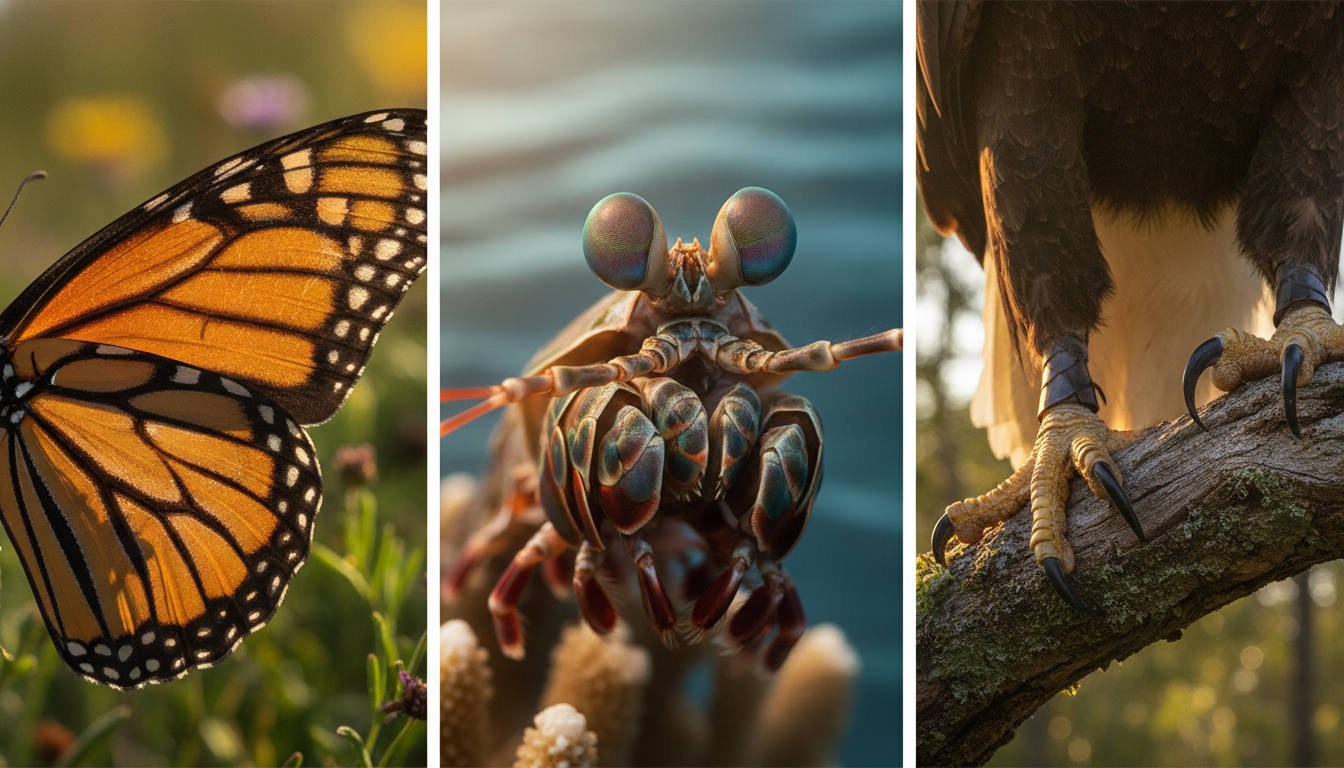
The mantis shrimp (Stomatopoda) possesses the most complex visual system ever studied in any animal. While humans have 3 types of color receptors, the mantis shrimp has up to 16 different types. It sees in the ultraviolet and infrared spectrum and can perceive polarized light. To discover how its brain processes all this information, scientists still have much work ahead.
Extraordinary physical abilities
See some of the most impressive physical capacities in the animal kingdom:
- Peregrine falcon: reaches speeds of about 389 km/h in a dive, being the fastest animal on the planet in active movement
- Flea: can jump up to 200 times the length of its own body, one of the greatest jump proportions relative to size in nature
- Leafcutter ant: carries loads of up to 50 times its own weight
- Bat: emits and interprets ultrasound with a precision that allows it to detect thin wires in the dark, using echolocation
- Axolotl (Ambystoma mexicanum): capable of regenerating entire limbs, including parts of the heart and brain, without leaving scars
For those who want to delve deeper into other surprising abilities of the animal world, it’s worth checking out this complete article: Incredible animals: abilities that will surprise you.
Ecological importance: incredible is also essential
Being extraordinary in the animal kingdom is rarely a luxury — it’s almost always a necessity. And many of these incredible abilities play a fundamental role in the planet’s ecosystems.
- Pollinating bats are responsible for the reproduction of hundreds of tropical plant species
- Humpback whales, with their migration routes of up to 8,000 km, transport nutrients between different ocean regions
- Beavers, by building dams, create wetland habitats that benefit dozens of other species
- Bees, with their sophisticated communication dance, coordinate the pollination of crops that feed a large part of humanity
Incredible animals don’t exist in a vacuum: they sustain complex ecological webs, and the loss of one species can have cascading consequences that are difficult to predict.
What science still doesn’t know
However far biology has advanced, animals continue to surprise researchers. Some questions remain open:
- How exactly do octopuses process visual information despite being colorblind?
- What is the real limit of the Greenland shark’s longevity?
- How do migratory birds detect Earth’s magnetic field to navigate with such precision?
- What exactly occurs in the metabolism of tardigrades during cryptobiosis?
Each new discovery opens more questions than answers — which makes the study of zoology and evolutionary biology a permanently vibrant field.
Conclusion: nature as the master of engineering
What makes certain animals the most incredible in the world is not a single factor, but a combination of resilience, intelligence, sensory perception, physical ability, and ecological relevance. In each case, we’re faced with the result of an evolutionary process that lasted millions of years, shaping living beings with elegant and efficient solutions to life’s challenges.
Looking at these animals carefully is a way to better understand the planet we live on — and to understand that intelligence, resilience, and creativity are not exclusive privileges of the human species. Nature is, above all, an incomparable master of living engineering.


