
The path garbage takes before becoming something new
You toss a PET bottle into the blue bin, the truck comes by, and done — mission accomplished, right? Almost. What happens after that is a complex chain, full of stages, machines, workers, and chemical processes that most people have never seen up close. Recycling is, in practice, much more than just separating plastic from paper.
In Brazil, the topic gained momentum with the National Solid Waste Policy (PNRS), a law approved in 2010 that established goals and responsibilities for the entire chain — from manufacturer to consumer. More than a decade later, the country still recycles only a small fraction of the waste it produces. Understanding why this happens starts with understanding how the process really works, from beginning to end.
This article walks you through that journey: from selective collection on your street to the raw material that returns to shelves in the form of a new product. No excessive romance, no alarmism — just how a system that matters really works.
What is recycling, anyway?
Before anything else, it’s worth separating some concepts that are often confused.
Recycling is the process of transforming discarded material into raw material to manufacture a new product. It’s not the same thing as reuse (using the same object for another purpose, without transforming it) or composting (organic decomposition of food scraps and plants).
The most common recyclable materials are:
- Paper and cardboard — newspapers, boxes, magazines, office sheets
- Plastic — PET bottles, packaging, containers (identified by numbers 1 to 7 in recycling triangles)
- Glass — bottles, jars, bottles (excluding mirrors, tempered glass, and light bulbs, which have different disposal)
- Metal — aluminum cans, steel cans, metal scrap
Materials contaminated with food scraps, used toilet paper, photographs, carbon paper, and some multilayer packaging (like juice boxes) are problematic — sometimes they cannot be recycled, sometimes they require special processes.
Selective collection: where it all begins
The journey of recyclable material begins at home, with separation. In many Brazilian municipalities, selective collection works with the model of colored bins, defined by ABNT and popularized by Conama:
- 🔵 Blue — paper and cardboard
- 🔴 Red — plastic
- 🟢 Green — glass
- 🟡 Yellow — metal
- 🟤 Brown — organic waste
- ⚫ Gray/black — rejects (what cannot be recycled)
In practice, however, most Brazilian cities adopt a simplified version: two streams — dry waste (mixed recyclables) and wet waste (organics and rejects). The selective collection truck picks up only the dry waste and takes it to the sorting facility.
Another entry point is Ecopoints (voluntary drop-off centers scattered throughout the city) and reverse logistics campaigns, where manufacturers are legally required to collect products such as batteries, electronics, and pesticide containers.
Sorting centers: the heart of the system
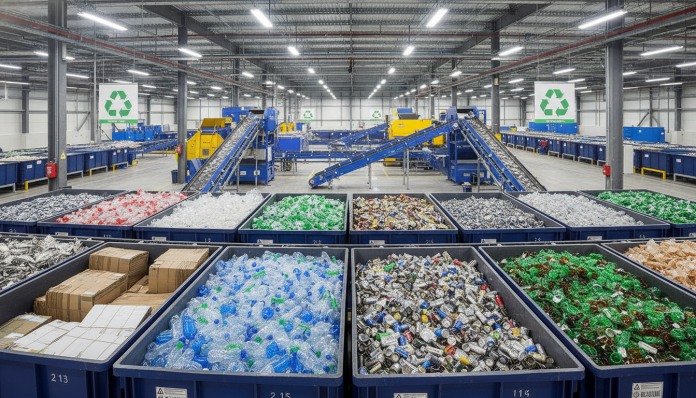
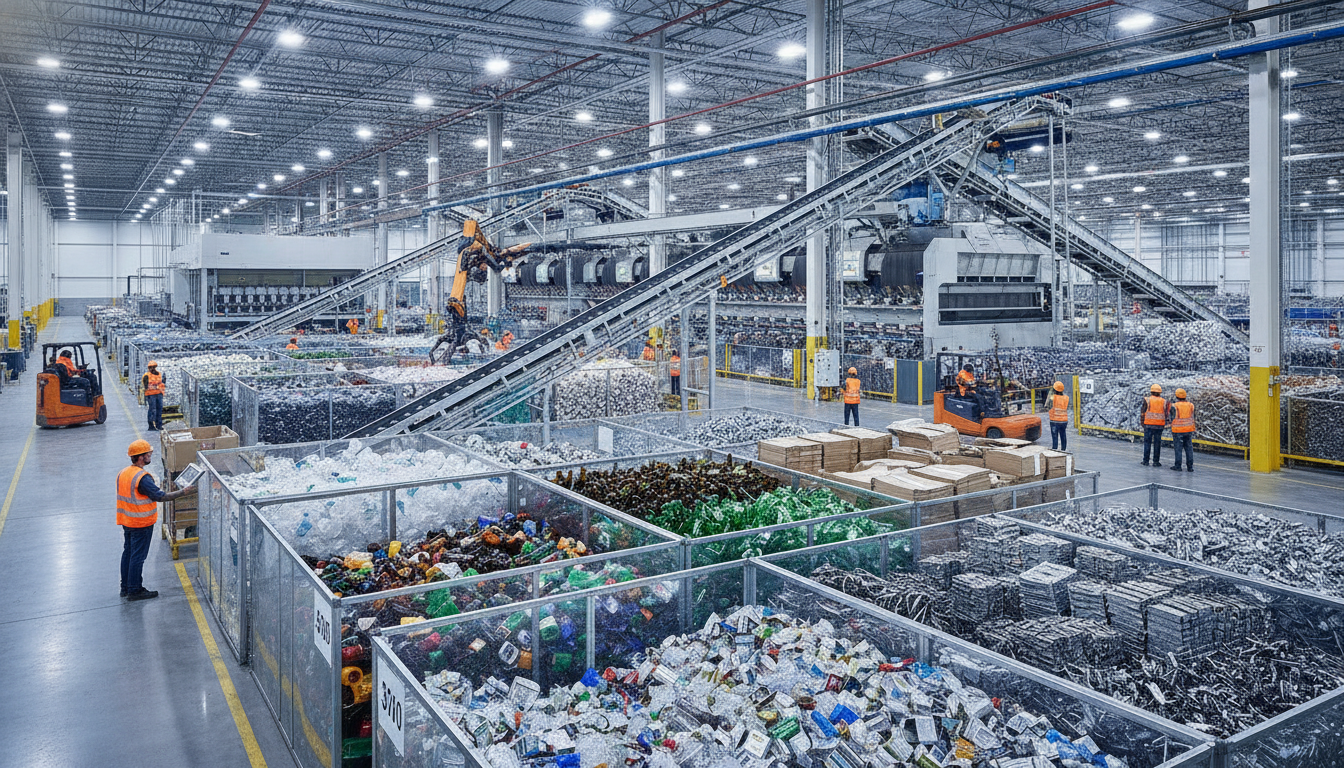
After the truck passes, the material goes to a sorting center — also called a sorting warehouse or recycling facility. This is where the process gains real complexity.
How a sorting center works
- Reception and weighing — The truck unloads the material in a receiving area. The weight is recorded for control and payment to cooperatives.
- Conveyor belt feeding — Workers or machines spread the material on conveyor belts.
- Manual sorting — Waste pickers and sorters separate materials by type and quality, also removing rejects that came mixed by mistake (or carelessness).
- Automated separation — In more modern centers, equipment such as magnetic separators (for ferrous metals), Foucault currents (for aluminum), and optical systems with infrared sensors identify and divert materials automatically.
- Pressing and baling — The separated material is compacted into bales to facilitate transport and storage.
- Commercialization — The bales are sold to recycling industries, which will transform them into new raw material.
Work in sorting centers is mostly done by waste picker cooperatives, a group that plays a fundamental role in Brazilian recycling. It is estimated that waste pickers are responsible for a large portion of recyclable material that reaches the industry in the country — an invisible workforce for most consumers.
From sorting to industry: how each material is processed
Each type of material goes through a different industrial process after leaving the sorting center. Understanding this helps explain why some materials are easier (and more profitable) to recycle than others.
Aluminum
Aluminum is the recycling champion in terms of efficiency. Recycling an aluminum can uses about 95% less energy than producing primary aluminum from bauxite ore. The process involves melting the cans in high-temperature furnaces, removing impurities, and shaping the metal into ingots that return for the manufacture of new cans or other products. A recycled can can be back on shelves in about 60 days.
Paper and cardboard
Bales of paper arrive at recycled paper factories, where they are mixed with water in large tanks to form a paste called pulp or secondary cellulose. This pulp goes through cleaning processes (removal of inks, staples, and impurities), refinement, and finally is transformed into new rolls of paper. Paper can be recycled on average 5 to 7 times before its fibers become too short for reuse.
Plastic
Plastic is the most challenging material, precisely because of its variety. Each type (PET, HDPE, PVC, LDPE, PP, PS, and others) requires a different process and cannot be mixed. After sorting by type, the plastic is washed, shredded into flakes or pellets, and melted to be molded again. PET from soft drink bottles, for example, can become textile fiber for clothing and carpets, or new packaging.
Glass
Glass is crushed into fragments called glass cullet or cullet. These fragments are melted in furnaces along with sand, limestone, and soda ash (sodium carbonate) to form new glass. Glass can be recycled infinitely without loss of quality — but must be separated by color (clear, amber, and green) to avoid contaminating the final product.
Why not everything that looks recyclable is accepted
A common mistake is thinking that “anything clean can go in the blue bin.” In practice, sorting centers refuse or discard material for several reasons:
- Contamination by organic waste — a pizza box with grease, for example, can ruin the cardboard
- Composite materials — packaging made of multiple layers of different materials is difficult to separate
- Market with no demand — some types of plastic have low market value and don’t justify processing costs
- Special glasses — mirrors, tempered glass, and TV screens contain compounds that interfere with the melting process
- Size and shape — very small packaging (loose caps, for example) can get lost on conveyor belts and are not processed individually
This explains why the quality of home separation directly impacts system efficiency. The cleaner and better separated the material arrives, the lower the rejection rate at sorting centers.
The cycle closes: recycled product reaches the market
At the end of the industrial process, the recycled material becomes raw material sold to manufacturers. This market has its own dynamics: the price of recycled aluminum, paper, and PET varies according to supply, demand, and even the price of virgin raw materials — which, when cheap, compete with recycled materials.
This is why recycling doesn’t depend only on people’s good will. It is an economic system that needs incentives, regulation, infrastructure, and a functioning buyer market all at the same time.
When you buy a product with recycled content seal — a bottle, a notebook, a recycled polyester shirt — you close this cycle and help sustain the demand that keeps the system turning. Like the great inventions that changed the world, as you can see in How great inventions changed the world, recycling is a human solution to a problem created by humans themselves — and it continues to evolve.
What you can do to make it work better
Recycling is not the exclusive responsibility of government or industry. The behavior of those who discard the material makes a real difference. See what helps in practice:
- Rinse packaging before throwing away — you don’t need to sterilize it, but remove food scraps
- Crush cans and bottles to reduce volume and facilitate transport
- Don’t mix rejects with recyclables — a disposable diaper in a bag of recyclables can contaminate everything
- Dispose of electronics, batteries, and light bulbs at specific points, never in regular garbage
- Check your municipality’s collection guide — rules vary from city to city
- Prefer products with less packaging and single-material packaging (made of one type of material), easier to recycle
Conclusion: a system that only works together
Garbage recycling, seen up close, is a large and interdependent gear. It starts with a simple gesture — separating trash at home — and goes through sorting warehouses, conveyor belts, machines, waste picker cooperatives, industrial furnaces, and raw material markets before it is completed.
No part of this chain works alone. Home separation without efficient collection is useless. Collection without a buyer market is not sustainable. A market without constant supply of quality material cannot scale.
Understanding how the system works is the first step to participate in it more consciously and to demand from authorities and companies the links that are still missing. The blue bin on the curb is not the end — it’s just the beginning of a story worth knowing.