

Look up on a clear day and you’ll face one of humanity’s oldest questions: why does the sky have that characteristic blue color? Children ask this naturally, adults rarely stop to truly answer it — and when they do, they often resort to vague explanations like “because of the atmosphere” or “because of the sea”. Spoiler: it’s not because of the sea.
The true answer involves physics, light, and a phenomenon discovered in the nineteenth century that is still taught in the world’s best universities today. And the good news is that it can be explained in a completely accessible way, without needing a degree in astrophysics. Prepare yourself to never look at the sky the same way again.
The most fascinating thing of all is that the blue color of the sky isn’t “up there” waiting to be seen. It is produced every instant, in real time, by the interaction between the Sun’s light and the air molecules that surround us. It’s a spectacle of physics happening all the time, invisible to those who don’t know the behind-the-scenes.
Sunlight is not just yellow
Before understanding the sky, you need to understand light. The sunlight that reaches us appears white or slightly yellowish, but it is actually composed of all colors of the visible spectrum at the same time — red, orange, yellow, green, blue, indigo and violet. This is what the English physicist Isaac Newton demonstrated in 1666, by passing sunlight through a glass prism and observing that it separated into the colors of the rainbow.
Each color corresponds to a different wavelength:
- Red: long wavelength (~700 nanometers)
- Orange and yellow: medium wavelengths
- Green: intermediate wavelength (~550 nanometers)
- Blue and violet: short wavelengths (~450–420 nanometers)
This difference in wavelength is the central ingredient to explaining the color of the sky.
What is Rayleigh scattering?
When sunlight enters Earth’s atmosphere, it encounters billions of gas molecules, mainly nitrogen (N₂) and oxygen (O₂). These molecules are much smaller than the wavelengths of visible light, and when light hits them, part of that light energy is absorbed and re-emitted in all directions — a process called scattering.
But not all colors scatter equally. British physicist Lord Rayleigh (John William Strutt, 1842–1919) was the one who, in the late nineteenth century, mathematically calculated that the intensity of scattering is inversely proportional to the fourth power of the wavelength. In plain language: the shorter the wavelength, the more the light scatters.
In practice, this means that blue light, having a short wavelength, scatters across all corners of the atmosphere with much greater intensity than red or yellow light. Blue light literally “bounces” in all directions, illuminating the entire sky from any point you look.
This phenomenon became known as Rayleigh scattering, named after its discoverer, who won the Nobel Prize in Physics in 1904 — though for another discovery, that of the argon gas.
But then why isn’t it violet?
Here’s a legitimate question many people have: if violet has an even shorter wavelength than blue, it should scatter even more. Shouldn’t the sky be violet?
The answer involves two combined factors:
- Sunlight emits less violet: The spectrum of sunlight is not uniform. The Sun emits proportionally less energy at violet frequencies than at blue frequencies, so there’s less violet to scatter in the first place.
- Our eyes are less sensitive to violet: The human eye has specialized cells called cones, responsible for color vision. We have three types of cones, sensitive to red, green and blue. Our sensitivity to violet is significantly lower than to blue. Even if there is scattered violet in the sky, our brain “weighs” that color less in the final perception.
The result is that the combination of abundantly scattered blue with a touch of violet that our eyes partially capture results in that characteristic blue — sometimes deeper, sometimes lighter, depending on atmospheric conditions.
Why is the sunset orange and red?
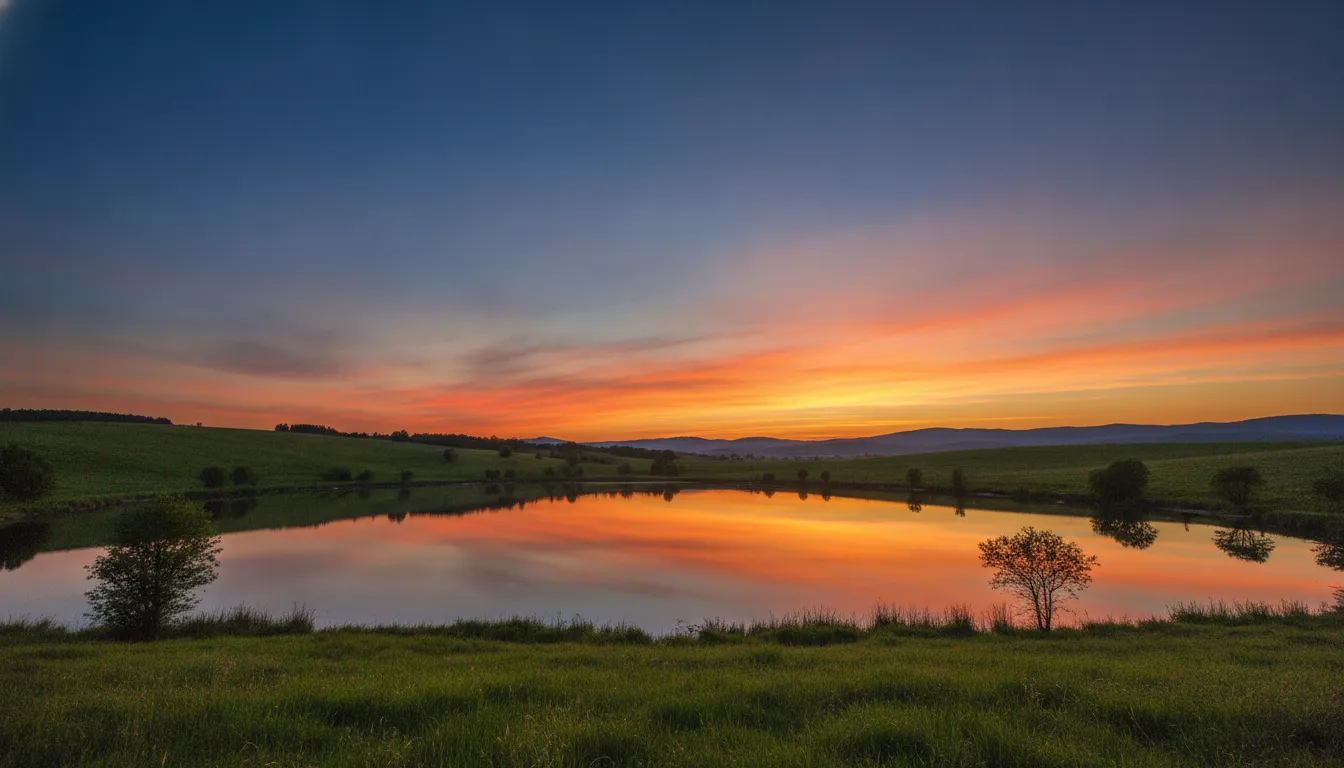
If you understood Rayleigh scattering, the sunset will make perfect sense. When the Sun is low on the horizon — at sunrise or sunset — its light travels a much longer path through the atmosphere to reach your eyes than when it’s high in the sky.
Along this extended path, blue light is scattered in so many directions that it practically “gets lost” before reaching you. What’s left are the long-wavelength colors: orange, yellow and red, which scatter little and manage to cross all that thickness of atmosphere relatively intact.
That’s why the sky near the horizon is tinted with warm tones at sunset and sunrise. It’s not magic — it’s subtractive physics: the blue was scattered along the way, and only the red made it to the end.
The sky on other planets
A curious way to confirm that the sky’s color depends on atmospheric composition is to look at other planets. On Mars, the atmosphere is much thinner and composed mainly of carbon dioxide (CO₂), with suspended iron oxide dust particles. The result? The Martian sky is brownish or reddish during the day, with pinkish and bluish tones near the horizon at sunset — exactly the opposite of what we see on Earth.
On Neptune and Uranus, the atmospheres are rich in methane, which absorbs red light and reflects blue-green, giving the planets that characteristic color. In these cases, it’s not Rayleigh scattering, but selective absorption — another optical mechanism.
These examples make it clear: the color of the sky is a property of the atmosphere, not an absolute characteristic of space. In the vacuum of space, without an atmosphere, the sky is black even with the Sun nearby.
Why is the sky lighter near the horizon?
Even on a perfectly blue day, the sky directly above your head — the so-called zenith — appears more intensely blue, while the sky near the horizon appears lighter, almost white. Why?
When you look at the horizon, you’re seeing through a much larger layer of atmosphere than when you look up. In that thick layer, light has gone through so many scattering processes (from all colors) that they mix and the result looks more white or grayish. At the zenith, you look through a smaller and cleaner layer of atmosphere, where blue dominates more clearly.
This effect is amplified on days of high humidity or pollution, when larger particles (water droplets, dust, smoke) come into play. Large particles scatter all colors equally, in a different process called Mie scattering, leaving the sky with a white, gray or milky appearance.
Practical curiosities about the sky’s blue
- The blue sky is the reason photographers prefer certain times: The “golden hour” (shortly after sunrise and before sunset) and the “blue hour” (shortly before sunrise and after sunset) have completely distinct light qualities, all explained by Rayleigh scattering.
- Sea water is also blue, but for a different reason: The ocean absorbs longer wavelengths (red) and reflects blue. It’s a coincidence of colors, not a cause. Blue sea and blue sky have different physical origins.
- Cigarette smoke seen against a dark background appears bluish: Smoke contains very fine particles that, like air molecules, scatter more blue light — a visible-scale Rayleigh scattering.
- Animals perceive the sky differently: Bees see in ultraviolet and can see patterns in the sky invisible to us.
If you like visual natural phenomena like this, you’ll love knowing that Brazil’s most beautiful beaches are an open-air laboratory for observing variations in light, color and reflection throughout the day.
Conclusion: an everyday miracle with a physicist’s name
The blue of the sky is not an accident, an illusion, or a cultural convention. It is the direct and mathematically predictable result of how short-wavelength light interacts with the tiny molecules that make up the air we breathe. Lord Rayleigh put equations to this in the nineteenth century, and since then physics hasn’t changed the answer.
What can change is our way of looking. Knowing that every time you look up at the sky you’re witnessing billions of collisions between photons and molecules, all conspiring to paint the firmament blue, is one of the most beautiful things science can offer: transforming the ordinary into the extraordinary without taking anything away from its beauty.
The next time someone asks “why is the sky blue?”, you have the answer — and it’s much better than “because of the atmosphere”.