
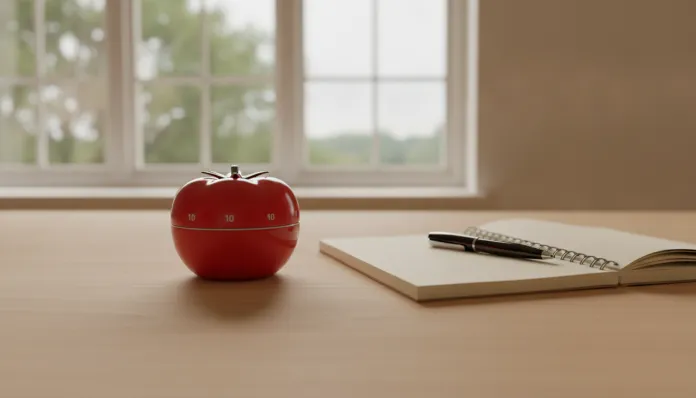
Pomodoro Technique: What It Is and How to Use It in Your Day
Have you ever found yourself staring at an important task and simply unable to start? Or worse, spent hours in front of your computer feeling like you haven’t made any progress? This is one of the most common problems of modern life — and one of the most popular solutions to tackle it has an Italian name and was created with a simple tomato-shaped kitchen timer.
The Pomodoro Technique is a time management method developed in the late 1980s by Italian university student Francesco Cirillo. The name comes directly from the kitchen timer he used at the time, shaped like a tomato — pomodoro, in Italian. The concept is simple: work with total focus in short blocks of time, interspersed with regular breaks. But the effectiveness behind this simplicity is what has made the method one of the most adopted worldwide for improving productivity.
Whether you’re studying for an exam, hitting work targets, or even organizing household tasks, Pomodoro can be adapted to practically any routine. In this article, you’ll understand where the technique came from, how it works in practice, and how to incorporate it into your daily life in a realistic and efficient way.
The Origin of the Pomodoro Technique
Francesco Cirillo developed the method while a student at LUISS University in Rome. Frustrated by his own difficulty concentrating, he decided to test a simple experiment: commit to studying for just 10 minutes uninterrupted, using a timer to create a sense of urgency and clear boundaries.
The timer he had on hand was one of those tomato-shaped kitchen clocks. The experience worked well enough for him to continue refining the method over the following years. In 1992, Cirillo formalized the technique in a document that would later become a book — “The Pomodoro Technique” — published more widely in the 2000s and also available in Portuguese.
The method gained popularity especially with the rise of digital work and, more recently, with the expansion of home office. In a scenario where distractions are just a click away, having a clear time structure became increasingly valuable.
How the Method Works in Theory
The central principle of the Pomodoro Technique is dividing work time into 25-minute blocks, called “pomodoros,” separated by short breaks. The logic is that short, defined periods of focus are easier to maintain than long, uninterrupted hours — and that breaks help the brain process and recover energy.
The basic structure is:
- 1 pomodoro = 25 minutes of focused work
- After each pomodoro: short break of 5 minutes
- After every 4 pomodoros completed: long break of 15 to 30 minutes
During the pomodoro, the goal is total dedication to a single task. Any interruption — a message, a random thought, an urge to check your phone — should be noted and saved for later. After the long break, the cycle starts again.
This structure creates what Cirillo calls “artificial urgency”: knowing the timer will go off soon encourages the brain to stay on task, rather than procrastinate.
Step by Step: How to Apply Pomodoro Today
You don’t need any sophisticated app to get started. A phone with a timer is enough. See how to apply the method from scratch:
- Choose a specific task — Before starting, define exactly what you’ll do during that pomodoro. The more specific the task, the better. Instead of “study English,” prefer “review vocabulary from chapter 3.”
- Set the timer for 25 minutes — Use your phone’s timer, a physical clock, or an app. The sound of the timer at the end is part of the ritual and helps create a sense of completion.
- Work with total focus — For the 25 minutes, dedicate yourself only to the chosen task. If an idea or interruption comes up, write it down and return to the task.
- Take your 5-minute break — Stand up, drink water, breathe. Avoid using this time for social media, as it can make returning to focus more difficult.
- Record the completed pomodoro — Use a list, a notebook, or an app to mark it. This visual record is motivating and helps track your productivity.
- Repeat the cycle — After 4 pomodoros, take a longer break (15 to 30 minutes) before starting again.
- Review at the end of the day — See how many pomodoros you completed and what was accomplished. This helps you plan better for the following days.
Tools for Using the Technique
Although a regular timer works fine, there are apps developed specifically for the Pomodoro method that make the process easier, especially for those who work on computers:
- Forest — Gamifies the process: you “plant a tree” that grows during focus and withers if you leave the app. Available for Android and iOS.
- Pomofocus — Free browser-based tool, no registration needed. Simple and effective.
- Toggl Track — Designed for those who also want to record time spent by project or client.
- Focus To-Do — Combines a to-do list with the Pomodoro timer in one place.
- Be Focused (iOS/macOS) — Popular among Apple users, with integrated productivity reports.
None of these tools are essential. If you prefer the analog approach, a kitchen timer and a notebook do exactly the same job — and without the distractions of a screen.
Adaptations: Pomodoro Doesn’t Have to Be Rigid
One of the most common criticisms of the technique is that 25 minutes can feel too short for certain tasks requiring deep immersion — like writing a complex report, programming, or entering a creative flow state. The good news is that Cirillo himself has always maintained that the method is a starting point, not an absolute rule.
Many people adapt the intervals with good results:
- Extended pomodoro: 50 minutes of focus + 10 minutes of break, popular among programmers and writers.
- Reduced pomodoro: 15 minutes of focus + 5 of break, recommended for less demanding tasks or for beginners.
- Flexible pomodoro: no rigid timer, but with the commitment not to interrupt the block until completing a section of the task.
The essential thing is to preserve the two pillars of the method: defined periods of focus and regular and intentional breaks. The number of minutes is secondary.
If you’re trying to build new study or work habits, it may be helpful to combine Pomodoro with other organizational strategies — such as the GTD method (Getting Things Done) or prioritized task lists. For those setting up a more structured productivity routine, including for a personal project, a good starting point is thinking about how to organize a business with little money, where time management is usually one of the first challenges.
Who Benefits Most from This Technique?
The Pomodoro Technique isn’t a universal solution, but it fits well with quite varied profiles and situations:
- Students who need to maintain focus during long review sessions and avoid procrastination before exams.
- Remote professionals who work from home and face excessive stimuli and lack of structure.
- Freelancers who need to control time spent on different clients or projects.
- People who struggle to start tasks — the commitment of just 25 minutes reduces initial resistance.
- Those prone to multitasking — the method forces you to choose one task at a time, which, according to behavioral and cognitive studies, tends to result in higher quality work.
On the other hand, professions that require constant availability or attention to multiple demands simultaneously — such as real-time customer service or surgery — don’t fit well within the method’s isolation structure. In these cases, adaptations or complementary techniques make more sense.
Pomodoro and Mental Health: Worth Considering
From the perspective of mental health and well-being, Pomodoro’s structure can bring benefits beyond productivity. Regular breaks help reduce mental fatigue accumulated throughout the day, and the sense of progress — seeing pomodoros crossed off the list — contributes to motivation and a sense of accomplishment.
Research in cognitive psychology suggests that intentional rest between work periods supports memory consolidation and decision-making. This is especially relevant for those who study or need to learn new content.
> Important: if you experience chronic difficulty concentrating, significant anxiety about tasks, or symptoms that significantly impact your routine, these issues deserve evaluation by a healthcare professional. Productivity techniques are support tools, not substitutes for specialized care.
In fact, those seeking ways to learn and stay curious can also benefit from quality audiovisual content — as explored in the article about documentaries for learning, which shows how the format can be a powerful ally of continuous learning.
Conclusion

The Pomodoro Technique has existed for decades and remains relevant for one simple reason: it respects how the human brain actually works. Instead of demanding uninterrupted hours of focus — something most people can’t sustain — it proposes short cycles, planned breaks, and a clear commitment to one task at a time.
Getting started is easier than it seems. You don’t need any app, any course, or any elaborate preparation. A timer, a task list, and the willingness to try for 25 minutes are already enough to take the first step.
If it works for you, great — deepen it, adapt it, and make the method your own. If it doesn’t work right away, try adjusting the intervals or combining it with other techniques. The most important thing is to get out of paralysis and start — and sometimes, a simple tomato-shaped timer is all that’s missing for that to happen.


