
World Cup: Curious Facts That Few People Know
The Football World Cup is the biggest sporting event on the planet. Every four years, billions of people around the globe stop everything to follow the competition for the most coveted trophy in the world’s most popular sport. But behind the historic thrashings, the heroes and villains who marked generations, there exists a gallery of curiosities, coincidences and surprising stories that most fans have simply never heard of.
Did you know that the first World Cup was held at a time when European players needed to cross the Atlantic by ship to reach the competition? Or that an original trophy was buried to escape thieves during World War II? The tournament that moves crowds also holds secrets that go far beyond the pitch. From the unlikely origin of the tournament to records that seem impossible, the World Cup is a chest overflowing with stories that deserve to be told.
In the following lines, you’ll dive into this parallel universe that exists in the shadows of the spotlight. Prepare to see the world’s most famous tournament through different eyes.
The Birth of the World Cup: An Almost Rejected Idea
The first edition of the World Cup took place in 1930, in Uruguay. But few know that the idea almost never got off the ground. Jules Rimet, FIFA president at the time and one of the main creators of the tournament, faced considerable resistance from European federations, who didn’t want to fund the long transatlantic journey.
The result was that only four European teams participated in that first edition: France, Belgium, Yugoslavia and Romania. Most European clubs refused to release their players, and some countries simply didn’t show up. The Europeans who went to Uruguay, by the way, traveled together on the same ship, crossing the Atlantic in about two weeks.
Uruguay was chosen as host for a combination of factors: it was the Olympic football champion (having won the 1924 and 1928 editions) and committed to covering the costs of all participating teams, in addition to building a new stadium from scratch — the legendary Estadio Centenario, hastily inaugurated during the tournament itself. Uruguay also won that edition, defeating Argentina 4-2 in the final.
The Story of the Trophy and Hidden Gold
The original World Cup trophy, named the Jules Rimet Cup in honor of its creator, has a trajectory worthy of a movie script. Created by French sculptor Abel Lafleur and made of gold-plated silver, the trophy represented the Greek goddess of victory, Nike.
During World War II (1939–1945), with Europe in flames, FIFA vice-president Ottorino Barassi made a drastic decision to protect the object: he hid the cup in a shoebox under his bed in Rome, so it wouldn’t be confiscated by the Nazis. The strategy worked, and the trophy survived the conflict.
Decades later, in 1966, when the World Cup was held in England, the trophy was stolen while on public display in London. The object was found days later, wrapped in newspaper, by a dog named Pickles, during a walk in the Beulah Hill neighborhood. The dog instantly became a national celebrity.
The story doesn’t end there. After Brazil won the triple championship in 1970 and earned the right to keep the trophy permanently, it was stolen again in Rio de Janeiro in 1983 — this time, it was never recovered. It’s believed to have been melted down. The current trophy, of completely different design, was created in 1974 and is made of solid 18-karat gold.
Records That Seem Impossible
The World Cup is fertile ground for numbers that defy logic. Some of them are so impressive they seem like fiction:
- The highest score in history of a World Cup was Hungary 10 x 1 El Salvador, in 1982, in Spain.
- The fastest goal of the tournament was scored by Turkey’s Hakan Şükür, in just 11 seconds after kickoff, in the third-place match between Turkey and South Korea in 2002.
- Miroslav Klose of Germany is the all-time top scorer in World Cup history, with 16 goals scored across four editions (2002, 2006, 2010 and 2014).
- Brazil is the only national team to have participated in every edition of the tournament, without exception — from 1930 to the present day.
- The biggest thrashing in a World Cup match was recorded in a qualifying phase (not in the final tournament): Australia 31 x 0 American Samoa, in 2001, although this record belongs to the qualifiers, not the tournament itself.
If you want to know more about the history of the sport that makes all this possible, check out The history of football: how it all began.
Countries That Exist on the Field, But Not on Today’s Map
Football records the passage of time in curious ways. Some national teams that graced newspaper pages during World Cups simply no longer exist as countries:
- Czechoslovakia competed in two finals (1934 and 1962) before splitting into the Czech Republic and Slovakia in 1993.
- Yugoslavia reached two semifinals (1930 and 1962) before fragmenting into multiple nations during the 1990s.
- The Soviet Union participated in eight editions and still holds the record for its biggest win — 9-0 over Yugoslavia in 1952 (at the Olympics) — before dissolving in 1991.
- West Germany won three World Cup titles (1954, 1974 and 1990) as a separate country, before German reunification.
Every time a fan searches for these names in historical rankings, they encounter entities that existed only in a specific period of history.
Behind-the-Scenes Curiosities: Facts Nobody Tells
Beyond the pitches, the World Cup is also a stage for unusual stories that rarely appear in the news:
- The official ball changes each edition. Each World Cup has a ball developed specifically for that tournament. The famous Jabulani, used in South Africa in 2010, was the target of widespread criticism from goalkeepers and players, who complained about its unpredictable trajectory.
- Referees also have history. Mexican Rogelio Ahumada was the only referee to officiate at the first World Cup in 1930, during one of the group stage matches.
- The most famous own goal in World Cup history was scored by Colombian Andrés Escobar in 1994 — a tragedy that, unfortunately, had brutal consequences off the pitch.
- Tiny countries also participate in the qualifiers. San Marino, with fewer than 35,000 inhabitants, regularly competes in European qualifying phases, although it has yet to qualify for the main tournament.
- Does the crowd influence the result? The 1930 World Cup was the only one held without the need for qualifiers — all participants were directly invited by FIFA.
Brazil and the World Cup: Beyond Five Championships
Brazil is, by far, the biggest winner of the World Cup, with five titles: 1958, 1962, 1970, 1994 and 2002. But the country’s relationship with the tournament goes far beyond the trophies:
- Brazil is the only country to have hosted the World Cup twice: in 1950 and in 2014.
- The 2-1 defeat to Uruguay in the 1950 final, at the Maracanã packed with over 170,000 people, became known as the “Maracanazo” and is still considered one of the greatest sporting tragedies in Brazilian history.
- Pelé is the only player to have won three World Cup titles (1958, 1962 and 1970). He scored his first World Cup goal at just 17 years old, in the 1958 edition in Sweden, becoming the youngest scorer in a final in tournament history.
- The 7-1 thrashing suffered by Brazil against Germany in the semifinal of the 2014 World Cup in Belo Horizonte became known as the “Mineirazo” and still provokes passionate debates among fans and analysts worldwide.
To learn more about other surprising facts related to the country, check out the article Brazil surprises: facts that most don’t know.
Quick Facts to Impress Your Friends
Want to be the most curious person in the group during the next match? Keep this list handy:
- The 2026 World Cup will be the first in history with 48 teams in the final tournament, expanding from the previous format of 32 teams.
- The 2026 tournament will be held in three countries simultaneously: United States, Canada and Mexico — the first time three nations will co-host a World Cup.
- The word “goleiro” doesn’t have a direct and immediate translation in English — “goalkeeper” is used, or “goalie” in informal language.
- The current trophy weighs 6.175 kilograms and is 36.8 centimeters tall.
- Only eight countries have won the world title: Brazil, Germany, Italy, Argentina, France, Uruguay, England and Spain.
- The 1942 and 1946 World Cups were canceled because of World War II.
Conclusion
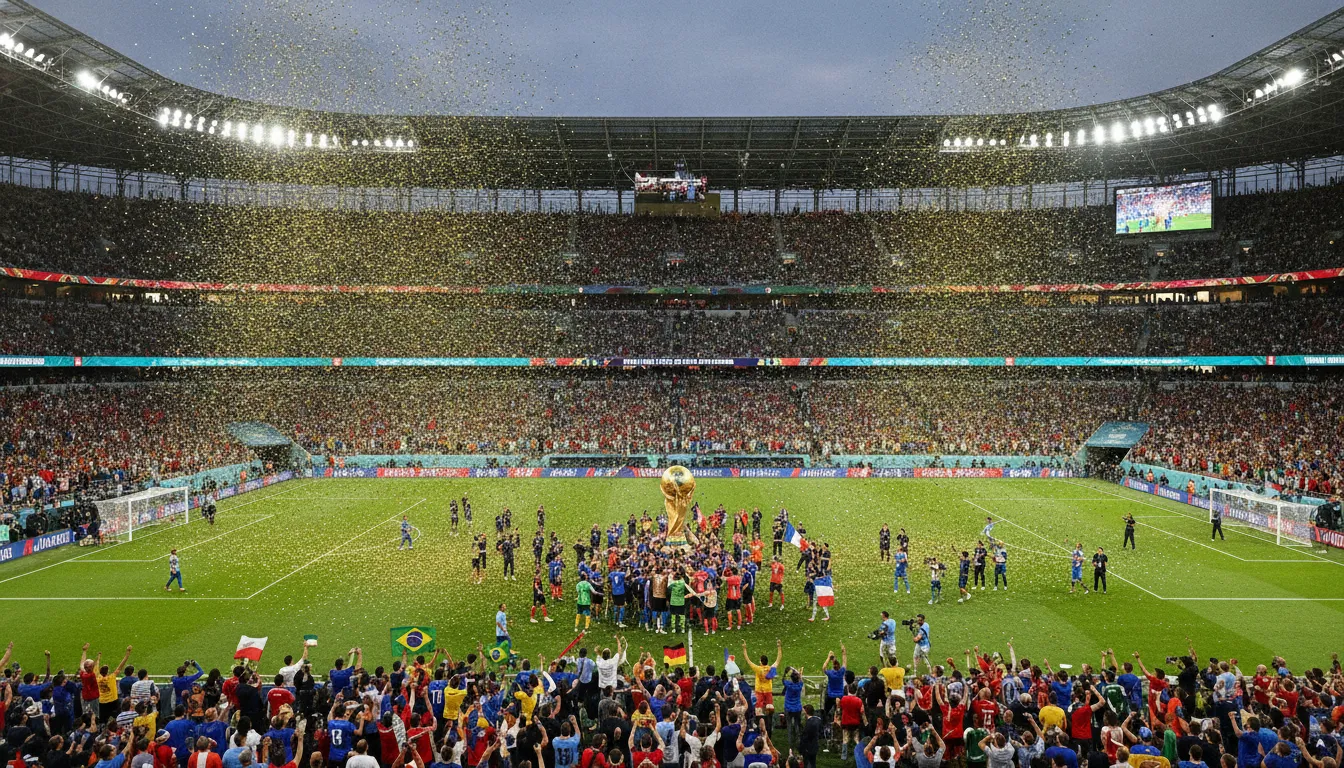
The World Cup is much more than ninety minutes of ball rolling. It’s a living archive of human history, filled with unlikely characters, epic twists and curiosities that challenge any screenwriter. From the dog that found the stolen trophy to the fastest goal in history, passing through national teams from countries that no longer exist, each edition of the tournament adds new chapters to this encyclopedia that never stops growing.
In 2026, with the largest number of teams in history participating in the tournament and the novelty of three countries sharing the host duties, new curious facts will certainly be written. And when in a few years someone asks “did you know that…”, it might just be about something that happened in that edition.
The World Cup, after all, is just that: a machine for producing stories that no one forgets — and creating curiosities that few know, but everyone should.