
Brazil is a country of continental proportions, with over 200 million inhabitants, eight distinct biomes, and a history spanning centuries. Yet, much of what makes the country truly extraordinary remains unknown—not to foreigners, but to Brazilians themselves. These are silent world records, surprising geographical facts, and historical curiosities that rarely appear in textbooks.
How many know, for example, that Brazil hosts the largest tropical forest on the planet and, at the same time, has one of the largest savannas in the world? Or that the federal capital was built in record time, becoming a World Heritage site just a few decades later? The country holds secrets that impress even those born here. In this article, we gather some of the most fascinating—and verifiable—facts about Brazil that most Brazilians simply never stopped to learn.
The Country That Fits Several Countries Within Itself
Brazil is the fifth largest country in the world by land area, with approximately 8.5 million square kilometers. To truly grasp this size: the entire continent of Europe could fit within Brazil’s territory with some room to spare. Brazil is larger than the contiguous 48 states of the United States (excluding Alaska and Hawaii).
But what few realize is the practical consequence of this vastness: the country has four official time zones, meaning that while residents of Manaus are having lunch, those in Acre are still having breakfast. The Fernando de Noronha archipelago even has its own time zone, with a 30-minute difference from Brasília time.
Moreover, Brazil borders ten of the twelve countries in South America—only Chile and Ecuador do not share a boundary with Brazilian territory. This places the country in a unique strategic position on the continent, both geopolitically and culturally.
The Amazon Is Bigger Than You Imagine
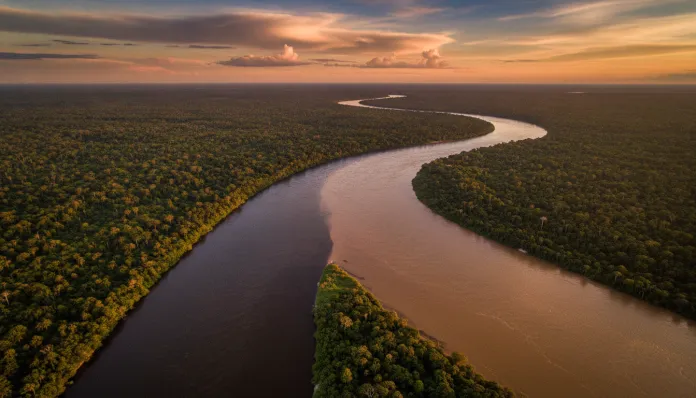
When talking about the Amazon, most think of a large forest. But the actual numbers surpass any imagination. The Amazon Rainforest covers about 5.5 million square kilometers, spread across nine countries. The Brazilian portion represents about 60% of this total.
The Amazon River, which cuts through this forest, carries alone about 20% of all the freshwater that the world’s rivers pour into the oceans. At certain times of the year, its mouth releases so much water into the Atlantic that freshwater can be found more than 100 kilometers from the coast.
The biodiversity is also record-breaking: it is estimated that the Brazilian Amazon houses more than 10% of all known species on the planet. New species are regularly described by science, meaning that part of Brazil’s biodiversity is still literally unknown even to scientists themselves.
Brasília: A City Built from Scratch in Record Time
The federal capital of Brazil did not exist before 1960. Brasília was built in a practically uninhabited savanna in the country’s center and inaugurated on April 21, 1960, after just three years and ten months of construction—a feat of engineering and logistics considered extraordinary for any era.
The urban design by Lúcio Costa and the monumental architecture by Oscar Niemeyer drew so much international attention that, in 1987, Brasília was declared a World Heritage Site by UNESCO—becoming the youngest city in the world to receive this title at the time.
What surprises many is that the city’s pilot plan is shaped like an airplane (or a bird, depending on interpretation), something visible only in aerial images or maps. It is one of the few capitals in the world entirely planned before its inhabitants existed.
Brazil Has the Largest Japanese Population Outside Japan
The city of São Paulo hosts the largest Japanese community outside Japan, with estimates pointing to more than 1.5 million Japanese descendants living in Brazil. The Liberdade neighborhood in São Paulo is historically associated with this community and blends elements of Japanese culture with the identity of São Paulo.
This immigration officially began in 1908, when the ship Kasato Maru brought the first Japanese immigrants to work on coffee plantations in the interior of São Paulo. Throughout the 20th century, this community grew, diversified, and contributed decisively to Brazilian agriculture, medicine, arts, and cuisine.
Curiously, Brazil also has the largest population of Lebanese descendants outside Lebanon—it is estimated that between 7 and 10 million Brazilians have Lebanese ancestry, a number that surpasses Lebanon’s own population.
Historical Facts Rarely Told in Basic Education
Brazil’s history is rich in episodes little known to the general public:
- Brazil was the seat of the Portuguese court: between 1808 and 1821, the Portuguese royal family, fleeing Napoleon, settled in Rio de Janeiro. It was the only time in modern history that a colonial metropolis was governed from its colony.
- Rio de Janeiro was the capital of the Empire and later the Republic for almost 200 years, from 1763 until Brasília’s inauguration in 1960.
- Brazil was the last country in the Americas to abolish slavery, with the signing of the Lei Áurea on May 13, 1888—23 years after the United States and more than half a century after the United Kingdom.
- The Proclamation of the Republic in 1889 was described by Marshal Deodoro da Fonseca himself as something that happened without careful planning. Witnesses of the time reported that many residents of Rio de Janeiro thought it was just another cabinet change.
- Brazil is the only Portuguese-speaking country in the Americas, a result of the Treaty of Tordesillas in 1494, which divided the “to be discovered” lands between Portugal and Spain.
Brazilian Records That the World Knows Better Than We Do
Brazil holds world records that many of its citizens are unaware of:
- It is the largest producer and exporter of coffee in the world for over 150 consecutive years—no other country has come close to breaking this streak.
- It has the largest reserve of surface freshwater on the planet, considering rivers, lakes, and aquifers like the Guarani, which extends across four South American countries.
- The Guarani Aquifer is one of the largest underground freshwater reservoirs in the world, with an estimated area of 1.2 million square kilometers under the soil of Brazil, Argentina, Paraguay, and Uruguay.
- Brazil holds the record for five FIFA World Cup titles in men’s soccer, being the only country to have participated in all editions of the World Cup.
- It is the second-largest soybean producer in the world, a position that alternates with the United States depending on the agricultural year.
The Cultural Richness Beyond Carnival
Brazil is often reduced, in the global imagination, to carnival, soccer, and beaches. But the country’s cultural diversity goes far beyond:
- Brazil officially recognizes over 270 indigenous languages, in addition to Portuguese. Some of these languages are spoken by only a few hundred people, making them linguistic heritages at risk of disappearing.
- Capoeira, created by enslaved Africans in Brazil, was inscribed by UNESCO on the Intangible Cultural Heritage of Humanity List in 2014.
- Frevo, bumba meu boi, and the Círio de Nazaré are other Brazilian cultural expressions internationally recognized by UNESCO.
- Brazil has the largest diversity of orchids in the world, with more than 3,500 cataloged species—a reflection of botanical richness that far exceeds the Amazon rainforest.
For those who want to discover Brazil beyond the famous destinations, it’s worth exploring off-the-beaten-path Brazilian destinations to explore, where the country’s geographical and cultural diversity is shown in its most authentic form.
Some of the Biggest Curiosities in a Quick List
- Pão de queijo originates from the state of Minas Gerais and is made with cassava starch—a tuber native to South America consumed for millennia.
- The guaraná, a beverage consumed throughout Brazil, comes from a native Amazonian plant (Paullinia cupana) that indigenous peoples used long before Europeans arrived.
- The largest city in the Southern Hemisphere is São Paulo, with over 12 million inhabitants in the municipality and about 22 million in the metropolitan area.
- Brazil has over 7,400 km of coastline—one of the largest in the world—with beaches ranging from the humid tropical environment of the North to the cold and windy beaches of the South.
- The Pantanal is the largest continuous wetland area on the planet, covering parts of Brazil, Bolivia, and Paraguay, and hosts one of the largest concentrations of wildlife in the Western Hemisphere.
Conclusion
Truly knowing Brazil is an exercise that few undertake—and it always surprises. A country that hosts the largest tropical forest, the largest Japanese community outside Japan, the youngest capital to be a World Heritage site, and records that the entire world knows better than we do deserves to be explored with genuine curiosity.
Each region holds stories, landscapes, and cultures that do not appear in conventional tourist itineraries. And the first step to discovering this unknown Brazil begins right here: with the awareness that there is much more behind what we already know. As someone very wise once said, the greatest country in the world for a Brazilian is yet to be discovered by the Brazilian themselves.
- The guaraná, a beverage consumed throughout Brazil, comes from a native Amazonian plant (Paullinia cupana) that indigenous peoples used long before Europeans arrived.
- Capoeira, created by enslaved Africans in Brazil, was inscribed by UNESCO on the Intangible Cultural Heritage of Humanity List in 2014.
- It has the largest reserve of surface freshwater on the planet, considering rivers, lakes, and aquifers like the Guarani, which extends across four South American countries.
- It is the largest producer and exporter of coffee in the world for over 150 consecutive years—no other country has come close to breaking this streak.
- Brazil is the only Portuguese-speaking country in the Americas, a result of the Treaty of Tordesillas in 1494, which divided the “to be discovered” lands between Portugal and Spain.
- The Proclamation of the Republic in 1889 was described by Marshal Deodoro da Fonseca himself as something that happened without careful planning. Witnesses of the time reported that many residents of Rio de Janeiro thought it was just another cabinet change.
- Brazil was the last country in the Americas to abolish slavery, with the signing of the Lei Áurea on May 13, 1888—23 years after the United States and more than half a century after the United Kingdom.
- Rio de Janeiro was the capital of the Empire and later the Republic for almost 200 years, from 1763 until Brasília’s inauguration in 1960.