
The Roots of Carnival: Where Does This Celebration Come From? n
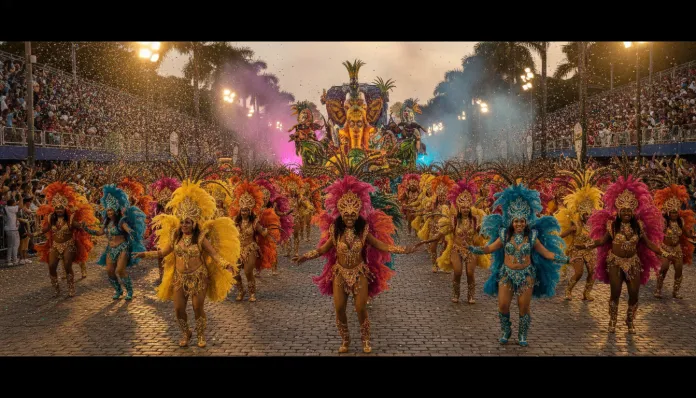
Carnival is undoubtedly the biggest popular festival in Brazil. For four days — and often much longer, depending on the city — the entire country stops to dance, sing, and celebrate with energy that impresses the whole world. But few people truly know the story behind it all: how a European festival with even older roots transformed into this explosion of color, rhythm, and identity that Brazil exports to the world.n
The trajectory of Brazilian Carnival is one of the richest stories in our culture. It travels through Portugal and Africa, the elegant halls of imperial Rio de Janeiro, the muddy streets where the common folk improvised their own party, until reaching the modern sambadromes and street blocks that have taken over the big cities. Understanding this history is to understand a little more about who we are as a people.n
Get ready for a journey through time — and rhythm.n
From Entrudo to Carnival: The Arrival of the Festival in Braziln
The festival we know today as Carnival arrived in Brazil through Portuguese colonizers in the 17th century, under the name Entrudo. Entrudo was an Iberian popular celebration marking the period before Lent — the days of abstinence preceding Easter in the Christian calendar. The word “carnival” itself has uncertain origins, but the most accepted theory among historians is that it comes from the Latin carnem levare or carne vale, expressions meaning something like “farewell to meat” — a reference to the upcoming fast.n
The Entrudo practiced in colonial Brazil was a rather violent celebration by today’s standards. It mainly consisted of throwing water, flour, rotten eggs, and even mud at neighbors. There was no class distinction in the streets: rich and poor, white and black mingled in this collective chaos. Colonial authorities tried to ban the game several times over the centuries, without much success.n
It was only from the 19th century that Entrudo began to be gradually replaced by a more “civilized” version of the festival, inspired by European masquerade balls — especially the famous carnivals of Venice and Nice.n
The Elegant Carnival of the Empiren
With the arrival of the Portuguese royal family in Rio de Janeiro in 1808 and the subsequent cultural opening of the country, Brazilian elites began organizing masquerade balls in the European style. In 1840, the Jornal do Commercio reported what many researchers consider the first indoor carnival ball in Brazil, held at the Hotel Italia in Rio de Janeiro.n
From then on, carnival societies began to emerge. Organized groups of revelers created allegories, elaborate costumes, and parades with decorated floats — directly influenced by the European corso model. The first major Rio societies, such as the Tenentes do Diabo, Democráticos, and Fenianos, founded in the second half of the 19th century, were pioneers in this format and attracted crowds to the streets of Rio.n
This elite carnival coexisted tensely with the popular street carnival, which never ceased to exist. And it was exactly from this tension — and this mix — that something completely new would be born.n
Samba Takes the Stagen
The most transformative chapter in the history of Brazilian Carnival begins in the early decades of the 20th century, with the rise of samba. The rhythm has deep roots in the African culture brought by enslaved people, especially in the Bantu traditions from regions now corresponding to Angola and Congo. In Rio de Janeiro, samba took shape in the black communities of the hills and poor neighborhoods of the city.n
In 1917, the samba “Pelo Telefone”, recorded by Donga and Mauro de Almeida, is considered the first recorded samba in history — although the authorship was disputed at the time, especially by figures like Ernesto dos Santos, known as Donga. The recording symbolically marked the entry of the rhythm into the phonographic market and urban culture.n
A few years later, in 1928, the Deixa Falar was founded in Rio de Janeiro, considered the first samba school in history. The name “school” was not by chance: the association was near a teacher training institute in the Estácio neighborhood, and the founders used the term with pride and irony at the same time. Soon other schools emerged — Mangueira (1928), Portela (1923, although it adopted this name only in 1935), and many others that became cultural institutions in the country.n
The Samba School Parade: From Asphalt to Sambadromen
For decades, samba school parades took place on the main avenues of Rio de Janeiro, without a fixed structure. The competition between schools became more professional over time, with judges, criteria, and trophies. The Special Group, the elite of Rio schools, attracted more and more public and media attention.n
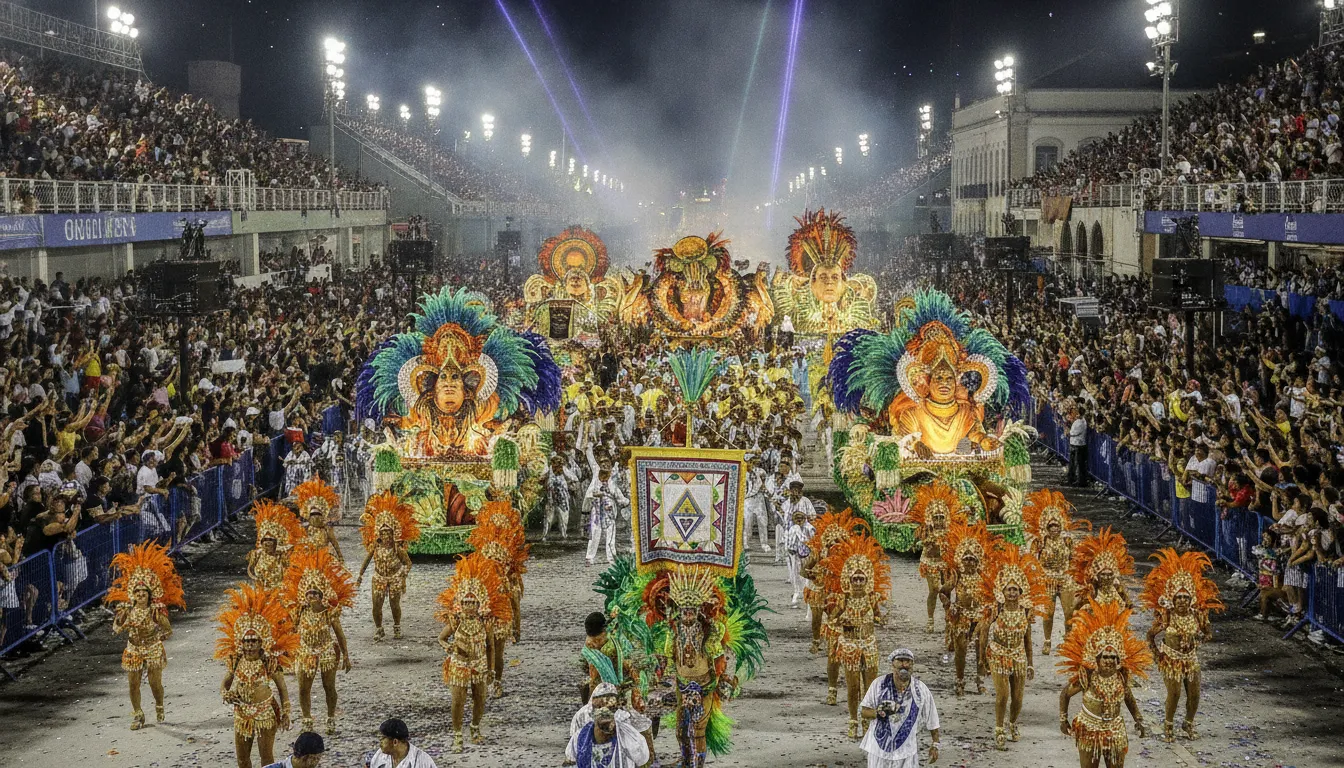
Then came the idea of creating a permanent space for the parades. In 1984, architect Oscar Niemeyer designed and inaugurated the Sambadrome of Marquês de Sapucaí in Rio de Janeiro — a 700-meter-long runway with covered stands and boxes, capable of hosting tens of thousands of people. The work was built in record time and definitively transformed the Rio carnival.n
Today, Rio’s Sambadrome is one of the most famous stages in the world and annually receives millions of Brazilian and foreign tourists — anyone planning a visit can check the guide with the best times to travel through Brazil’s regions to organize the trip in advance.n
The Carnival of Salvador and the Frevo of Pernambuco: Other Equally Rich Traditionsn
It would be a mistake to tell the story of Brazilian Carnival thinking only of Rio de Janeiro. Salvador, in Bahia, hosts one of the most populous and vibrant parties in the world. The Bahian carnival is characterized by trios elétricos — trucks with huge sound systems that lead crowds through the streets. The invention is attributed to Dodô and Osmar, who in 1950 roamed the streets of Salvador playing on an adapted truck. It was the embryo of what would become a revolution in the northeastern carnival.n
Meanwhile, in Recife and Olinda, in Pernambuco, the carnival has a completely different soul. The frevo — a fast-paced rhythm, danced with colorful umbrellas in acrobatic movements — is the greatest symbol of the Pernambucan festival. In 2012, UNESCO recognized frevo as an Intangible Cultural Heritage of Humanity, confirming its global importance. The maracatu and caboclinhos are also part of the rich cultural mosaic of the northeastern carnival.n
The Street Blocks: The Party Returns to the Sidewalksn
In recent decades, one of the most striking trends in Brazilian Carnival has been the explosion of street blocks. Cities like São Paulo, Rio de Janeiro, Belo Horizonte, and Recife have seen an impressive growth in the number of blocks that take to the streets during Carnival, gathering hundreds of thousands of revelers in some cases.n
In Rio de Janeiro, traditional blocks such as the Cordão do Bola Preta (founded in 1918) and the Banda de Ipanema (created in 1965) coexist with more recent blocks that have emerged in the last decades. In São Paulo, the street block movement gained strength especially from the 2000s and transformed the city, which historically had a more distant relationship with the festival, into one of the largest street carnivals in the country.n
Some of the main characteristics of street blocks in Brazil:n
- Free or low-cost participation — unlike the boxes and stands of the sambadromes
- Varied repertoire — ranging from classic samba to marchinha, axé, and even national pop
- Strong community identity — many blocks originate in specific neighborhoods and carry the face of their territory
- Diverse audience — children, the elderly, families, and young people parade together
- Creative costumes — often with political, cultural, or simply nonsensical themesn
Curiosities and Historical Milestones of Brazilian Carnivaln
For those who want to dive even deeper into the history of the festival, it’s worth knowing some lesser-known milestones:n
- The first official competition between samba schools in Rio took place in 1932, won by the Mangueira school
- The marchinha “Ai, Seu Mé” is considered one of the oldest known Brazilian carnival compositions, from the early 20th century
- The Rei Momo — a fat and cheerful character symbolizing the official opening of carnival in various cities — originates from Greek mythology: Momo was the god of mockery and satirical criticism
- The carnival of Florianópolis and other cities in southern Brazil has strong influence from the Azorean communities that colonized the region
- During the Estado Novo period (1937–1945), Getúlio Vargas’s government promoted samba as a symbol of national identity — one of the first cases in the world of state appropriation of a popular culture originally marginalizedn
Conclusion: A Festival That Reinvents Itself Without Losing Its Souln
 nn
nn
The history of Brazilian Carnival is, in essence, the history of Brazil. It is a narrative of encounters — sometimes violent, always intense — between African, European, and indigenous cultures. It is the story of how the people, often marginalized, created something so powerful that it ended up being recognized worldwide as a symbol of a country.n
From colonial Entrudo to illuminated sambadromes, from Salvador’s trios elétricos to Olinda’s frevo-filled streets, Carnival resists and reinvents itself every year. In 2026, the festival completes another cycle — and continues to be, for millions of Brazilians, much more than a celebration. It is identity, memory, and cultural resistance.n
Knowing this history is a way to enjoy Carnival with different eyes. Because when you hear a samba school plot or see a frevo dancer spin their colorful umbrella, you are witnessing centuries of living history.
- The marchinha “Ai, Seu Mé” is considered one of the oldest known Brazilian carnival compositions, from the early 20th century
- Varied repertoire — ranging from classic samba to marchinha, axé, and even national pop