
Amazing Animals and Their Unique Abilities
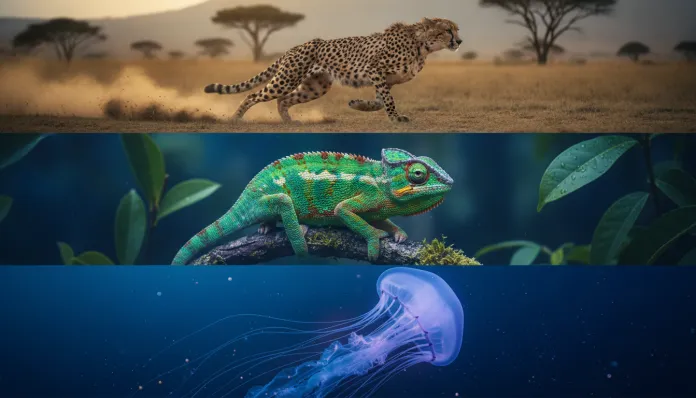
Nature is an open-air laboratory that never ceases to amaze. Across the planet—from ocean depths to African savannas, tropical forests to icy tundras—there are creatures with abilities so extraordinary they defy belief. It’s no exaggeration to say that any science fiction script would struggle to surpass what evolution has created over millions of years.
These adaptations are neither magic nor coincidence; they result from intense environmental pressures that have shaped each species over generations. An animal that can regenerate body parts, another that sees magnetic fields, and a third that survives in the vacuum of space—all exist with solid scientific documentation. Learning about these abilities is both a biology lesson and an invitation to humility in the face of life.
In this article, you’ll discover some of the world’s most fascinating animals and understand, in simple terms, what makes each truly unique. Prepare to see the animal kingdom with completely new eyes.
The Tardigrade: Earth’s Most Resilient Creature
If there’s a champion of survival, it’s the tardigrade—affectionately known as the “water bear.” Less than 1 millimeter long, this tiny aquatic invertebrate is nearly indestructible.
The tardigrade can enter a state called cryptobiosis: it retracts its legs, expels nearly all body water, and becomes a microscopic barrel. In this state, it can withstand:
- Temperatures from -272 °C (near absolute zero) to 150 °C
- Pressures six times greater than those in the ocean’s deepest trenches
- Ionizing radiation doses lethal to any other known multicellular organism
- The vacuum of space—confirmed by experiments conducted by the European Space Agency (ESA)
Discovered in the 18th century by German naturalist Johann August Ephraim Goeze in 1773, tardigrades inhabit nearly all moist environments on Earth: mosses, lichens, soils, beaches, and ocean floors. They remind us that size isn’t everything when it comes to resilience.
The Octopus: Intelligence and Disguise in One Creature
Few animals combine intelligence and physical skill as impressively as the octopus. With a highly developed nervous system—about two-thirds of its neurons are in its tentacles, not its central brain—it can learn, solve problems, and even use tools.
Real-Time Mimicry
An octopus’s camouflage ability goes beyond merely changing color. Its skin contains cells called chromatophores, which expand and contract in milliseconds, and other structures that alter surface texture. The result is perfect mimicry of corals, rocks, and even other species.
The mimic octopus (Thaumoctopus mimicus), found in Indo-Pacific tropical waters, takes it further: it imitates the shape and behavior of dangerous animals like sea lions, jellyfish, and flatfish, depending on the threat faced. It’s a dynamic and contextual defense few other animals can execute.
The Bat: Echolocation, the Biological Sonar
Bats have functional vision, but most species hunt in darkness using a biological technology that took human engineers decades to replicate as sonar: echolocation.
The animal emits ultrasonic pulses—sounds above the human hearing range—and interprets returning echoes to map its environment with surprising precision. This allows a bat to detect a thread just 0.08 millimeters in diameter in complete darkness and catch insects mid-flight.
With over 1,400 recognized bat species, the Chiroptera order is the second largest among mammals, behind only rodents. In Brazil, these animals play a crucial ecological role as pollinators and insect population controllers, making them important allies of agriculture and native ecosystems.
The Elephant: Memory, Empathy, and Infrasonic Communication
The saying “elephant memory” has scientific backing. African and Asian elephants show remarkable ability to recognize individuals—both of their own species and humans—after decades apart. Older matriarchs carry a mental map of territories traversed years ago, guiding the herd in search of water during droughts.
What Few Know: They “Speak” Through the Ground
Besides audible sounds, elephants communicate via infrasound—very low-frequency vibrations, below 20 Hz, inaudible to humans. These vibrations travel through the ground for kilometers and are detected by the animals’ feet and trunks, which act as sensitive receptors.
Researchers have identified that elephants can detect and interpret calls from other groups over distances exceeding 10 kilometers through this seismic channel. It’s a long-distance communication form that science is still mapping in detail.
The Peregrine Falcon: Unmatched Speed in the Animal Kingdom
When it comes to speed, no animal on Earth surpasses the peregrine falcon (Falco peregrinus) in free fall. During its hunting dive—called a stoop—the bird folds its wings and plummets toward prey at speeds reaching 389 km/h, according to documented records.
To endure this speed without harm, the peregrine falcon has remarkable anatomical adaptations:
- Nictitating membranes (a kind of third eyelid) that protect the eyes during the dive
- Nostrils with conical structures that regulate air pressure and prevent wind impact from damaging the lungs
- Vision with acuity up to eight times greater than human vision, capable of spotting a pigeon over 1.5 km away
Widely distributed worldwide, the peregrine falcon is one of the most studied animals in ornithology and has inspired human aerodynamic projects.
The Axolotl Salamander: Near-Perfect Regeneration
The axolotl (Ambystoma mexicanum), an amphibian native to Mexico’s lakes—especially the Xochimilco system in what is now Mexico City—possesses one of the most studied and coveted abilities in medicine: the ability to regenerate complex tissues without scarring.
Unlike mammals, which form scar tissue after injuries, the axolotl can fully regenerate:
- Amputated limbs
- Parts of the heart
- Spinal cord segments
- Brain portions
The process involves forming a structure called a blastema—a mass of cells that “unlearn” their specialization and reorganize to rebuild lost tissue. This phenomenon has been the subject of extensive scientific research, especially in regenerative medicine.
Unfortunately, the axolotl is critically endangered in its natural habitat, according to the International Union for Conservation of Nature (IUCN). The degradation of Xochimilco’s channels and the introduction of invasive species have drastically reduced its wild populations.
The Mantis Shrimp: Vision Beyond Human Reach
The mantis shrimp (Stomatopoda)—despite its common name, neither a shrimp nor a mantis, but a crustacean—has the most complex visual system described in nature. While humans have three types of photoreceptors (cells sensitive to red, green, and blue colors), this animal can have up to 16 different types.
Besides seeing ultraviolet and infrared light, it can detect polarized light—something no human optical technology can do with the same passive efficiency. This gives it a perception of the environment completely different from anything we can imagine.
And it’s not just the vision: its claws can strike at speeds up to 23 meters per second, generating shockwaves in the water that stun or kill prey even without direct contact. Research aquariums often reinforce their tanks with special acrylic to withstand these impacts.
Conclusion: Nature as the Greatest Source of Innovation
The animals presented here are not mere curiosities of nature—they are examples of how evolution, given enough time, solves problems in ways that human ingenuity is still learning to understand. The tardigrade inspires cell preservation research. The axolotl opens doors to regenerative medicine. Bat echolocation laid the groundwork for sonar and medical ultrasound development.
Each species carries millions of years of experimentation and refinement. Therefore, the loss of any of them—as is rapidly happening with the axolotl and many others—represents not only an ecological tragedy but the erasure of solutions we haven’t even begun to study fully.
Knowing these animals is the first step to valuing them. And valuing is the prerequisite for protecting. After all, on a planet still holding so many secrets, curiosity itself can be a form of conservation.