
You don’t need a gym, expensive equipment, or a lot of space to keep your body moving. In times when a busy routine leaves little time for commuting and gym memberships weigh on the budget, working out at home has become not just a viable alternative but a smart choice for millions of people. The good news is that with your own body weight, you can effectively work on strength, endurance, flexibility, and even cardiovascular conditioning.
The idea that physical progress can only be made with dumbbells, treadmills, and machines is a longstanding myth. Disciplines like gymnastics, martial arts, and military training have proven otherwise for centuries: the human body is, in itself, a powerful training tool. What changes is the organization of exercises, the intensity applied, and above all, consistency over time.
This guide brings together accessible exercises, explained practically, for those who want to start moving at home — or resume a physical activity routine without complications. Remember: the information here is general in nature. Before starting any exercise program, especially if you have pre-existing health conditions, consult a doctor or fitness professional.
Why does home training work?
Functional training using your own body weight — known in English as bodyweight training — is widely recognized by health and fitness professionals as an effective way to develop muscle strength and endurance. The advantage lies precisely in its versatility: the intensity can be adjusted for beginners or advanced individuals simply by changing the angle of movement, the number of repetitions, or rest time.
Moreover, regular physical exercise is associated with a range of scientifically documented benefits, such as improved mood, reduced stress, strengthened immune system, weight control, and decreased risk of chronic diseases like hypertension and type 2 diabetes. These benefits do not depend on a specific location to train — they depend on regularity.
Another point in favor of home training is the reduction of practical barriers. Without the need for commuting, it’s easier to fit 30 or 40 minutes of activity into your routine, whether early in the morning, during a lunch break, or in the evening.
What you’ll need (almost nothing)
The list of useful items is small and optional:
- Yoga mat or exercise mat — for floor exercises, protects joints and offers more comfort
- Comfortable clothing — that allows free movement
- Suitable sneakers — or barefoot on the mat, depending on the exercise
- Water bottle — hydration is essential in any workout
- Stopwatch or phone — to control sets and rest time
That’s it. No equipment, no extra expense needed.
Warm-up: never skip this step
Before any intense exercise, warming up prepares muscles, joints, and the cardiovascular system for effort. A 5 to 10-minute warm-up is enough to reduce the risk of injury and improve performance during the workout.
Dynamic warm-up suggestion:
- March in place — 2 minutes lifting knees to hip height
- Shoulder rotation — 10 circles forward and 10 backward
- Hip rotation — feet shoulder-width apart, 10 circles each side
- Partial squat — descend only halfway, 15 slow repetitions
- Jumping jacks — 30 seconds at a moderate pace
These movements gradually raise body temperature and activate the main muscle groups that will be worked.
Essential exercises: a complete circuit
Below is a circuit of exercises that works the entire body. For beginners, it is recommended to perform 2 sets of each exercise with 60 seconds rest between them. More experienced individuals can advance to 3 sets and reduce rest to 30 to 45 seconds.
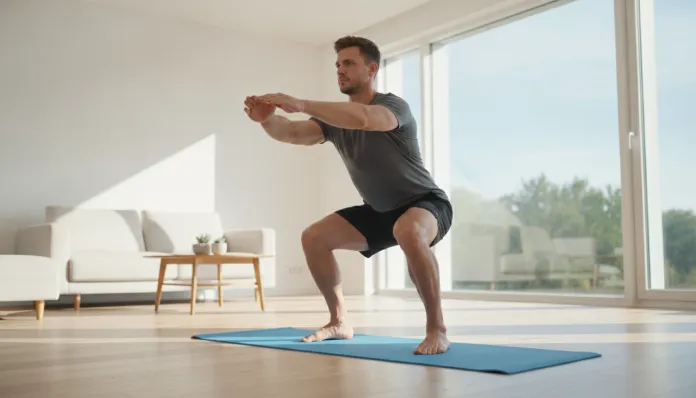
Bodyweight Squat
The squat is one of the most complete movements that exist. It works the quadriceps (front of the thigh), glutes, hamstrings, and core (trunk muscles).
- Stand with feet shoulder-width apart, toes slightly pointed out
- Keep your chest up and eyes forward
- Bend your knees and push your hips back as if sitting in a chair
- Descend until thighs are parallel to the ground (or as comfortable)
- Rise by pressing heels into the ground
- Repetitions: 12 to 15
Push-up
Classic and efficient, works the chest, shoulders, triceps, and core.
- Place hands on the ground shoulder-width apart and stretch your body in a plank position
- Keep the body rigid, without letting the hips drop or rise
- Bend elbows until chest nearly touches the ground
- Push back to the starting position
Beginner version: rest knees on the ground, keeping the rest of the body aligned.
- Repetitions: 8 to 12
Plank
Isometric exercise — meaning without movement — that strengthens the core, lower back, shoulders, and glutes.
- Place forearms on the ground, elbows below shoulders
- Stretch legs and rest toes on the ground
- Keep body in a straight line from head to heels
- Breathe normally and hold the position
- Time: 20 to 45 seconds
Lunge
Works glutes, quadriceps, and balance.
- Stand with feet together
- Step forward with one leg
- Bend both knees until the back knee nearly touches the ground
- Return to starting position and alternate legs
- Repetitions: 10 per leg
Glute Bridge
Great for glutes, hamstrings, and lower back.
- Lie on your back with knees bent and feet flat on the ground
- Place arms along the body
- Contract glutes and lift hips to form a straight line from shoulders to knees
- Hold for 2 seconds at the top and lower slowly
- Repetitions: 15
Mountain Climber
Dynamic exercise that combines core work with increased heart rate.
- Start in a high plank position (arms extended, hands on the ground)
- Quickly bring one knee towards the chest and return
- Alternate legs at a constant pace, as if running in place
- Time: 30 seconds
How to build your weekly routine
Consistency beats intensity, especially for beginners. A simple and realistic plan is more effective than long and irregular workouts.
Level Weekly Frequency Duration per Session Beginner 2 to 3 times 20 to 30 minutes Intermediate 3 to 4 times 30 to 45 minutes Advanced 4 to 5 times 45 to 60 minutes Tips for maintaining consistency:
- Choose fixed times — the body adapts to routine
- Start with small goals and increase progressively
- Alternate workout days with active rest days (light walking, stretching)
- Record your workouts in a notebook or app to track progress
- Vary exercises every 4 to 6 weeks to avoid stagnation
Stretching and recovery: the end matters as much as the beginning
Ending the workout with static stretching helps relax worked muscles, improve flexibility over time, and reduce muscle tension in the following hours.
Recommended stretches after the workout:
- Quadriceps: standing, bend one knee and hold the ankle with your hand for 30 seconds each side
- Hamstrings: sitting on the ground, stretch one leg and lean forward for 30 seconds
- Glutes: lying on your back, cross one ankle over the opposite knee and pull the leg towards the chest
- Shoulders and chest: interlace fingers behind the back and open the chest, holding for 20 seconds
- Lower back: lying down, hug both knees to the chest for 30 seconds
Each stretch should be done gently, without pain, with calm breathing and no bouncing.
Conclusion
Keeping your body active does not require a high financial investment, sophisticated equipment, or daily hours dedicated to the gym. With consistency, minimal space, and the right exercises, you can build strength, improve endurance, and take care of your health in a real and progressive way — all at home.
The secret is to start. It doesn’t matter if the first set of push-ups is on your knees or if the squat isn’t as deep in the first days. What turns exercise into results is repetition over time. And on this journey, every session counts — whether it’s 20 minutes on a weekday afternoon or half an hour on a Saturday morning.
Take care of your body with the tools you already have. They are more than enough to start.
Mais Lidas
O Jornal Meia Hora é um portal de notícias que oferece informações atualizadas sobre política, economia, esportes, entretenimento e mais. Nosso compromisso é manter nossos leitores informados com notícias precisas e imparciais.
Redação
Trending
Categorias
© Jornal Meia Hora. Todos os direitos reservados.
- Hamstrings: sitting on the ground, stretch one leg and lean forward for 30 seconds
- Quadriceps: standing, bend one knee and hold the ankle with your hand for 30 seconds each side
- Time: 30 seconds
- Repetitions: 15
- Repetitions: 10 per leg
- Time: 20 to 45 seconds
- Repetitions: 8 to 12
- Repetitions: 12 to 15
- Shoulder rotation — 10 circles forward and 10 backward
- Comfortable clothing — that allows free movement