
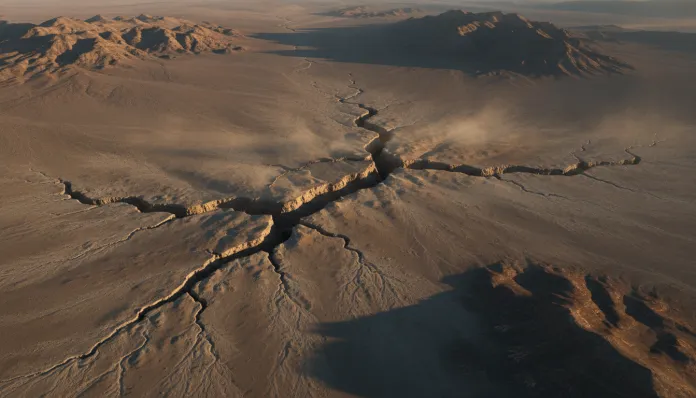
Imagine sitting at home, peacefully, when suddenly the ground starts to vibrate, furniture shakes, glass rattles, and a feeling of helplessness overwhelms you. In seconds, the Earth — which always seemed the most solid and reliable thing in the world — turns into something alive, agitated, and unpredictable. This experience, lived by millions around the globe, is what we call an earthquake, revealing a fundamental truth about our planet: the Earth is in constant motion.
Earthquakes are among the most powerful and terrifying natural phenomena. They can last just a few seconds or extend for entire minutes, with effects ranging from imperceptible vibrations to the total destruction of entire cities. But what exactly makes the Earth shake? Why do some places suffer earthquakes much more frequently than others? And can science predict when the next one will occur? Let’s explore all this now.
To understand earthquakes, one must first understand the structure of our planet — and discover that the solid ground beneath our feet is far less static than it seems.
The Earth’s Structure: It All Starts Inside
The Earth is not a solid, homogeneous ball. It is composed of distinct layers, each with different physical and chemical characteristics. The outermost layer, where we live, is called the crust. Below it is the mantle, a thick layer made of partially molten or pasty rocks, behaving like an extremely viscous fluid over millions of years. At the planet’s center are the outer core (liquid) and the inner core (solid), primarily composed of iron and nickel.
The heat generated by the core creates convection currents in the mantle — similar to what happens when you boil water in a pot. This slow but constant movement pushes, pulls, and drags the Earth’s crust from below. And this is where the story of earthquakes begins.
Tectonic Plates: The Large Moving Blocks
The Earth’s crust is not a single, continuous piece. It is divided into huge fragments called tectonic plates, which float on the mantle and move very slowly — on average, a few centimeters per year, roughly the speed at which fingernails grow. There are about 15 to 20 main plates, along with several smaller ones.
These plates fit together like a giant puzzle, and it is at their edges — called plate boundaries — that the most intense action occurs. Depending on how two plates interact, the result can be very different:
- Convergent boundaries: plates move towards and collide with each other. One can dive beneath the other (a process called subduction), forming ocean trenches and volcanic chains. This type of boundary is responsible for the world’s deepest and most powerful earthquakes.
- Divergent boundaries: plates move away from each other, creating fissures on the ocean floor or continents. They generally generate less intense earthquakes.
- Transform boundaries: plates slide laterally past each other, like two pieces of wood being rubbed together. The famous San Andreas Fault in California, USA, is a classic example. This lateral movement can accumulate enormous tension and release devastating earthquakes.
What Really Causes the Tremor
When two plates try to move but get stuck due to the friction between rocks, tension builds up along the geological fault — a fracture in the crust where the plates meet. Over time, this tension grows until it exceeds the rocks’ resistance, which then break or slip abruptly. This rupture releases a huge amount of energy in the form of seismic waves, which propagate through the Earth’s interior and surface, causing the vibrations we feel as an earthquake.
The exact point where the rupture starts, inside the Earth, is called the focus or hypocenter. The point on the surface directly above the focus is called the epicenter — usually where the damage is most intense. Earthquakes can have shallow (less than 70 km deep), intermediate, or deep foci (up to more than 700 km). Generally, shallow earthquakes are more destructive because the waves travel a shorter distance to reach the surface.
Types of Seismic Waves
The waves generated by an earthquake are divided into two main groups:
- P waves (primary): these are the fastest and first to arrive. They propagate by compressing and expanding rocks, like sound in the air.
- S waves (secondary): they arrive later and cause movements perpendicular to the direction of propagation, shaking the ground side to side.
- Surface waves: the slowest but often the most destructive. They cause the undulating and circular movements that topple structures.
How Earthquake Intensity is Measured
You have certainly heard of the Richter scale. Developed by seismologist Charles Richter in 1935, it was the standard for measuring earthquake magnitude for decades. Today, scientists prefer to use the moment magnitude scale (Mw), which is more accurate for large earthquakes, but the principle is similar: it’s a logarithmic scale, meaning each point higher represents about 10 times the amplitude of the waves and about 32 times the energy released.
To get a practical idea:
Magnitude What Happens Less than 2.0 Imperceptible to humans 2.0 to 3.9 Felt slightly by some people 4.0 to 4.9 Felt by many people; minor damage 5.0 to 5.9 Can cause damage to fragile structures 6.0 to 6.9 Destructive in populated areas 7.0 to 7.9 Major earthquake; serious damage over large areas 8.0 or more Catastrophic; devastation over vast regions Some of the most intense earthquakes ever recorded include the 1960 Valdivia earthquake in Chile (estimated magnitude of 9.5 — the largest ever instrumentally recorded), the 1964 Alaska earthquake (9.2), and the 2004 Indian Ocean tsunami earthquake (9.1), which killed over 200,000 people in several countries.
Where Earthquakes Occur Most Frequently
It’s no coincidence that countries like Japan, Chile, Indonesia, Mexico, and some US states experience so many earthquakes. These places are located on or near active tectonic plate boundaries. The most seismic zones on the planet form the so-called Pacific Ring of Fire — an arc that surrounds the Pacific Ocean and concentrates about 90% of all the world’s earthquakes.
Brazil, on the other hand, is situated within the South American Plate, far from the most active boundaries. Therefore, earthquakes here are generally low in intensity and rarely cause significant damage. But this doesn’t mean the country is completely free of seismic activity: regions like the interior of Ceará, Rio Grande do Norte, and Minas Gerais record tremors with some regularity, though almost always imperceptible to the population.
Can Earthquakes Be Predicted?
This is perhaps the most important question — and the honest answer from science is: not yet, with sufficient precision to be useful. Despite decades of intense research, no reliable method has been developed to predict in advance the time, exact location, and magnitude of an earthquake. There are signs that sometimes precede seismic events — such as small preliminary tremors called foreshocks, variations in water levels in artesian wells, or unusual animal behavior — but these indications are too inconsistent to serve as a basis for reliable alerts.
What science can do very well is real-time seismic monitoring: networks of seismographs around the world continuously record the planet’s activity, and early warning systems — already in use in Japan, Mexico, and other regions — can detect P waves (the first and less destructive) and send warnings seconds or even tens of seconds before S waves and surface waves (the truly destructive ones) arrive. A short time, but one that can save lives.
How to Protect Yourself During an Earthquake
For those living in seismic regions, knowing the basic safety measures can make all the difference:
- Duck, cover, and hold on: the current guidance from experts is to crouch, protect yourself under a sturdy table or next to a strong internal wall, and hold on to avoid being thrown.
- Stay away from windows, mirrors, and heavy furniture.
- Do not run outside during the tremor: most injuries occur when people try to run and are hit by falling objects.
- If outdoors, move away from buildings, poles, and trees.
- After the tremor, be alert for aftershocks (smaller tremors that often follow the main event) and pay attention to tsunami alerts if in a coastal area.
Conclusion: A Living Earth Beneath Our Feet
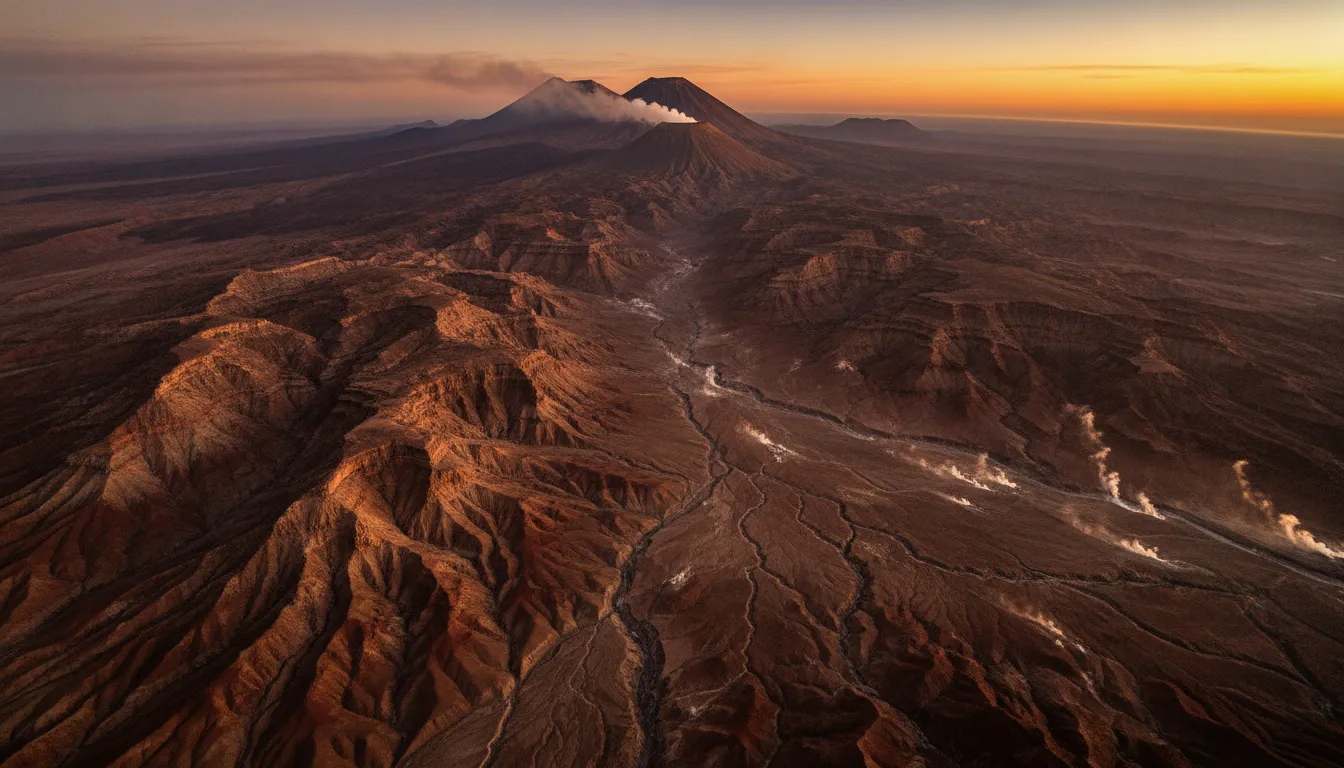
Earthquakes are, above all, a powerful reminder that Earth is a dynamic planet, constantly transforming. The same process that over billions of years shaped continents, opened oceans, raised mountains, and created conditions for life is also responsible for these violent and unpredictable episodes. Understanding the causes of earthquakes — from convection currents in the mantle to the buildup of tension in geological faults — doesn’t eliminate the danger, but it helps us coexist with it more consciously and prepared.
Science continually advances in seismic monitoring and earthquake engineering, making cities and buildings more resilient. And just as we explore other mysteries of nature — such as why we dream and what dreams mean — geophysics continues to unravel the secrets of our own planet. The Earth shakes because it is alive. And understanding this is the first step in learning to respect it.
Mais Lidas
O Jornal Meia Hora é um portal de notícias que oferece informações atualizadas sobre política, economia, esportes, entretenimento e mais. Nosso compromisso é manter nossos leitores informados com notícias precisas e imparciais.
Redação
Trending
Categorias
© Jornal Meia Hora. Todos os direitos reservados.
- Stay away from windows, mirrors, and heavy furniture.
- S waves (secondary): they arrive later and cause movements perpendicular to the direction of propagation, shaking the ground side to side.
- Divergent boundaries: plates move away from each other, creating fissures on the ocean floor or continents. They generally generate less intense earthquakes.


