
Why is Volleyball One of Brazil’s Most Loved Sports?
Few sports bring together beach, court, friends, and competition as naturally as volleyball. In Brazil, the sport goes beyond Olympic medals and famous names: it’s present on the sands of Copacabana, neighborhood courts, physical education classes, and weekend games. It’s no wonder the country is a world powerhouse in both indoor and beach volleyball.
But newcomers to the sport might feel a bit lost. Who can touch the ball? How many times? What is a “libero”? Why did the referee blow the whistle? These questions are completely normal for any beginner, and answering them makes all the difference in enjoying a match or diving into practice.
This guide gathers the basic volleyball rules in a clear, straightforward manner. Whether to play with friends, understand a game on TV, or join an amateur team, you’ll leave here ready to hit the court with much more confidence.
The Objective of the Game: It’s That Simple
Volleyball is played between two teams separated by a net. The goal is to make the ball hit the ground on the opponent’s side — or force the opposing team to make an error. Each point is called a rally, and the team that wins the rally scores the point, regardless of who served.
This system is known as rally point and was officially adopted by the International Volleyball Federation (FIVB) in the 1990s. Before that, only the serving team could score points — making matches longer and more unpredictable in terms of scoring.
Today, sets (the game’s segments) go up to 25 points, with the requirement to win by at least two points. The fifth set, when played, goes up to 15 points. A complete match consists of up to five sets, and the team that wins three of them takes the victory.
The Court, the Net, and Official Measurements
Knowing the playing area helps a lot in understanding various rules. The official volleyball court measures 18 meters long by 9 meters wide, divided in half by the net. Each team plays on a half of 9 meters x 9 meters.
The net height varies according to the category:
- Adult Men: 2.43 meters
- Adult Women: 2.24 meters
- Youth and Recreational Categories: adapted heights according to age group
Inside the court, there is a line parallel to the net, 3 meters away, called the attack line. It marks the front zone (near the net) and the back zone (near the end line). This division is important for understanding some game restrictions, as we’ll see later.
Touch Rules: The Heart of the Game
This is one of the most important — and most confusing — parts. Here’s how it works:
- Each team is allowed a maximum of three touches to return the ball to the opponent’s side. The block may or may not count as one of the three touches, depending on how it occurs (more details below).
- The same player cannot touch the ball twice consecutively — with one exception: if they block, they can touch it again immediately.
- The ball can be touched with any part of the body — this rule was updated by the FIVB and now allows contact with the foot, leg, head, and torso, as long as the touch is clean.
- Holding, grabbing, or throwing the ball is not allowed. The contact must be quick and clean.
- The ball cannot touch the ground within the team’s own court. When this happens, the point goes to the opponent.
What Counts as a Touch Error?
- Touching the ball twice in a row (except during a block)
- Holding or “sticking” the ball during contact
- The team touching the ball more than three times before returning it
- The ball touching the net’s side antenna or going out of bounds
Serve, Reception, and Rotation: Understanding the Game Flow
The serve is the start of each rally. The player serves from behind the end line and must make the ball pass over the net and land within the opponent’s court. There are basically two common types of serves:
- Underhand Serve: arm swings from bottom to top, classic for beginners
- Overhand Serve (Floating or Powerful): the player tosses the ball up and hits it with the palm; it can be floating (no spin, making reception difficult) or jump serve (more aggressive, used at a high level)
After the serve, the opposing team usually uses the three touches as follows: reception → set → attack. This is the classic pattern, although not mandatory.
Rotation is another fundamental point. Whenever a team earns the right to serve (i.e., won the rally and the opponent was serving), players rotate one position clockwise. This ensures everyone goes through the front and back positions throughout the set. Mispositioning during the serve is a fault, and the point goes to the opposing team.
Court Positions: Who Does What
A volleyball team consists of six players on the court at the same time. The positions are numbered from 1 to 6, but in practice, players have well-defined roles:
- Setter: the team’s “conductor.” They touch the ball before the attacker, organizing the offensive play.
- Opposite: usually the main scorer, plays diagonally to the setter.
- Outside Hitter (or Wing Spiker): attacks from the ends of the net.
- Middle Blocker: plays in the middle of the net, responsible for blocks and quick attacks.
- Libero: player with a different colored jersey. Specialist in defense and reception, cannot attack above the net or serve. Can enter and exit the game freely (without counting as substitutions), but only to replace back-row players.
The libero was a position created by the FIVB in 1998 to enhance defense and increase game dynamics. Today, it’s indispensable in any competitive team.
Substitutions, Technical Timeouts, and Other Practical Rules
Each team can make up to six substitutions per set in official indoor volleyball. Substitutions involve one player entering in place of another, and this same pair can only swap once per set (except for the libero, who has their own rules).
The technical timeout (or time-out) can be requested by the coach or captain. Each team is entitled to two technical timeouts per set, lasting 30 seconds each. In televised competitions, there is usually also an automatic technical timeout when a team reaches 8 and 16 points in the set.
Other Rules That Frequently Cause Confusion
- Touching the Net: touching the net during play is a fault, except when contact is with the top cable and does not interfere with the play — a rule that varies slightly according to competition level.
- Crossing into the Opponent’s Court: stepping or crossing the center line is allowed, as long as it doesn’t interfere with the opponent.
- Ball on the Line: if the ball touches the line, it is considered in the court.
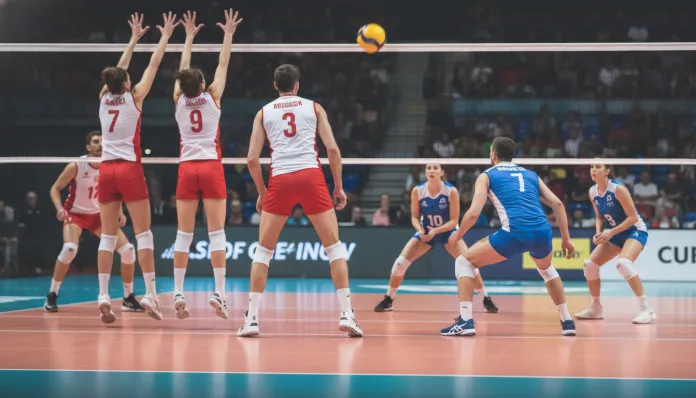
- Block: front-row players can attempt to block the opponent’s attack at the net. The block can be performed by up to three players simultaneously.
Beach Volleyball: The Main Differences
Beach volleyball follows a similar logic but with important differences worth knowing:
- Only two players per team (no fixed positions or libero)
- Sets go up to 21 points (except the third, which goes up to 15)
- Each team is entitled to one technical timeout per set
- Communication between players is essential, as there is no fixed setter
- The sand demands more physical effort but also offers more freedom of movement
Brazil is an Olympic champion in both men’s and women’s beach volleyball in various editions, which helps explain the sport’s enormous popularity in the country.
Conclusion: The Best Way to Learn is by Playing

Volleyball may seem full of rules at first glance, but in practice, they become natural quickly. Knowing that each team has three touches, that rotation is mandatory, and that the libero is the defensive specialist already puts any beginner far ahead in understanding the game.
The most important thing is not to be afraid of making mistakes. Every experienced player was once the one who didn’t know where to run or hit the ball out of bounds several times in a row. Improvement comes with practice, attention to what’s happening on the court, and, of course, with a good group to play with.
If you want to turn volleyball into a regular habit, it’s worth thinking about how to organize your routine to include the sport consistently. Check out this guide on how to set personal goals and actually achieve them — it can greatly help in turning the desire to play into real practice.
Now just grab a ball and start!
- Sets go up to 21 points (except the third, which goes up to 15)
- Crossing into the Opponent’s Court: stepping or crossing the center line is allowed, as long as it doesn’t interfere with the opponent.
- Opposite: usually the main scorer, plays diagonally to the setter.
- Overhand Serve (Floating or Powerful): the player tosses the ball up and hits it with the palm; it can be floating (no spin, making reception difficult) or jump serve (more aggressive, used at a high level)
- Underhand Serve: arm swings from bottom to top, classic for beginners
- The same player cannot touch the ball twice consecutively — with one exception: if they block, they can touch it again immediately.
- Adult Women: 2.24 meters