
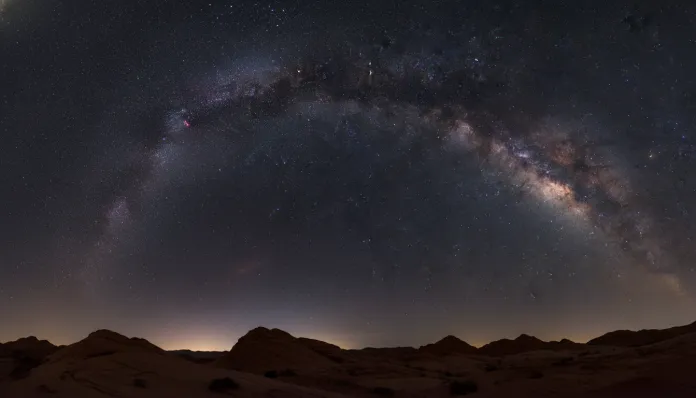
Look up at the sky on a clear night and try counting the stars. You’ll see a few thousand with the naked eye — a tiny fraction of the estimated 200 to 400 billion stars that inhabit just the Milky Way. Now expand that thought: there are hundreds of billions of galaxies in the observable universe. Seems like a lot, right? Well, brace yourself for a twist: everything you just imagined represents less than 5% of the universe’s total content. The remaining 95% of reality is made of something we cannot see, touch, or directly detect.
This is not a science fiction story. It’s the current state of human knowledge about the cosmos. Modern science has reached a disconcerting conclusion: most of the universe is composed of entities we call dark matter and dark energy. Not because they are dark or mysterious by nature, but because they simply do not emit, absorb, or reflect light — and therefore are invisible to all our telescopes, no matter how powerful.
Understanding what the universe hides beyond the visible is one of the greatest intellectual adventures in human history. And the journey begins with a simple question: if we don’t see these things, how do we know they exist?
The Universe You Don’t See: Ordinary Matter is the Minority
Everything ever discovered, cataloged, and studied by humanity — stars, planets, cosmic dust, gas, black holes, you, this text — is made of baryonic matter, the common type of matter formed by protons, neutrons, and electrons. According to the most accepted cosmological models, this type of matter represents only about 4.9% of the universe.
The other two main ingredients are:
- Dark matter: accounts for approximately 27% of the universe’s content
- Dark energy: represents about 68% of the total
Together, these two unknown entities dominate the composition of the cosmos. Physics knows they exist because of the effects they cause. It’s like knowing there’s wind without seeing it — we perceive it by the movement of leaves. In the case of the universe, the “leaves” are galaxies, stars, and the very geometry of space-time.
Dark Matter: The Invisible Glue of Galaxies
In the 1970s, astronomer Vera Rubin and her collaborator Kent Ford made an observation that would change cosmology forever. While studying the rotational speed of stars in spiral galaxies, they noticed something strange: stars on the edges of galaxies moved too fast. According to classical Newtonian physics, the farther from the center, the slower the movement should be — like more distant planets orbiting the Sun more slowly. But galaxies did not follow this rule.
The only coherent explanation: there was much more mass in these galaxies than visible matter could justify. Something invisible — and very heavy — was there, exerting gravity. This something became known as dark matter.
What Do We Know About It?
- Does not interact with light (does not emit or absorb photons)
- Has mass and therefore exerts gravitational attraction
- Is distributed in halos around galaxies
- Influences how structures like galaxy clusters form
- Is not composed of ordinary matter — not extinguished stars or conventional black holes
What Don’t We Know?
The exact composition of dark matter remains one of physics’ greatest mysteries. The most studied hypotheses include hypothetical particles called WIMPs (Weakly Interacting Massive Particles) and axions, extremely light particles predicted by certain extensions of the Standard Model of particle physics. None of these particles have been definitively detected experimentally as of 2026.
Dark Energy: The Engine of Accelerated Expansion
If dark matter is the “glue” of the universe, dark energy is its opposite: a force that pushes things away from each other, accelerating the cosmos’ expansion.
In 1998, two independent teams of astronomers — led by Saul Perlmutter, Brian Schmidt, and Adam Riess — discovered, by observing distant supernovae, that the universe not only expands, as expected since the time of Edwin Hubble, but this expansion is accelerating. The discovery was so surprising that it earned the 2011 Nobel Prize in Physics for the three researchers.
For the universe to expand faster and faster, something must counteract gravity — which by nature should be slowing everything down. This “something” was called dark energy. Mathematically, it can be represented by the so-called cosmological constant, a term that Albert Einstein himself introduced in his general relativity equations and later discarded — calling it his “biggest blunder.” History showed he might have been wrong to discard it.
Characteristics of Dark Energy
- Uniform: appears to be distributed homogeneously throughout space
- Repulsive: acts against gravity on cosmic scales
- Increasing in influence: as the universe expands, matter dilutes, but dark energy remains constant per unit volume — therefore, over time, it increasingly dominates
- Unknown in nature: could be a property of empty space itself, a dynamic field (called “quintessence”), or something not yet imagined
How Do Scientists Investigate the Invisible?
Science has developed ingenious tools to study what cannot be seen directly.
Gravitational Lenses
When light from distant objects passes through a concentration of dark matter, it is bent — as if passing through a lens. This phenomenon, predicted by Einstein’s general relativity, creates visible distortions in images of distant galaxies. By analyzing these distortions, astronomers map where dark matter is concentrated.
Mapping Cosmic Background Radiation
The Cosmic Microwave Background (CMB) is the “echo” of the Big Bang — radiation that permeates the universe and carries information about its primordial conditions. Missions like the European Space Agency’s Planck satellite have analyzed this background with extraordinary precision, providing detailed measurements of the proportions of dark matter, dark energy, and ordinary matter.
Computational Simulations
With values obtained from observations, cosmologists run enormous simulations modeling the formation of cosmic structures — like galaxies and matter filaments. When simulations include dark matter and dark energy, the results match what we see in the real universe. When these components are removed, everything collapses.
Underground Detectors and Particle Accelerators
Experiments like LUX-ZEPLIN (LZ), installed 1.5 km deep in a mine in South Dakota, USA, attempt to capture the rare signal of a dark matter particle interacting with ordinary atoms. So far, no conclusive detection has been confirmed, but the limits set by these experiments have already ruled out many hypotheses and narrowed the field of possibilities.
Parallel Universes, Extra Dimensions, and Other Frontiers
Beyond dark matter and dark energy, speculative — yet mathematically rigorous — cosmology ventures into territories even more distant from everyday experience.
The string theory and its developments suggest the existence of extra spatial dimensions beyond the three we perceive. These dimensions would be “rolled up” on minuscule scales, imperceptible, but could have observable consequences. Meanwhile, the multiverse theory — existing in various versions — proposes that our universe may be just a bubble in an ocean of universes, each with potentially different physical properties.
It’s important to differentiate: these ideas, though seriously explored by theoretical physicists, have not yet been experimentally confirmed. They are mathematically coherent hypotheses but await — perhaps for a long time — some form of observational test.
What Does the Future Hold for This Quest?
The next decade promises significant advances. The Euclid Space Telescope, launched by the European Space Agency in 2023, is mapping billions of galaxies with the explicit goal of investigating the nature of dark energy and dark matter. The Vera C. Rubin Observatory in Chile — named in honor of the astronomer who helped establish evidence for dark matter — is beginning operations and promises to produce the most detailed survey of the southern sky ever made.
Additionally, next-generation particle physics experiments continue the search for WIMPs, axions, and other candidate particles. The combination of deep space data with laboratory experiments may finally reveal what this invisible majority of the universe is made of.
Conclusion: The Beauty of What We Don’t Yet Know
We live in a universe where 95% of reality remains an enigma. Far from being a reason for discouragement, this fact is an invitation to curiosity — and perhaps the greatest argument against any intellectual arrogance. Science has come far enough to know there is something, and precise enough to measure its proportions. But it has not yet come close to understanding what that something really is.
Every galaxy we observe is supported by an invisible scaffold. Every second that passes, the universe expands a little more by the force of an energy we cannot name. And somewhere, in underground laboratories and telescopes aimed at the deep sky, scientists continue to ask humanity’s oldest question: what is out there?
The universe hides much. But, little by little, it reveals its clues.
Curious about other secrets closer to home? Also check out Secrets of Brazil Most Brazilians Ignore and discover surprising curiosities about the country.
- Repulsive: acts against gravity on cosmic scales
- Dark energy: represents about 68% of the total