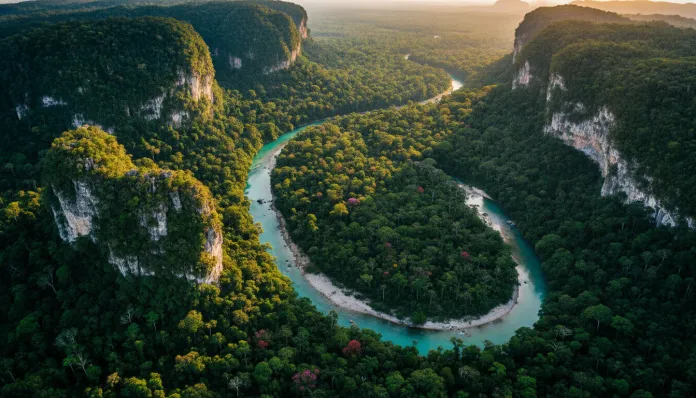
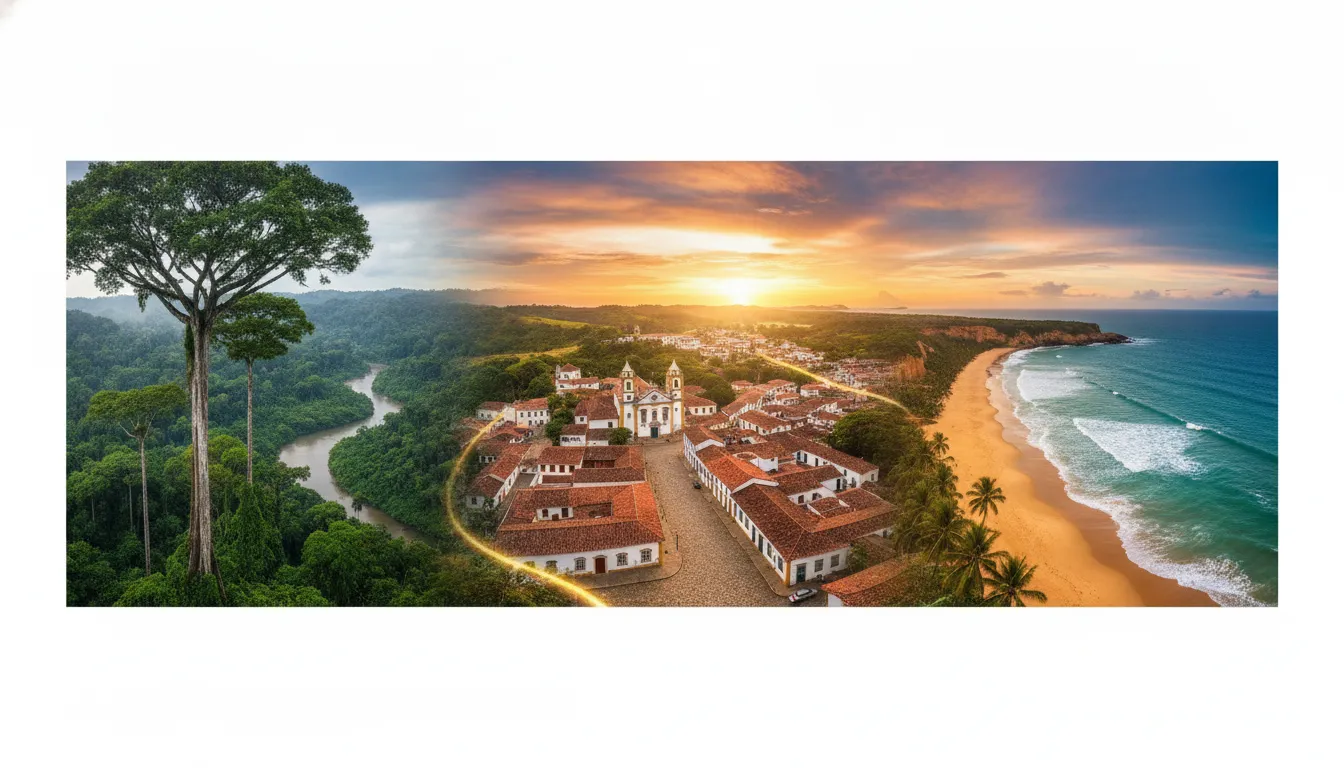
Brazil is one of the most fascinating and complex countries in the world — and also one of the least understood by its own inhabitants. With 8.5 million square kilometers, over 210 million people, and a history that dates back millennia before the arrival of Europeans, the territory holds geographical, historical, and cultural secrets that surprise even the most curious Brazilians. Most of us learned the basics in school: discovery, independence, carnival. But there are much deeper layers waiting to be explored.
How many Brazilians know, for example, that there is a city founded by Confederate American immigrants in the interior of São Paulo? Or that Brazil harbors the largest underground freshwater reservoir in the world? Or that the Amazon holds traces of complex civilizations that flourished long before any European colony set foot on these lands? These are not myths or urban legends — they are documented facts, studied and, in many cases, still being revealed by science.
This article gathers some of the most surprising secrets about Brazil that most Brazilians simply do not know — or have never stopped to think about. Get ready to look at the country you live in differently.
The Guarani Aquifer: The Invisible Ocean Beneath Your Feet
Beneath four South American countries — Brazil, Argentina, Paraguay, and Uruguay — lies one of the largest underground freshwater reserves on the planet. The Guarani Aquifer covers about 1.2 million square kilometers, with the majority (approximately 70%) located in Brazilian territory, in the southern, southeastern, and central-western states.
To give an idea of its scale: the volume of water stored in the Guarani Aquifer is estimated at 37,000 km³ — enough to supply the world population for over 2,000 years, according to researchers in the field. The aquifer was formed about 245 million years ago from sediments of ancient sand dunes covered by layers of volcanic basalt over geological eras.
Despite its vastness, inadequate exploitation worries water resource specialists. The aquifer’s natural recharge is slow, and unplanned use could compromise a reserve that took tens of millions of years to form. It is an invisible treasure — and therefore often forgotten in everyday conversations.
Americanópolis: The City Founded by the Defeated of the American Civil War
In the interior of the state of São Paulo, about 170 kilometers from the capital, lies the city of Americana. The name is no coincidence. The city was founded, starting in 1866, by immigrants from the Confederate States of America — the side that lost the American Civil War (1861–1865).
After the defeat, a group of Southern Americans who did not accept the abolition of slavery and the reconstruction of the South left the United States in search of lands where they could start anew. The Brazil of the Second Empire, still under the slave regime, was an attractive destination. Emperor Dom Pedro II even encouraged this immigration as part of an agricultural colonization project.
These immigrants, known as “Confederates” or “Confederates of Brazil”, brought cotton cultivation techniques and left cultural marks that persist to this day. Every year, descendants of these families hold the Confederate Party in Santa Bárbara d’Oeste, a neighboring city to Americana, with music, typical Southern American 19th-century attire, and cuisine inherited from their ancestors. It is one of the most unusual and contradictory pages of Brazilian history.
The Amazon That Wasn’t Wild: Pre-Columbian Civilizations of the Forest
For decades, common sense — and much of academia — believed that the Amazon was a virtually untouched forest before the arrival of Europeans, inhabited by small and dispersed groups. This myth began to crumble strongly in the last decades of the 20th century and has been progressively dismantled by impressive archaeological discoveries.
Research conducted by Brazilian and international archaeologists revealed that the Amazon housed complex civilizations, with populations estimated in millions, cities interconnected by roads, sophisticated irrigation systems, and agriculture. The so-called “Terra Preta do Índio” is concrete evidence of this: it is a soil artificially enriched with charcoal, bones, and organic matter, intentionally created by pre-Columbian peoples to make the naturally nutrient-poor Amazonian land extremely fertile.
Huge geoglyphs — geometric shapes carved into the ground, visible mainly by satellite — have been discovered in states like Acre and Amazonas. Some are over 2,000 years old. Researchers like Anna Roosevelt and, more recently, teams from the University of São Paulo and international institutions have expanded knowledge about these civilizations that the forest swallowed after the demographic collapse caused by diseases brought by Europeans.
Brazil Almost Had Another Capital Before Brasília
Every Brazilian knows that the capital was moved from Rio de Janeiro to Brasília in 1960. But few know that the idea of moving the capital to the country’s interior has much older roots — and that another city almost gained this title before Brasília existed.
The proposal to internalize the Brazilian capital appears in the Constitution of 1891, which reserved an area of 14,400 km² in the Central Plateau for the future federal capital, called the Federal District. But before that, during the colonial and imperial periods, names like Ouro Preto (then Vila Rica), Petrópolis, and even Goiás Velho were considered at different historical moments.
In the 19th century, the engineer and politician José Bonifácio de Andrada e Silva even proposed the name “Brasília” for the future inland capital — decades before the city existed. The persistence of this idea over more than a century speaks volumes about the strategic vision that part of the Brazilian political elite always had about the need to occupy and integrate the national territory.
Fernando de Noronha: An Archipelago with a History of Prison and Espionage
The archipelago of Fernando de Noronha, now one of Brazil’s most sought-after and preserved tourist destinations, has a much less paradisiacal history than the crystal-clear waters suggest. Located about 360 kilometers from the northeastern coast, the archipelago has been a political prison site for centuries.
From the 18th century onwards, Fernando de Noronha was used as a place of exile — a destination for exiles, criminals, and political prisoners sent by the Portuguese Crown. In the 20th century, during Getúlio Vargas’s Estado Novo and later during the military dictatorship (1964–1985), the archipelago was again used as a prison for political opponents.
Moreover, during World War II, Fernando de Noronha played a strategic role: the United States built a military base on the archipelago, with a runway, as part of the effort to patrol the South Atlantic against German submarines. This American presence is little known but left physical marks that can still be observed on the site.
The Language Brazil Almost Didn’t Speak: Nheengatu and Historical Portunhol
Portuguese was not always the dominant language in Brazil. For much of the colonial period, especially in the 17th and 18th centuries, the most spoken language in the colony was Nheengatu — also called “Língua Geral” or “Língua Geral Amazônica”. It is a language based on Tupi, simplified and adapted by Jesuit missionaries to facilitate communication with indigenous peoples.
In regions like the Amazon, Nheengatu was more common than Portuguese among settlers, indigenous people, and mestizos. It was only with the reforms of the Marquis of Pombal in 1757 that Portuguese was imposed by decree as the mandatory language in the colony, and teaching in other languages was prohibited. Still, Nheengatu survived — and is spoken to this day by communities in the Upper Rio Negro, in Amazonas. In 2002, the municipality of São Gabriel da Cachoeira made Nheengatu a co-official language alongside Portuguese, a unique case in Brazil.
This history reveals that Brazilian linguistic identity was constructed by political choices, not just by the natural force of one language over others.
Natural Secrets: Brazil Has the World’s Largest Tropical Wetland
The Pantanal is known as the largest floodplain on the planet — but many Brazilians underestimate its size and importance. With about 150,000 to 200,000 km² in Brazilian territory (in addition to parts in Bolivia and Paraguay), the Pantanal is larger than many European countries.
The biome is considered one of the richest in biodiversity in the world, with animal densities — especially jaguars, capybaras, caimans, and aquatic birds — that rival African savannas. Unlike the Amazon, where dense vegetation makes wildlife sightings difficult, the Pantanal offers unique conditions for observing wild animals in their natural habitat.
Brazil is the only South American country that speaks Portuguese — all its neighbors speak Spanish, except for Guyana (English), Suriname (Dutch), and French Guiana (French).
The Amazon Rainforest produces a significant portion of its own rain through a phenomenon called “flying rivers” — water vapor currents that move through the atmosphere.
Brazil has the largest population of Japanese outside Japan — the Japanese-Brazilian community, mainly concentrated in São Paulo, is estimated at 1.5 to 2 million people.
The Christ the Redeemer is not the largest Christ statue in the world — there are larger Christ statues in other countries, such as Christ the King in Portugal and Christo Redentor in Bolivia.
Serra da Capivara, in Piauí, houses rock paintings over 25,000 years old, challenging conventional theories about the arrival of the first humans in the Americas.
Conclusion
Brazil holds much more than carnival, football, and paradisiacal beaches. Beneath the surface that the world knows — and that we sometimes reduce to stereotypes — there is a country with historical, geographical, and cultural layers of rare depth. From Amazonian civilizations that predate medieval Europe to the invisible aquifer that feeds the continent, from American Confederates who became Paulistas to the language the Marquis of Pombal tried to erase, Brazil is a vast archive of stories that deserve to be read and reread.
Knowing these secrets is not just intellectual curiosity — it is also a way to strengthen the sense of belonging and understand why this country is so unique. And if the reading has sparked the desire to explore these places with your own eyes, remember: it is possible to travel through Brazil intelligently and affordably, without the need for large expenses.
The greatest secret of all may be this: Brazil is still being discovered — even by ourselves.
Para fornecer as melhores experiências, usamos tecnologias como cookies para armazenar e/ou acessar informações do dispositivo. O consentimento para essas tecnologias nos permitirá processar dados como comportamento de navegação ou IDs exclusivos neste site. Não consentir ou retirar o consentimento pode afetar negativamente certos recursos e funções.
Funcional
Always active
O armazenamento ou acesso técnico é estritamente necessário para a finalidade legítima de permitir a utilização de um serviço específico explicitamente solicitado pelo assinante ou utilizador, ou com a finalidade exclusiva de efetuar a transmissão de uma comunicação através de uma rede de comunicações eletrónicas.
Preferências
O armazenamento ou acesso técnico é necessário para o propósito legítimo de armazenar preferências que não são solicitadas pelo assinante ou usuário.
Estatísticas
O armazenamento ou acesso técnico que é usado exclusivamente para fins estatísticos.O armazenamento técnico ou acesso que é usado exclusivamente para fins estatísticos anônimos. Sem uma intimação, conformidade voluntária por parte de seu provedor de serviços de Internet ou registros adicionais de terceiros, as informações armazenadas ou recuperadas apenas para esse fim geralmente não podem ser usadas para identificá-lo.
Marketing
O armazenamento ou acesso técnico é necessário para criar perfis de usuário para enviar publicidade ou para rastrear o usuário em um site ou em vários sites para fins de marketing semelhantes.