
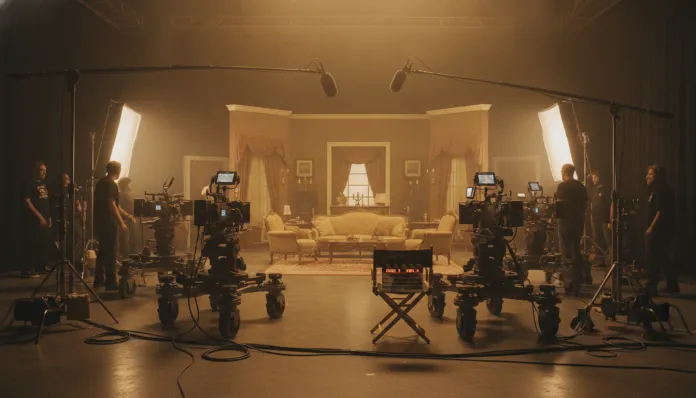
When the lights dim in the cinema and the screen begins to glow, the viewer is transported to another world—a universe meticulously crafted by hundreds, sometimes thousands, of professionals who never appear in the main credits. What we see on the big screen is just the tip of the iceberg. Behind every explosion, every emotional close-up, and every memorable line, there is a complex mechanism filled with creative solutions, ingenious improvisations, and secrets that the audience rarely knows.
The film industry is one of the most fascinating in the world precisely because it hides its own magic. Art directors transform common places into epic settings. Sound effects specialists create the sound of a medieval battle using household items. Stunt doubles risk their lives so that famous actors can appear in impossible scenes. And all of this happens away from the spotlight, behind the scenes where true cinema is made.
In this article, we will open the studio doors and reveal some of the most surprising secrets of film production—information that will forever change the way you watch a movie.
The Work of Departments No One Sees
A major feature film can involve more than 20 different departments working simultaneously. Among those less known to the public are:
- Continuity: A professional dedicated exclusively to ensuring that no detail changes between takes. If the actor held the glass with the right hand in a certain scene, they must do the same in the next—even if the filming occurs days later.
- Art and Set Design: Responsible for building, finding, and decorating each filmed environment. In period productions, they research historical documents to ensure each object is true to the period depicted.
- Makeup and Hair: Go far beyond common makeup. They create fake wounds, age actors by decades in just a few hours, and, in some cases, spend more than four hours a day transforming faces.
- Cinematography: The director of photography (also called DP or cinematographer) decides how each scene will be lit and framed. It is a role so important that it can completely define the emotional tone of a film.
These professionals rarely appear in interviews or award events, but they are the ones who make possible the illusion we see on screen.
The Magic of Sound Effects: Foley and the Art of Deceiving the Ears
Did you know that almost no sound you hear in a movie was captured directly on set? Most of the audio—footsteps, creaking doors, clothes moving, punches—is recreated in a studio by specialists called foley artists.
The name comes from Jack Foley, an American pioneer who developed this technique in the 1920s and 1930s. His work consisted of creating sound effects live while watching projected images. Today, the process is more sophisticated, but the essence remains the same: imitating reality with creativity.
Some classic examples of what foley artists use:
- Footsteps in snow: Cornstarch inside a plastic bag, compressed at the right rhythm.
- Punches and impacts: Hitting a slice of raw meat or a wet pillow.
- Crackling fire: Recording crumpled cellophane slowly.
- Galloping horses: Coconut halves hit against various surfaces—a famous technique still in use.
- Breaking bones: Celery or carrot being snapped close to the microphone.
This art demonstrates that cinema is, above all, a consciously constructed perception experience—and that our brain accepts as real without question.
Stunt Doubles: The Unsung Heroes of the Screen
When James Bond jumps from a burning building or when an action character faces dozens of enemies at once, the real risk-taker is usually not the famous actor—it is the stunt double.
Stunt doubles (or stunt performers in English) are highly trained professionals in martial arts, acrobatics, high-speed vehicle driving, jumps, and much more. They work closely with directors to plan each risky scene, calculating camera angles that hide the switch between the actor and their substitute.
Besides protecting the main actors, stunt doubles are also crucial for maintaining the filming schedule. If an actor gets injured, the entire production stops—which can cost hundreds of thousands of dollars per day in major productions. Stunt doubles, being specifically trained for risk, reduce this possibility.
Despite the importance of their work, stunt doubles have historically not been eligible for major film awards, such as the Oscars. This absence has been a subject of debate in the industry for decades, with advocates arguing that institutional recognition is more than fair for professionals who literally risk their lives for art.
The Secret of Filming Out of Order
Something that surprises those unfamiliar with the behind-the-scenes: films are rarely shot in the order they appear on screen. The filming sequence is determined by logistical and financial factors—not narrative ones.
For example:
- All scenes that happen in the same setting are filmed together, even if they are at completely different moments in the story.
- If an actor has a limited schedule, their scenes are concentrated in a specific block of days.
- Outdoor scenes depend on the weather and natural light, so they are scheduled according to the weather forecast.
- Scenes with special effects or large physical structures are often filmed at the beginning, before the budget runs out.
This requires an impressive ability from actors to emotionally enter and exit scenes out of context. An actor may experience the character’s most tragic scene on the first day of filming, even before having built a relationship with the cast.
Directors like Stanley Kubrick were known for demanding dozens—sometimes more than a hundred—takes of the same scene. Others prefer spontaneity and approve the first attempts. There is no rule: each director has their own philosophy.
CGI, Models, and the Art of Creating Worlds
CGI (Computer-Generated Imagery) transformed cinema from the 1990s and has become ubiquitous in recent decades. But few know that, even in productions with million-dollar budgets, physical models, miniatures, and hand-built sets are still widely used—often in combination with digital.
This happens because the human eye detects, even unconsciously, certain qualities of light and texture that CGI still struggles to replicate perfectly. Physical objects reflect and absorb light in organic ways that computers need to calculate with enormous effort. Therefore, a real explosion—even if controlled and safe—often seems more convincing than a digital one.
Another widely used technique is performance capture (motion capture), where actors wear suits with sensors that record their movements and expressions, which are then transferred to digital characters. This technology was popularized by films like the Lord of the Rings trilogy (early 2000s) and has become standard in large-scale productions.
If you are curious to explore the art and technique behind humanity’s great visual creations, also check out what you didn’t know about great artists in history—the connections between classical art and cinema are deeper than they seem.
The Language of the Set: Terms Every Film Buff Should Know
The filming environment has its own vocabulary. Knowing it helps understand how things work behind the scenes:
- Clapperboard: The iconic object clapped before each take. Besides marking the start of the scene, it helps synchronize audio and image in editing.
- Take: Each time a scene is filmed. “Take 1” is the first attempt; if it doesn’t work, comes “Take 2,” and so on.
- First Assistant Director (1st AD): In practice, the person who manages the set daily, ensuring the schedule is met. It is one of the most stressful roles in the entire production.
- Gaffer: Head of the electrical lighting team.
- Grip: Responsible for assembling, moving, and operating camera equipment, such as tracks and cranes.
- Wrap: When someone shouts “wrap!”, it means that day’s filming—or the entire film—has been completed.
- Playback: Immediate review of a newly filmed scene on the monitor.
These terms circulate among professionals worldwide, and many of them originate from American English, reflecting Hollywood’s influence on the global industry.
Inside Editing: Where the Film Truly Comes to Life
There is a famous saying in cinema: “a film is made three times—once in the script, once in the filming, and once in the editing”. The editing room is where loose fragments of scenes gain meaning, emotion, and rhythm.
Editors work with hours and hours of raw material to find the best moments, build the right tension, and decide exactly when to cut from one shot to another. A cut a millisecond before or after can completely change a scene’s emotional impact.
Great editors, like Thelma Schoonmaker—who collaborated with Martin Scorsese on dozens of films throughout her career—are considered co-authors of the film as much as the director. The Academy of Motion Picture Arts and Sciences recognizes this with the Oscar for Best Editing, one of the most contested categories of the awards.
For those who want to dive even deeper into the world of audiovisual production, documentaries to learn while having fun are an excellent entry point—many delve into the industry’s backstage with depth and enthusiasm.
Conclusion
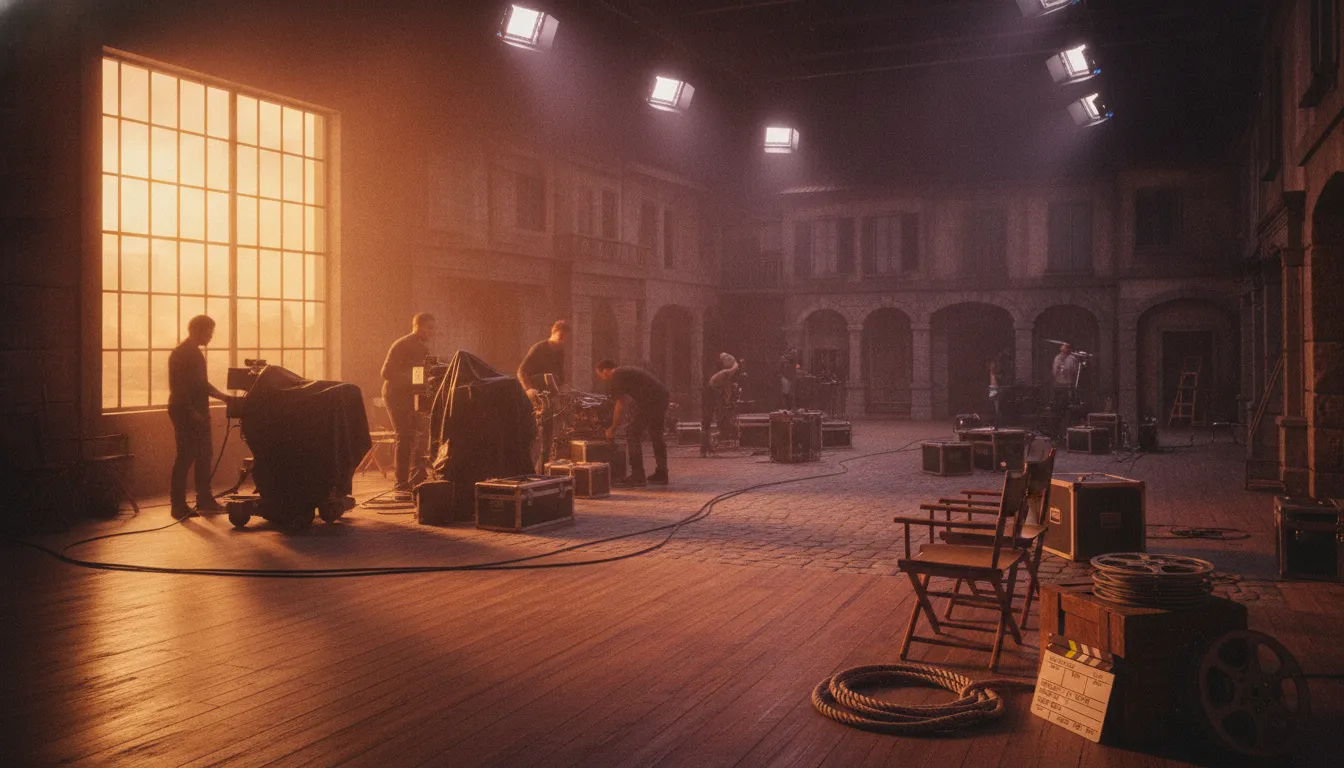
Cinema is a collective art like few others. Every film that reaches the screens carries the invisible work of hundreds of professionals—foley artists creating sounds with improbable objects, stunt doubles planning jumps to the millimeter, editors choosing the perfect cut from thousands of options, and continuity supervisors checking if the glass is in the right hand.
Knowing these behind-the-scenes details does not diminish the magic of cinema—on the contrary, it deepens it. When you understand how much effort, technique, and creativity is behind each scene, the experience of watching a film becomes even richer. The next time you sit in the dark seat and the screen lights up, remember: you are not just seeing a product. You are witnessing the result of an extraordinary human collaboration, full of secrets and stories that deserve to be told.
- Take: Each time a scene is filmed. “Take 1” is the first attempt; if it doesn’t work, comes “Take 2,” and so on.
- Clapperboard: The iconic object clapped before each take. Besides marking the start of the scene, it helps synchronize audio and image in editing.
- Punches and impacts: Hitting a slice of raw meat or a wet pillow.
- Art and Set Design: Responsible for building, finding, and decorating each filmed environment. In period productions, they research historical documents to ensure each object is true to the period depicted.


