
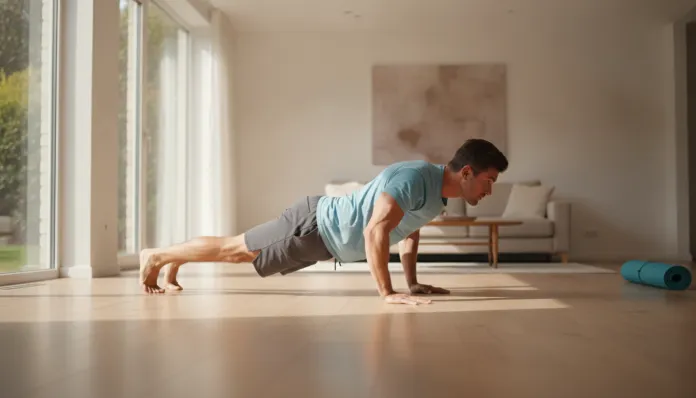
Who hasn’t thought about starting to exercise but stumbled over lack of time, gym costs, or simply the laziness of leaving the house? This barrier is more common than it seems. The good news is that building an efficient physical activity routine doesn’t require a membership, expensive equipment, or travel. With a mat, a little space, and some motivation, you can work your entire body without leaving your apartment or house.
Health and physical education experts have emphasized for years that exercises using your own body weight — known as calisthenics — are sufficient to improve muscular endurance, flexibility, balance, and cardiovascular health when practiced regularly and with proper progression. In other words, it’s not the sophistication of the workout that yields results: it’s the consistency.
This article gathers practical, accessible, and safe exercises for those who want to start — or resume — a routine at home. Remember: the guidelines here are informational and general. Individuals with pre-existing health conditions, injuries, or specific questions should consult a doctor or fitness professional before starting any activity.
Why Training at Home Works?
The idea that a gym is indispensable gained traction with fitness industry marketing over the decades, but the science of human movement points in another direction. The body responds to the stimulus — not the location where it is applied.
Exercises like squats, push-ups, planks, and jumping jacks engage large muscle groups and significantly elevate heart rate. When organized into sets, repetitions, and with progressive difficulty over time, they promote real physical adaptations, such as increased strength, improved aerobic conditioning, and reduced sedentary behavior.
Another relevant factor is adherence. Research in health behavior consistently indicates that practicality is one of the biggest determinants of continuity. When the workout is just a few steps away from the bed or sofa, the chances of maintaining the routine increase considerably.
What You Need Before Starting
Before jumping into the exercises themselves, some basic points make all the difference in the quality and safety of the workout:
- Minimum space: an area of approximately 2m x 2m is sufficient for most exercises
- Proper attire: comfortable clothing that does not restrict movement
- Footwear: shoes with good grip or, on safe floors, barefoot
- Mat or pad: essential for floor exercises, protecting knees and hips
- Hydration: have water nearby and drink before, during, and after the workout
- Warm-up: never skip this step — 5 to 10 minutes of light movements prevent injuries
Warm-up: The Step That Cannot Be Ignored
The warm-up prepares joints, muscles, and the cardiovascular system for the effort that follows. It raises body temperature, increases blood flow, and improves movement range. Skipping this step is one of the most common — and risky — mistakes of those who train at home.
Suggested warm-up routine (5 to 8 minutes):
- March in place for 2 minutes, progressively raising the knees
- Shoulder rotation — 10 repetitions forward, 10 backward
- Hip rotation — 10 circles each side
- Light squat without weight — 10 slow repetitions
- Arm opening and closing (air hug) — 15 repetitions
- Lateral leg raises — 10 on each side
Essential Full-Body Exercises
Below is a selection of exercises that cover the main muscle groups. All can be done by beginners, with variations for those already more conditioned.
Bodyweight Squat
Muscles worked: quadriceps, glutes, hamstrings, and core (central body region)
- Stand with feet shoulder-width apart
- Slightly turn feet outward
- Bend knees and push hips back as if sitting in an imaginary chair
- Lower until thighs are parallel to the floor (or as comfortable)
- Rise by pushing heels against the floor
- Keep chest lifted and gaze forward
Beginner: 3 sets of 10 reps | Intermediate: 3 sets of 20 reps
Push-up
Muscles worked: chest, triceps, shoulders, and core
- Place hands on the floor, slightly wider than shoulders
- Extend legs back, supporting feet (classic position) or knees (easier version)
- Keep body straight — don’t let hips rise or sink
- Bend elbows and lower chest towards the floor
- Push back to the starting position
Beginner (knees on the floor): 3 sets of 8 reps | Intermediate: 3 sets of 15 reps
Plank
Muscles worked: core, lower back, shoulders, and glutes
- Place forearms on the floor, elbows below shoulders
- Extend legs back, supporting feet
- Contract abs and glutes
- Keep body straight from head to heels
- Breathe normally during hold time
Beginner: 3 sets of 20 seconds | Intermediate: 3 sets of 45 to 60 seconds
Lunge
Muscles worked: quadriceps, glutes, and calves
- Stand with feet together
- Step forward with one leg
- Bend both knees until the back knee almost touches the floor
- Push with the front foot and return to starting position
- Alternate legs
Beginner: 3 sets of 8 reps per side | Intermediate: 3 sets of 15 per side
Hip Raise (Glute Bridge)
Muscles worked: glutes, hamstrings, and lower back
- Lie on your back with knees bent and feet flat on the floor
- Keep arms along the body
- Contract glutes and push hips up
- Lift until body forms a straight line from shoulders to knees
- Hold for 2 seconds at the top and lower with control
Beginner: 3 sets of 12 reps | Intermediate: 3 sets of 20 reps
Creating a Weekly Routine
The ideal frequency varies according to each person’s goals and fitness level. Generally, for beginners, three to four training days per week with at least one rest day between sessions is a safe and effective starting point.
Day Activity Monday Full workout (30 min) Tuesday Rest or light walk Wednesday Full workout (30 min) Thursday Active rest (stretching) Friday Full workout (30 min) Saturday Light or free activity Sunday Rest Rest is not optional — it’s during rest that the body repairs and strengthens the muscles worked. Ignoring recovery days increases the risk of injuries and overtraining.
Tips for Maintaining Consistency
Creating the habit is, for many, the hardest part. Some simple strategies help make training an automatic part of the routine:
- Set a fixed time: training at the same time creates a mental trigger that facilitates adherence
- Start small: 20 minutes three times a week is a real start — don’t wait to have an hour free
- Prepare the environment: leave the mat laid out or the workout clothes ready the night before
- Track your progress: note repetitions, sets, and how you felt — seeing progress is motivating
- Use music or podcasts: auditory stimuli help make the workout more enjoyable
- Don’t wait for motivation to start: start and motivation will appear during the exercise
The organization of space and daily routine also influences the creation of healthy habits. If you want to better understand how to structure your environment to favor productivity and well-being, check out the article The Secret to a Tidy Home: Mastering Organization and Cleanliness — the principles directly apply to creating a workout routine.
Stretching: Closing the Cycle
Stretching at the end of the workout helps reduce muscle tension, improves flexibility over time, and contributes to a more comfortable recovery. Ten minutes of static stretching — where each position is held for 20 to 30 seconds — already make a noticeable difference.
Focus on the areas most used in the workout: calves, quadriceps, glutes, spine, and shoulders. Breathe deeply in each position and never push beyond a comfortable limit.
Conclusion
Training at home, efficiently and safely, is within reach for anyone — regardless of physical conditioning, budget, or routine. Basic calisthenic exercises, when practiced with regularity, progression, and attention to the body, can yield real results in strength, energy, and quality of life.
The secret is not in doing a lot at once, but in doing it consistently over time. Start with what you can today, respect your limits, and progress at your own pace. Just like any healthy habit — be it in diet, sleep, or routine organization — the building happens day by day, one session at a time.
And remember: in case of pain, persistent discomfort, or specific health conditions, always consult a doctor or fitness professional. The information presented here is general and educational and does not replace an individualized assessment.
Mais Lidas
O Jornal Meia Hora é um portal de notícias que oferece informações atualizadas sobre política, economia, esportes, entretenimento e mais. Nosso compromisso é manter nossos leitores informados com notícias precisas e imparciais.
Redação
Trending
Categorias
© Jornal Meia Hora. Todos os direitos reservados.
- Start small: 20 minutes three times a week is a real start — don’t wait to have an hour free
- Set a fixed time: training at the same time creates a mental trigger that facilitates adherence
- Proper attire: comfortable clothing that does not restrict movement


