
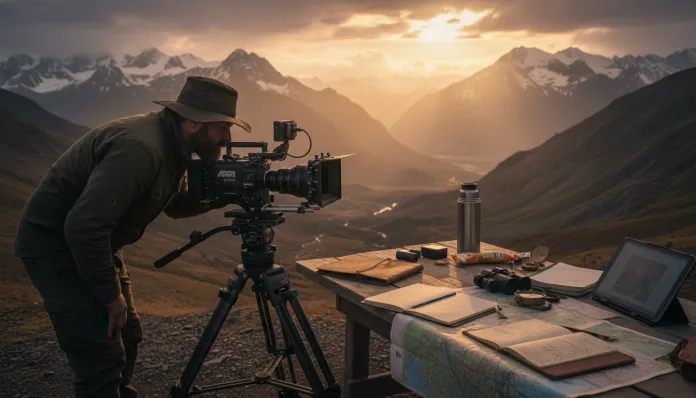
There is a peculiar sensation that occurs when you finish watching a documentary and realize the world has become a bit larger than it was before. That feeling that you have learned something that no one can take away from you — about science, history, human behavior, nature, or art. It’s no wonder that the documentary format is experiencing one of its best moments: streaming platforms, specialized channels, and even online festivals have made this type of content more accessible than ever, attracting audiences who would never have thought of sitting down to watch an “educational film.”
The truth is that modern documentaries are anything but boring or monotonous. Contemporary directors master narrative techniques that rival fictional series: cliffhangers, complex characters, carefully constructed soundtracks, and editing that holds attention from start to finish. The result is that you learn without realizing you’re “studying” — and that’s exactly its strength.
If you’re looking for a way to make better use of screen time, turning entertainment into personal growth, this guide presents categories, relevant titles, and tips for creating a true learning journey through documentaries.
Why Documentaries Are Powerful Learning Tools
Research in cognitive psychology generally indicates that associating new information with emotional and narrative contexts facilitates retention. That’s why a well-told story tends to stick in memory much more than a technical text on the same subject. Documentaries combine exactly these elements: narrative, emotion, image, and sound.
Moreover, the audiovisual format allows showing what words can hardly describe with the same effectiveness — the scale of the universe, the movements of a school of fish, the expression on a person’s face telling their story. This sensory richness creates what experts call multimodal learning, that is, the activation of different sensory channels at the same time, which enhances understanding.
Another relevant point: documentaries often present real experts, archival images, contextualized data, and diverse perspectives on the same subject. When well-produced, they serve as a condensed, accessible, and free course — or almost so.
Science and Nature: The World Seen from Another Angle
This is perhaps the most classic category of educational documentaries. Series produced by the BBC over the decades, such as “Planet Earth” (2006) and its sequel “Planet Earth II” (2016), redefined the standard of visual and scientific quality in the genre. The narration by Sir David Attenborough — present in dozens of productions about the natural world — has become a reference for how to communicate science with clarity and emotion.
In the field of astronomy, “Cosmos: A Spacetime Odyssey” (2014), presented by astrophysicist Neil deGrasse Tyson, is an essential starting point. The series revisits and updates Carl Sagan’s original work and explains concepts like the expansion of the universe, the evolution of stars, and humanity’s place in the cosmos in a way that is accessible to anyone.
For those interested in the microscopic world, documentaries on cell biology, genetics, and microbiology are gaining increasing space. They reveal that the most extraordinary life often happens on scales that our eyes cannot reach.
History and Society: Understanding the Present through the Past
Historical documentaries have the power to put into perspective events that have shaped the world as we know it. American director Ken Burns is an unavoidable name in this category: his long and detailed productions on the American Civil War, jazz, baseball, and other topics explore photographic archives and testimonies with almost archaeological care.
“13th” (2016), directed by Ava DuVernay, analyzes the U.S. prison system from a historical reading of the 13th Amendment to the American Constitution. It is an example of a documentary that uses data, interviews, and historical context to discuss a complex topic in depth.
For Brazilian audiences, documentaries about the country’s history — available on national platforms and YouTube — cover everything from the colonial period to cultural movements of the 20th century. The important thing when watching any historical documentary is to keep in mind that every film has a point of view: identifying the director’s perspective is part of the critical exercise of learning.
Economy, Technology, and Behavior: Documentaries that Change Your Worldview
One of the fastest-growing categories in recent years is documentaries on economics, human behavior, and the impact of technology on society. “The Social Dilemma” (2020), produced by Netflix, brought together former employees of major tech companies to discuss persuasive design mechanisms on social networks. Regardless of any political stance, the film raised relevant debates about attention, privacy, and mental health.
“Inside Job” (2010), which won the Oscar for Best Documentary, explains in detail the causes of the 2008 global financial crisis. It is a notable example of how the format can make complex economic concepts — like financial derivatives and leverage — understandable to the general public.
At the intersection of technology and the future, series and documentaries on artificial intelligence, biotechnology, and climate change have multiplied on platforms throughout the 2020s. For those who want to understand the transformations underway in the world of work and daily habits, this type of content offers a valuable overview. If you’re thinking, for example, about how to start a business with little investment, understanding technological trends through documentaries can be a good starting point.
Art, Culture, and Creativity: Learning Through Observation
Documentaries about art, music, cinema, and gastronomy are often underestimated as sources of learning but offer something that other formats rarely achieve: showing the creative process from within. Seeing a visual artist explaining their choices, a chef narrating the cultural origin of a dish, or a musician describing how they composed a song is a learning experience about creativity, discipline, and culture.
“Jiro Dreams of Sushi” (2011) follows Jiro Ono, owner of a sushi restaurant in Tokyo with three Michelin stars, and becomes, at the same time, a meditation on excellence, work, and dedication. “Amy” (2015), about singer Amy Winehouse, uses personal archives to construct a human and complex portrait — and teaches a lot about the music industry.
In the field of design and architecture, documentaries about figures like designer Dieter Rams or architect Tadao Ando reveal work philosophies that transcend their specific areas and speak about how to think and create with intention.
How to Create Your Own Documentary Journey
Watching documentaries intentionally enhances learning. Here are some practical suggestions:
- Choose one topic at a time: Instead of jumping between subjects, explore a topic in depth over a few weeks. Watch two or three documentaries on the same subject to get different perspectives.
- Take notes while watching: A physical notebook or a note-taking app can record new concepts, mentioned names, or questions that arise during the film.
- Research afterward: Use the documentary as a starting point, not an endpoint. Look for articles, books, or podcasts on the same topic to deepen what was presented.
- Discuss with someone: Explaining what you learned to someone else is one of the most effective ways to consolidate knowledge.
- Use subtitles in another language: If you’re learning English or another language, documentaries with subtitles in the original language are excellent immersion tools.
- Evaluate the source: Check who produced the documentary, when, and for what purpose. This helps contextualize the point of view presented.
- Alternate categories: Mixing science, history, art, and human behavior creates unexpected connections between different areas of knowledge.
Platforms and Where to Find Good Documentaries
- Netflix: Offers a wide catalog of original and licensed documentaries, with award-winning productions in various categories.
- YouTube: Channels like BBC, National Geographic, PBS, and dozens of independent producers provide free high-quality content.
- Mubi: A platform focused on art cinema and auteur documentaries, with specialized curation.
- DocPlay and similar: Platforms dedicated exclusively to the documentary genre, with thematic catalogs.
- Canal Curta! (Brazil): A Brazilian television and streaming channel specializing in national and international documentaries.
- Public digital libraries: Some public platforms, like the National Digital Library, offer access to audiovisual productions at no cost.
Conclusion
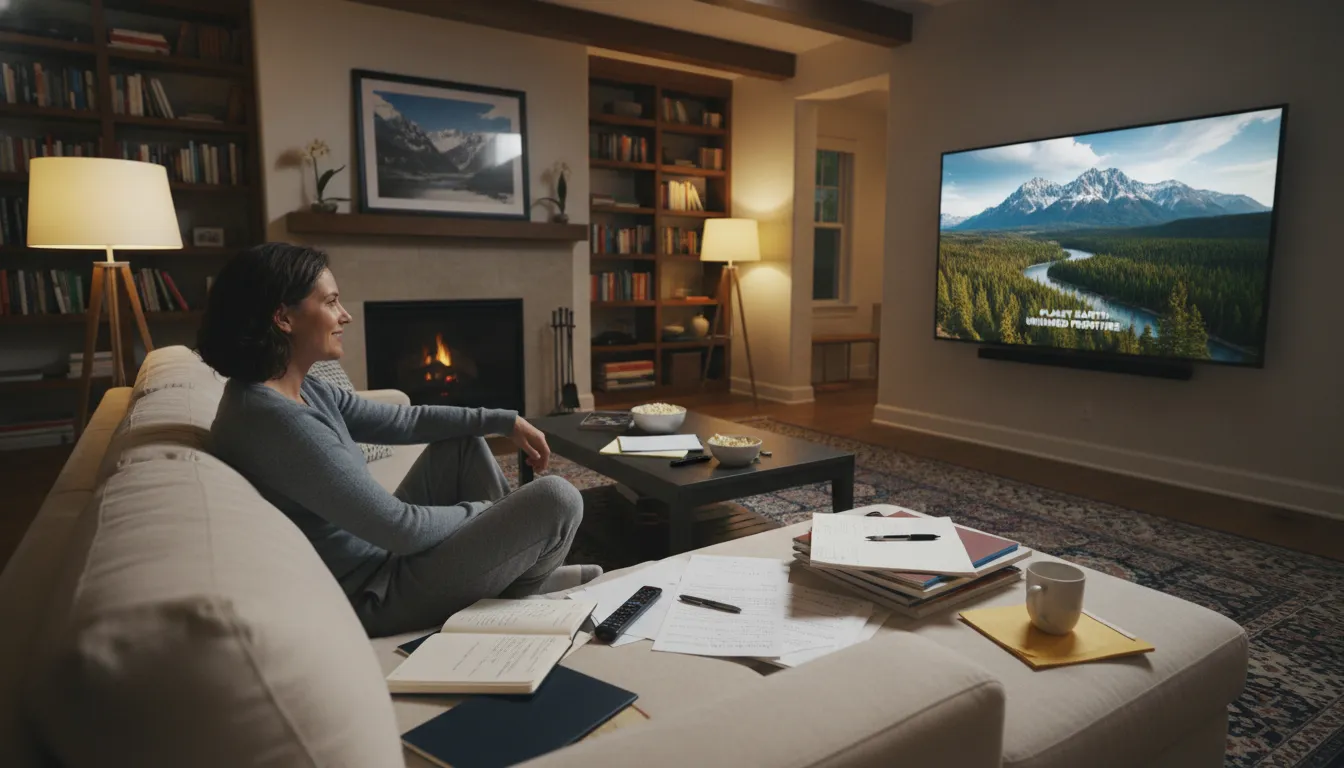
Documentaries are one of the richest and most accessible ways to learn continuously — about the planet, human history, science, art, and ourselves. In a time when information is abundant but attention is scarce, choosing content with intention makes a real difference in the quality of what we absorb.
Each session can be a door to a world you didn’t know yet. The astrophysics that seemed distant, the economic crisis you never quite understood, the artist who changed the history of music — all this can start with 90 minutes on the screen. The secret lies in choosing well, watching attentively, and taking the questions that arise beyond the final credits.
If you enjoy learning in various ways and are always seeking new experiences, perhaps a well-planned weekend trip might also fit into your repertoire — after all, learning doesn’t have to happen only on the screen.
- YouTube: Channels like BBC, National Geographic, PBS, and dozens of independent producers provide free high-quality content.
- Take notes while watching: A physical notebook or a note-taking app can record new concepts, mentioned names, or questions that arise during the film.


