

# 5 Essential Analyses to Transform Your Business Decisions Today
Introduction: The Power of Data-Driven Analyses
In today’s business environment, relying solely on intuition or past experience is no longer sufficient. The fierce competition, constant changes in consumer behavior, and rapid technological advancements require business leaders to adopt a more scientific, data-driven approach.
Business analytics have become the core of modern corporate strategy. Companies that invest in robust analytics can identify opportunities before their competitors, mitigate risks in advance, and optimize resources more efficiently. According to studies by McKinsey & Company, data-driven organizations are 23 times more likely to acquire customers, 6 times more likely to retain them, and 19 times more likely to be profitable.
This article presents five essential analyses that every manager should implement immediately to enhance the quality of their business decisions. From deep understanding of customer behavior to predictive analysis of market trends, each of these analytical tools offers valuable insights that can mean the difference between business success and stagnation.
1. Customer Behavior Analysis: Deeply Understanding Your Audience
The first and perhaps most fundamental analysis any business should master is a deep understanding of customer behavior. It’s not enough to know who buys your products or services; it’s essential to understand why they buy, when they buy, how they make decisions, and what motivates them to remain loyal or switch to competitors.
Key Elements of Behavioral Analysis
Customer behavior analysis encompasses several interconnected components. The first is mapping the customer journey, which identifies all touchpoints between the consumer and your brand, from initial discovery to post-sale. Understanding each stage of this journey allows you to identify friction points causing abandonment and opportunities for delight that can strengthen the relationship.
The second component is advanced segmentation, which goes beyond simple demographic data. Using modern analytical tools, you can segment customers based on behaviors, preferences, purchase history, digital engagement, and even sentiments expressed in interactions with the brand. This behavioral segmentation allows for much more effective personalization of offers and communications.
The analysis of lifetime value (LTV) is another critical element. This metric projects how much value a specific customer or customer segment will bring to the business over the entire relationship. Understanding LTV allows for smarter decisions about how much to invest in acquiring and retaining different types of customers.
Tools and Practical Implementation
Platforms like Google Analytics, Mixpanel, and Amplitude offer powerful resources for tracking and analyzing user behavior in digital environments. For businesses with a physical presence, CRM systems integrated with point-of-sale data can provide equally valuable insights.
Effective implementation of this analysis requires establishing clear KPIs related to customer behavior, such as conversion rate, cart abandonment rate, purchase frequency, average ticket size, and net promoter score (NPS). Regularly monitoring these metrics and comparing them with industry benchmarks provides valuable context for evaluating performance.
Additionally, qualitative techniques like customer interviews, focus groups, and feedback analysis can complement quantitative data, offering context and nuances that numbers alone do not reveal. Combining quantitative and qualitative methods provides a holistic view of customer behavior.
2. Advanced Financial Analysis: Beyond Profit and Loss
While basic financial statements are essential, advanced financial analyses offer much deeper insights into the business’s health and opportunities. Understanding not only if the company is profitable but which products, channels, or customer segments are most profitable allows for optimizing strategies and allocating resources more efficiently.
Profitability Analysis by Segment
One of the most revealing financial analyses is profitability by segment. This involves breaking down revenues and costs not just by product or service, but by sales channel, geographic region, customer type, or any other relevant business dimension.
Many companies discover through this analysis that a significant portion of their products or customers actually destroy value when all costs (including indirect and service costs) are properly allocated. This insight allows for strategic decisions about where to focus growth efforts and where restructuring or divestment may be necessary.
Contribution margin analysis is particularly valuable as it shows how much each product, service, or customer contributes to covering fixed costs and generating profit. Identifying products or services with high contribution margins allows for more profitable growth strategies.
Cash Flow Analysis and Financial Health
As emphasized by the Harvard Business Review, many profitable companies on paper face liquidity issues due to inadequate cash flow management. Projected cash flow analysis, which forecasts cash inflows and outflows over different time horizons, is crucial to ensure the business can meet commitments and seize opportunities.
Metrics like working capital, cash conversion cycle, and liquidity ratios provide visibility into the company’s ability to operate efficiently and respond to challenges. Sensitivity analysis, which examines how changes in key variables (such as sales volume, prices, or costs) affect financial outcomes, enables scenario planning and proactive risk management.
Implementing dynamic financial modeling, which allows for quickly simulating the impact of different strategic decisions on financial outcomes, transforms financial analysis from a retrospective activity into a powerful prospective tool for guiding decisions.
3. Competitive and Market Positioning Analysis
No business operates in isolation. Deeply understanding the competitive landscape and how your company positions itself in that context is essential for developing winning strategies. Modern competitive analysis goes far beyond simply identifying who the competitors are; it involves understanding their strategies, strengths, vulnerabilities, and likely moves.
Multidimensional Competitive Mapping
Effective competitive mapping considers multiple dimensions simultaneously. This includes price positioning, perceived quality, breadth of offering, distribution channels, marketing investment, technological capabilities, and brand strength. Tools like SWOT analysis (strengths, weaknesses, opportunities, and threats) and Porter’s five forces remain relevant when applied rigorously.
Monitoring relative market share and its evolution over time provides clear indicators of whether your strategies are working. Analyzing not only your own share but also how it is distributed among competitors can reveal important market changes, such as the emergence of new disruptive players or industry consolidation.
Brand positioning analysis, using techniques like perceptual maps, helps visualize how customers perceive different brands on relevant attributes. This can reveal unoccupied spaces in the market (white spaces) that represent opportunities for differentiation.
Continuous Competitive Intelligence
Modern competitive intelligence leverages digital tools for continuous monitoring. Social listening platforms allow tracking of competitor mentions and sentiment towards them. SEO tools reveal which keywords and content are driving traffic to competitor sites. Analyzing competitors’ job postings can indicate areas of strategic investment or expansion.
Public information such as financial reports, press releases, conference participation, and registered patents provide valuable data on strategic direction. As mentioned in our article on in-person conferences in the digital age, industry events remain valuable sources of competitive intelligence, allowing observation of product demonstrations, listening to executive presentations, and networking for insights.
Organizing this information into a structured competitive intelligence system, with regular updates and distribution to relevant decision-makers, ensures that competitive insights inform strategic decisions in real-time.
4. Operational and Efficiency Analysis
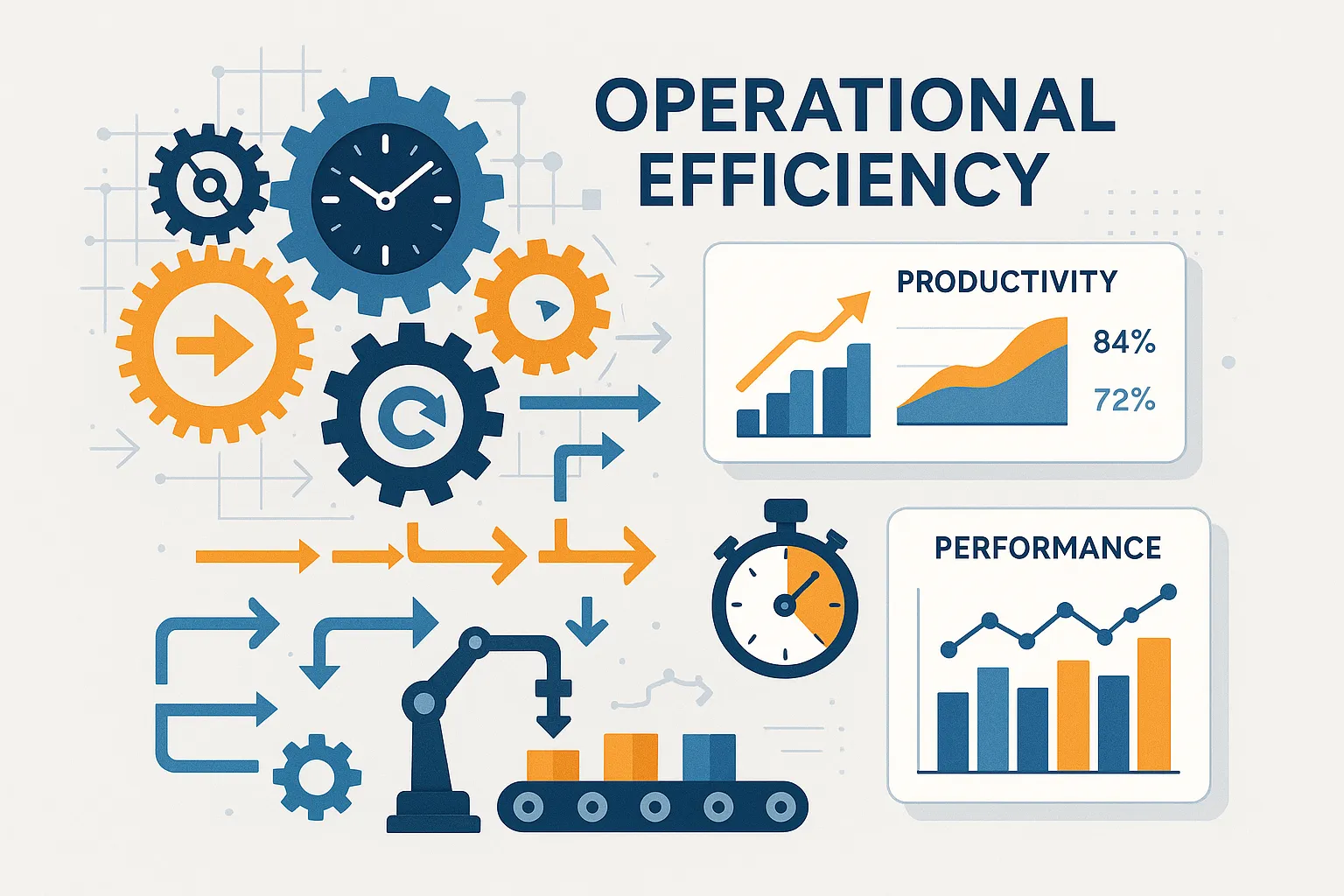
Operational excellence often represents the difference between marginally profitable and highly profitable businesses. Operational analysis identifies bottlenecks, inefficiencies, and optimization opportunities in business processes, allowing you to do more with less and free up resources for strategic initiatives.
Process Mapping and Optimization
The first step in operational analysis is mapping key processes from end to end. This involves documenting each step, responsible party, time required, resources consumed, and outputs produced. Process mapping tools and methodologies like Lean Six Sigma provide structured frameworks for this analysis.
Once mapped, processes can be analyzed to identify waste: steps that do not add value, rework, excessive wait times, unnecessary movements, and overproduction. Systematically eliminating these wastes often results in dramatic improvements in productivity and quality.
The analysis of resource utilization rates — whether people, equipment, or facilities — reveals capacities


