

# 7 Unexplored Destinations Around the World That Will Transform Your Travel Perspective
In an increasingly connected world, where social media repeatedly shows us the same paradisiacal beaches and iconic monuments, there is something profoundly liberating about discovering places that have not yet been invaded by mass tourism. These unexplored destinations offer not only untouched landscapes but also authentic experiences that reconnect us with the true essence of travel: discovering, exploring, and transforming through contact with the unknown.
The search for destinations off the traditional circuit is not just a passing trend but a growing movement among travelers who want something deeper than selfies at crowded tourist spots. Just as transformative books can change our perspective on life, visiting unexplored places can completely revolutionize our view of the world and our place in it.
In this article, we will explore seven extraordinary destinations that remain relatively unknown to mainstream tourism, each offering unique experiences that go far beyond the conventional. Get ready to add surprising places to your travel list and discover that the world still holds wonderful secrets waiting to be revealed.
1. Faroe Islands – The Forgotten Archipelago of the North Atlantic
Located between Iceland and Norway, the Faroe Islands are an archipelago of 18 volcanic islands that seem to have come straight out of a Nordic fantasy. With a population of just about 50,000, this autonomous territory of Denmark remains one of Europe’s best-kept secrets.
The landscapes of the Faroes are simply breathtaking: dramatic cliffs plunging into the Atlantic Ocean, waterfalls cascading directly into the sea, colorful villages with grass-roofed houses, and a mystical mist that envelops everything in an air of mystery and magic. The island of Vágar is home to one of the world’s most impressive visual phenomena: Lake Sørvágsvatn, which appears to be suspended above the ocean due to an optical illusion created by the unique topography of the area.
What makes the Faroes especially attractive to travelers seeking authenticity is the preservation of their cultural traditions. The Faroese language, a descendant of Old Norse, is still spoken daily. Traditional music, with its medieval ballads called “kvæði,” remains a living part of local culture. And the cuisine, which includes fermented lamb, air-dried fish, and the famous ræst (a traditional fermentation process), offers a unique culinary experience.
For nature lovers, the islands are a paradise for bird watching, with colonies of puffins, gulls, and other marine species. The hiking trails offer spectacular views, although the weather can be unpredictable – they say in the Faroes you can experience all four seasons in a single day.
2. Socotra, Yemen – The Alien Archipelago
If there is a place on Earth that seems to belong to another planet, that place is Socotra. This isolated archipelago in the Indian Ocean, technically part of Yemen, was separated from the African continent over 20 million years ago, resulting in a unique ecosystem where about a third of its flora exists nowhere else in the world.
The most emblematic tree of Socotra is the Dracaena cinnabari, known as the “dragon’s blood tree” due to its red resin and inverted umbrella shape that looks like it was designed by a science fiction illustrator. These ancient trees, some over 600 years old, create a surreal landscape that challenges our perception of what is possible in terrestrial nature.
In addition to the dragon’s blood trees, Socotra is home to the desert rose (Adenium obesum socotranum), which grows in bizarre and swollen shapes, adapted to arid conditions. The island also offers virtually deserted white sand beaches, limestone caves, sand dunes, and mountains reaching up to 1,500 meters in altitude.
The local population, predominantly of Arab and African origin, maintains a traditional lifestyle that has changed little over the centuries. They speak Soqotri, an ancient Semitic language with no written form, and live mainly from fishing, goat herding, and collecting resin and oils from endemic plants.
Visiting Socotra is challenging due to the unstable political situation in Yemen and limited tourist infrastructure, but for those willing to face these difficulties, the reward is a truly unique experience – walking among landscapes that seem like science fiction movie sets and witnessing an ecosystem that has remained isolated and virtually untouched by modernity.
3. Wakhan Corridor, Afghanistan – The Remote Corridor of the Pamir Mountains
The Wakhan Corridor is a narrow strip of Afghan territory extending eastward between Tajikistan to the north and Pakistan to the south, briefly touching the Chinese border. This remote and mountainous region, part of the impressive Pamir Mountains, is one of the most isolated and untouched places on the planet.
Historically, Wakhan was part of the ancient Silk Road, serving as a vital trade corridor between Central Asia and the Indian subcontinent. Today, the region remains virtually frozen in time, with nomadic Wakhi and Kyrgyz communities maintaining traditional pastoral lifestyles, herding yaks and living in yurts (traditional tents) at high altitudes.
The landscapes of Wakhan are of wild and untouched beauty: deep valleys carved by turquoise glacial rivers, snow-capped peaks reaching altitudes over 7,000 meters, and alpine pastures where herds graze during the short summers. The geographical isolation has preserved not only cultural traditions but also wildlife, including the rare snow leopard, Siberian ibex, and Marco Polo sheep.
Visiting Wakhan requires careful planning, physical endurance for the high altitudes, and a willingness to endure basic accommodation conditions. However, the region offers some of the most spectacular trekking experiences in the world, with trails leading through dramatic mountain landscapes, encounters with hospitable communities that rarely see foreigners, and a genuine sense of pioneering adventure.
It is important to note that, although Wakhan has remained relatively peaceful compared to other regions of Afghanistan, traveling to the country requires careful research on current security conditions and, ideally, the accompaniment of specialized tour operators with experience in the region.
4. São Tomé and Príncipe – The Forgotten African Paradise
While African destinations like the Seychelles and Mauritius attract thousands of tourists annually, the small island nation of São Tomé and Príncipe remains virtually unknown, offering everything travelers seek in a tropical island – stunning beaches, lush forests, rich culture – without the crowds.
Located in the Gulf of Guinea, this volcanic archipelago of two main islands was uninhabited until its discovery by the Portuguese in the 15th century. The colonial history left a unique heritage: abandoned cocoa plantations known as “roças,” now partially engulfed by the tropical jungle, which serve as atmospheric reminders of the past and, in some cases, have been transformed into charming accommodations.
São Tomé and Príncipe is a paradise for nature lovers. The island’s rainforests are home to endemic bird species, including the São Tomé sunbird and the crested ibis. The beaches, many completely deserted, offer golden or dark volcanic sands framed by palm trees and dramatic rock formations. Pico Cão Grande, a dramatic volcanic plug rising 663 meters directly from the jungle, is one of Africa’s most impressive geological formations.
São Toméan culture is a fascinating blend of African and Portuguese influences, reflected in local music, dance, and cuisine. The country is also known for its high-quality chocolate, produced from organic cocoa grown on the island’s plantations. Just as Brazil offers extraordinary natural diversity, São Tomé and Príncipe surprises with its concentrated biodiversity in a small territory.
For adventurers, the country offers opportunities for diving in crystal-clear waters, hiking through the rainforest, climbing volcanic peaks, and exploring secret beaches accessible only by boat. The tourist infrastructure is basic but adequate, and the absence of excessive development is precisely part of the charm.
5. Kham Region, Eastern Tibet – The Authentic Cultural Tibet
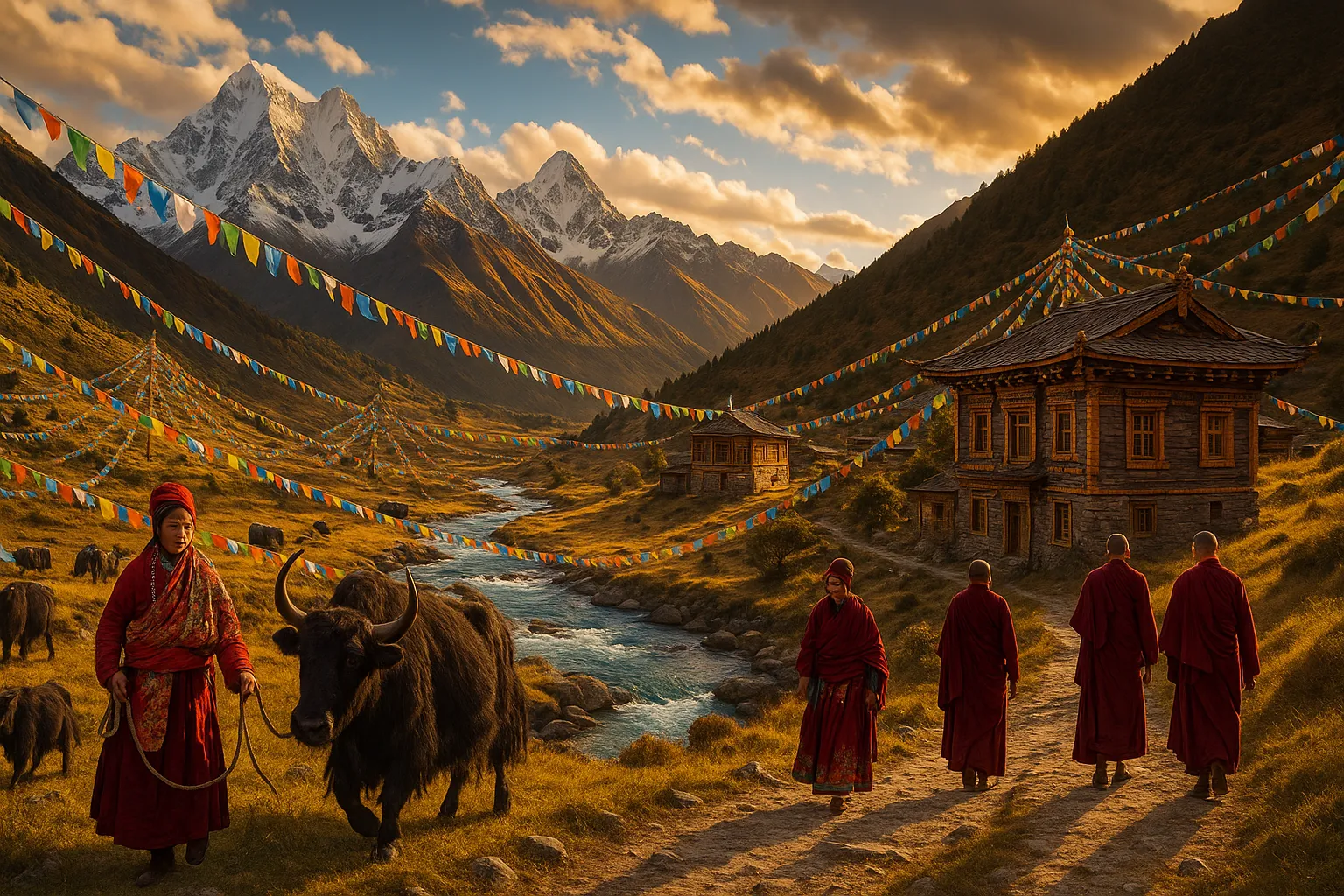
While Lhasa and the central regions of Tibet receive considerable attention (although access is controlled), the eastern region of Kham, which stretches between Tibet, Sichuan, and Yunnan in China, offers a more authentic and less regulated Tibetan experience, preserving cultural traditions and religious practices that have been suppressed in other areas.
Kham is often described as the “wild heart” of Tibet. The region is characterized by deep valleys, snow-covered mountains, rushing rivers, and vast plateaus where Tibetan nomads still live in yak-skin tents, following seasonal migration patterns that date back centuries. The landscape is dotted with spectacular Buddhist monasteries, many precariously perched on mountainsides, where monks maintain ancient spiritual practices.
One of the most notable aspects of Kham is its cultural diversity. The region is home to not only ethnic Tibetans but also a variety of minority groups.


