
Incredible Animals: Abilities That Defy Imagination
Imagine seeing with your eyes closed, breathing through your skin, or sleeping with half your brain while the other half stays awake. For humans, these feats sound like science fiction. For much of the creatures that share the planet with us, they are simply routine. The animal kingdom is a living laboratory of evolutionary solutions that took millions of years to perfect — and that, to this day, leave scientists amazed.
From the deepest oceans to the densest tropical forests, each species has developed unique strategies to survive, hunt, reproduce, and communicate. Some of these abilities are so sophisticated that they inspire human technologies, from submarine sonars to state-of-the-art adhesive materials. Others simply remind us that nature is, in many ways, beyond the reach of human engineering.
In this article, we dive into some of the most impressive capabilities of the animal world — with accessible explanations of how and why they work. Prepare yourself to look at animals with fresh eyes.
Echolocation: Seeing with Sound
Bats and dolphins are the most famous champions of an ability called echolocation — the capacity to “see” the environment by emitting high-frequency sounds and interpreting the returning echo. The system is so precise that a bat can detect a wire only 0.1 millimeter thick in complete darkness.
Bats emit ultrasonic pulses through their mouth or nose. When these sounds hit an object — a moth, for example — they bounce back. The animal processes this information in milliseconds, calculating distance, size, shape, and even surface texture. A bat’s brain devotes an enormous proportion of its capacity to interpreting these sound signals, which demonstrates how central this ability is to its survival.
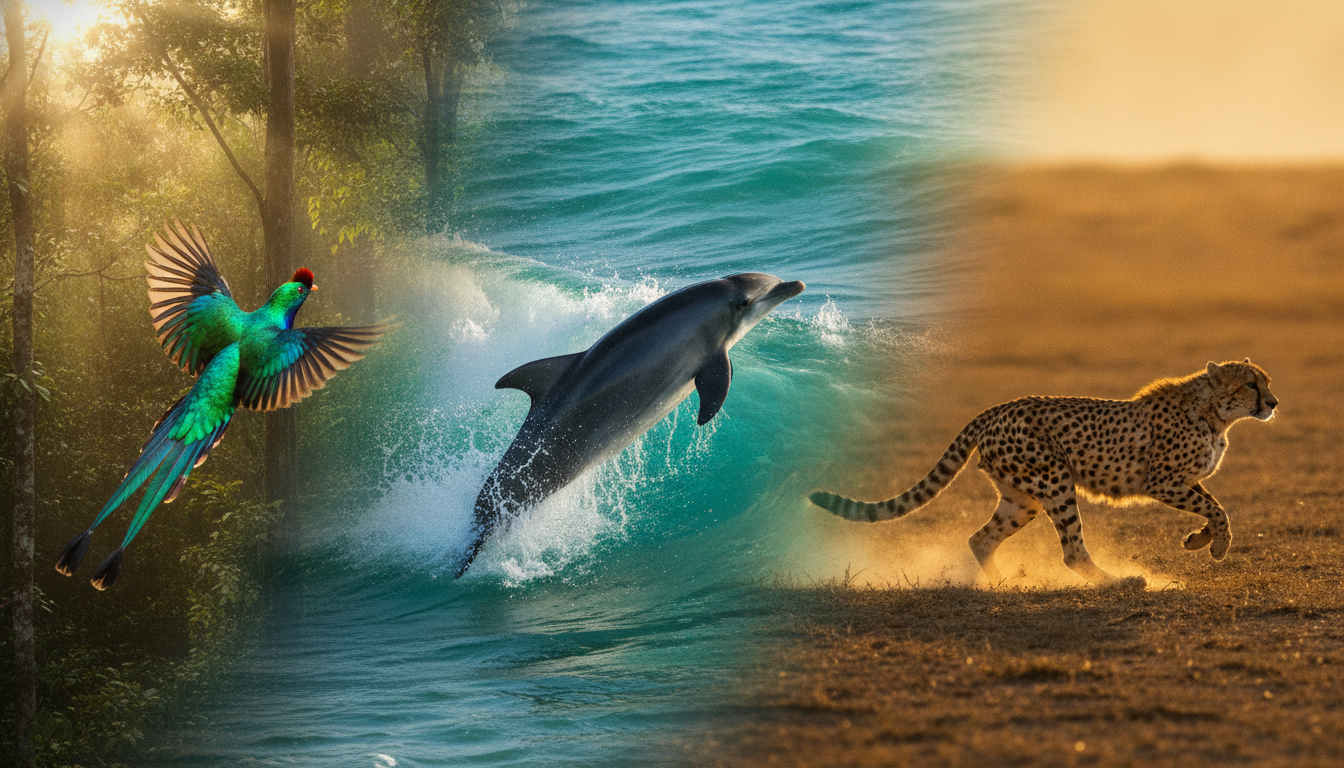
Dolphins do something similar in the aquatic environment, emitting high-frequency clicks through an organ called the melon, an adipose structure on the forehead that focuses the sounds. Their echolocation is so refined that it allows them to distinguish objects of different materials — such as metal and plastic — even if they are the same size. Researchers have used this principle to develop more efficient sonar systems, including for medical use in ultrasound imaging.
Sleeping with Half the Brain: The Secret of Dolphins and Birds
Sleep is, for humans, an activity that requires full dedication to rest. But imagine being able to sleep and stay awake at the same time — literally. Dolphins, whales, and many bird species do exactly that through a mechanism called unihemispheric slow-wave sleep.
In this process, only one hemisphere of the brain sleeps at a time, while the other remains active and alert. Dolphins, for example, need to surface regularly to breathe — which would be impossible during conventional deep sleep. With unihemispheric sleep, they can rest while continuing to swim, breathe, and monitor their surroundings simultaneously.
Migratory birds, such as the bar-tailed godwit (Limosa lapponica), also use this strategy during flights that can last days without pause. Documented studies have shown that this species can fly for more than eleven thousand kilometers without landing — a record among migratory birds. Partial brain sleep is what enables this seemingly impossible feat.
The Superhuman Strength of the Tarantula and the Natural Adhesive of the Octopus
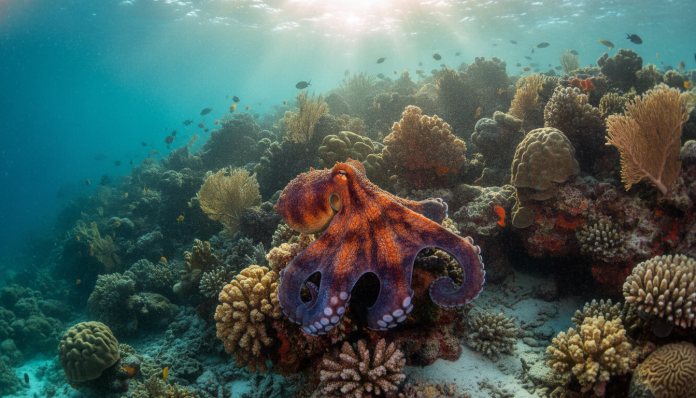
Nature invented adhesive long before humans did. Some species of octopuses have up to 240 suction cups on each tentacle, capable of exerting enough force to hold prey and open resistant shells. The mechanism is both hydraulic and muscular: each suction cup can create negative pressure independently, allowing the octopus to modulate grip force with surprising precision.
But the champion of natural adhesives might be the giant salamander and, in the insect world, the fishing spider (Dolomedes spp.) and certain beetles, which adhere to smooth surfaces thanks to microstructures in their feet that mimic the Van der Waals effect — a molecular attraction force of very short range. The gecko (Gekko gecko) is perhaps the most studied example: its toes possess millions of microscopic structures called setae, which create such intimate contact with the surface that molecular forces add up enough to support the animal’s weight at any angle, including upside down on glass.
Researchers at various universities around the world have attempted to replicate this structure in synthetic materials to create reusable adhesives that don’t depend on glue — with applications ranging from surgical equipment to robotics.
Regeneration: The Gift of Reconstructing One’s Own Body
The Axolotl: Master of Regeneration
The axolotl (Ambystoma mexicanum), a salamander native to Mexico, possesses an ability that defies what we know about animal biology: it can regenerate entire limbs, parts of the heart, lungs, and even portions of the central nervous system. It’s not just about scarring a wound — the axolotl reconstructs complex tissues, blood vessels, bones, and nerves with functional precision.
The process involves the formation of a structure called a blastema, a cluster of cells that “regresses” to a more primitive state and then redivides to form the necessary tissue. Scientists have studied this mechanism for decades hoping to understand how to activate similar capacities in human tissues.
The Starfish and Beyond
Starfish of various species can regenerate lost arms — and, in some species, an isolated arm can regenerate the entire body. Planarians, freshwater flatworms, are another impressive example: when cut into pieces, each fragment can originate a complete organism. This happens because these creatures possess a high proportion of adult stem cells relative to body size.
The Extraordinary Vision of the Mantis Shrimp
If you think humans see well, meet the mantis shrimp (Stomatopoda). While human eyes have three types of photoreceptors (for red, green, and blue), the mantis shrimp’s eyes have up to 16 different types of color receptors, in addition to sensors for ultraviolet and infrared light.
Interestingly, research published in peer-reviewed scientific journals has revealed that, despite this complexity, the mantis shrimp doesn’t necessarily “see” more colors than we do — its system seems to process information differently, identifying color ranges with extreme speed, more efficient for instantaneous decision-making than for the detailed perception we have. It is a different visual intelligence, not necessarily superior in all aspects, but fascinating in its uniqueness.
Furthermore, the mantis shrimp’s eyes move independently and can detect polarized light, which is useful for navigating and identifying prey with translucent shells.
Animal Communication: Languages We Are Still Learning to Decipher
Elephants and Infrasound
Elephants communicate through very low-frequency sounds — infrasound — that fall below the human hearing threshold (below 20 Hz). These sounds can travel several kilometers through soil and air, allowing separated herds to coordinate movements or alert each other about dangers. Elephants “hear” these signals both through their ears and their feet, which detect ground vibrations.
Bees and the Dance of Information
Worker bees perform the so-called waggle dance to inform hive mates of the direction and distance of food sources. The angle of the dance relative to vertical indicates direction relative to the sun; the duration of the central path indicates distance. It is a complex system of symbolic communication, with its own grammatical rules — and it was described in detail by zoologist Karl von Frisch, who received the Nobel Prize in Physiology or Medicine in 1973 precisely for this work.
Practical Abilities That Inspire Human Technology
The list of technologies inspired by the animal world is long and grows every year. See some concrete examples:
- Submarine sonar — based on the echolocation of bats and dolphins
- Dry reusable adhesives — inspired by gecko setae
- High-performance swimsuits — modeled after shark skin, which reduces friction with water thanks to micro-scales called dermal denticles
- Superhydrophobic materials — inspired by the lotus leaf and wings of some insects, which repel water and dirt through surface microstructures
- Building ventilation systems — based on termite mound architecture, which maintains internal temperature stability without mechanical systems
- Soft computing robotics — inspired by octopus tentacles to create flexible robotic arms
Conclusion: Nature as Master
What makes these abilities even more impressive is that none of them were designed — all emerged from billions of years of trial, error, and natural selection. Each adaptation exists because, at some point in evolutionary history, it made a difference between surviving and disappearing.
Studying the animal world is not only fascinating in itself; it is also an inexhaustible source of solutions to human challenges. The more we understand the mechanisms behind these abilities — the regeneration of the axolotl, the vision of the mantis shrimp, the communication of elephants — the more we realize how much we still have to learn from the other inhabitants of this planet.
Just as a healthy morning routine can transform our daily productivity by aligning our habits with our biological needs, the animal world reminds us that efficiency, adaptability, and creativity are universal principles — and that the best engineering often already exists in nature, waiting to be deciphered.