
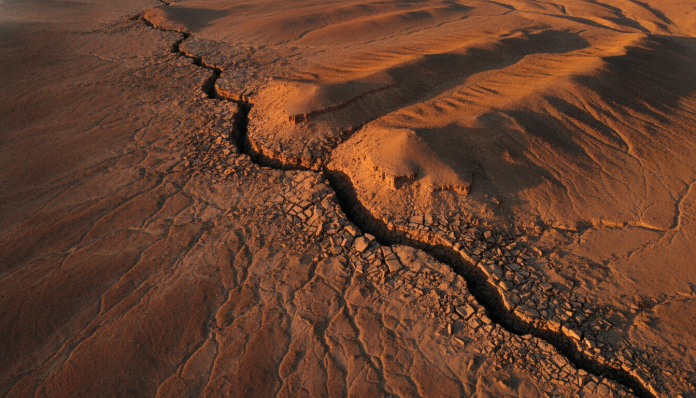
The Earth seems solid and stable beneath our feet, but the reality is quite different. Our planet is a dynamic, living sphere in constant motion — and earthquakes are one of the most dramatic manifestations of this internal activity. In a matter of seconds, the ground can shake, buildings can collapse, and entire landscapes can be transformed forever. But why does this happen?
The answer lies in the depths of the Earth, in geological processes that began billions of years ago and continue to this day. Understanding the origin of earthquakes is not just scientific curiosity: it is essential information for comprehending the planet we inhabit, the world’s most vulnerable regions, and what science can — and cannot — yet predict about these events.
In this article, we will delve into the causes of earthquakes, explain how they are measured, identify the most affected regions, and discover what happens inside the Earth to generate such tremendous force. Prepare to look at the ground with new eyes.
Earth’s interior: a machine in motion
To understand earthquakes, we must first know the structure of our planet. The Earth is not a uniform solid block. It is composed of distinct layers:
- Crust: the outermost layer, where we live. It can be between 5 km thick (beneath oceans) and 70 km thick (beneath large mountain ranges).
- Mantle: the intermediate layer, approximately 2,900 km thick. It is composed of solid rock, but behaves like an extremely viscous fluid on geological timescales.
- Outer core: liquid, composed mainly of molten iron and nickel.
- Inner core: solid, with temperatures exceeding 5,000°C.
The heat generated in the planet’s interior creates convection currents in the mantle — slow movements of hot material rising and cooler material sinking. These movements are the engine that drives the tectonic plates, and this is where the story of earthquakes truly begins.
Tectonic plates: the moving puzzle
The Earth’s crust is not a single piece. It is divided into large fragments called tectonic plates, which fit together like puzzle pieces. There are approximately 15 major plates — including the South American Plate, the North American Plate, the African Plate, the Eurasian Plate, and the Pacific Plate — plus dozens of smaller plates.
These plates move very slowly — on average, 2 to 10 centimeters per year, a speed comparable to the growth of human fingernails. But over millions of years, these movements build mountains, open oceans, and yes, cause earthquakes.
Plates can interact in three main ways:
- Convergent boundaries: two plates collide. One can sink beneath the other (subduction) or both can compress, forming mountain ranges like the Andes and the Himalayas.
- Divergent boundaries: two plates move apart, creating space for mantle material to rise and form new crust. This is what happens, for example, at the bottom of the Atlantic Ocean.
- Transform boundaries: two plates slide horizontally relative to each other. The famous San Andreas Fault in California (USA) is a classic example.
Why do earthquakes actually happen?
Earthquakes occur because tectonic plates do not move smoothly and continuously. Along plate boundaries, rocks become stuck to each other due to friction. Tension accumulates over years, decades, or even centuries — and when the breaking force is finally overcome, the stored energy is released abruptly, in the form of seismic waves.
The point inside the Earth where this rupture occurs is called the hypocenter (or focus). The point on the surface directly above the hypocenter is the epicenter — usually the location of the most intense shaking.
Seismic waves propagate from the focus in all directions, like waves created by a stone thrown in water. There are different types of seismic waves:
- P waves (primary): the fastest, which compress and expand material as they pass through. They are the first to be detected by seismographs.
- S waves (secondary): slower, moving material perpendicular to the direction of propagation. They only propagate through solids.
- Surface waves: the slowest, but usually the most destructive, as they propagate along Earth’s surface.
How are earthquakes measured?
The intensity of an earthquake is measured primarily by magnitude, which quantifies the energy released at the focus. The instrument used to detect and record seismic waves is the seismograph.
The most historically well-known scale is the Richter Scale, developed by seismologist Charles Richter in 1935. Today, scientists more frequently use the Moment Magnitude Scale (Mw), which is more accurate for large-scale events. Both are logarithmic — meaning an earthquake of magnitude 7 releases about 32 times more energy than one of magnitude 6.
Here is a practical reference for magnitudes:
| Magnitude | Description | Estimated frequency (per year) |
|---|---|---|
| Less than 2.0 | Imperceptible | Millions |
| 2.0 – 3.9 | Rarely felt | Over 1 million |
| 4.0 – 4.9 | Felt, rare damage | About 13,000 |
| 5.0 – 5.9 | Minor to moderate damage | About 1,300 |
| 6.0 – 6.9 | Destructive in populated areas | About 130 |
| 7.0 – 7.9 | Major earthquake, widespread damage | About 15 |
| 8.0 or more | Great earthquake, devastating | 1 to 2 |
The most seismically active regions on the planet
Not every part of the world experiences earthquakes with the same frequency or intensity. There is a region known as the Ring of Fire — a belt that surrounds the Pacific Ocean passing through Japan, Indonesia, the Philippines, the west coasts of the Americas (including Chile, Peru, and California) — where the vast majority of the planet’s earthquakes occur. It is estimated that approximately 90% of all seismic activity in the world happens in this region, due to intense tectonic and volcanic activity.
Other high seismic activity zones include:
- The Mediterranean and Middle East, where the Eurasian Plate meets the African Plate and the Arabian Plate.
- The Andes Cordillera, in South America, resulting from the subduction of the Nazca Plate beneath the South American Plate.
- The south of Asia, including Pakistan, India, and Nepal, where the Indian Plate continues colliding with the Eurasian Plate.
Brazil, located in the interior of the South American Plate, far from active tectonic boundaries, has relatively low seismic activity. Still, small tremors occur, especially in the Northeast and Center-West regions.
Submarine earthquakes and tsunamis
When an earthquake occurs at the ocean floor, it can vertically displace large volumes of water and generate giant oceanic waves known as tsunamis. In open ocean, these waves may be almost imperceptible, but as they approach shallow coastal waters, they gain height and devastating force.
One of the most tragic episodes related to tsunamis was the magnitude 9.1 earthquake that occurred in the Indian Ocean in December 2004, which generated a tsunami responsible for over 220,000 deaths in 14 countries. In Japan, the magnitude 9.0 earthquake of March 2011 caused a tsunami that devastated the northeastern coast of the country and triggered the Fukushima nuclear accident.
These events demonstrate why seismic monitoring and early warning systems are so important for the safety of populations around the world’s coasts — something science has evolved considerably in recent decades, as demonstrated by studies published by organizations such as the United States Geological Survey (USGS).
Is it possible to predict earthquakes?
This is one of the oldest and most urgent questions in seismology. The honest answer, to date, is: not reliably. Despite decades of research and significant technological advances, scientists still cannot predict with precision when, where, and with what magnitude an earthquake will occur.
What science can do is:
- Identify high-risk regions based on seismic history and tectonic activity.
- Develop seismic probability maps, estimating the chance of an earthquake of a certain magnitude occurring in a region within a time period.
- Detect P waves a few seconds before the more destructive S waves reach the surface, allowing alerts of seconds to minutes — time enough to stop trains, close gas valves, and for people to protect themselves.
Countries such as Japan and Mexico have advanced seismic alert systems in operation that have already saved lives in real events. Research in this area continues to be one of the priorities of global geophysics.
Conclusion

Earthquakes are, in essence, the most visible manifestation that Earth is a living planet in constant transformation. They arise from the inevitable movement of tectonic plates, from the silent accumulation of tensions in geological faults, and from the abrupt release of energy that can transform landscapes in seconds.
Understanding their causes — from convection currents in the mantle to tectonic plate boundaries — helps us not only to admire the complexity of the planet, but also to make smarter decisions about where and how to build cities, to develop warning systems that save lives, and to prepare communities to respond better when the earth shakes.
Science advances continuously, but nature still guards secrets. For now, the best we can do is understand the mechanisms, respect the power of the Earth, and invest in knowledge, prevention, and resilient infrastructure. After all, the planet will continue to move — with or without our permission.


