
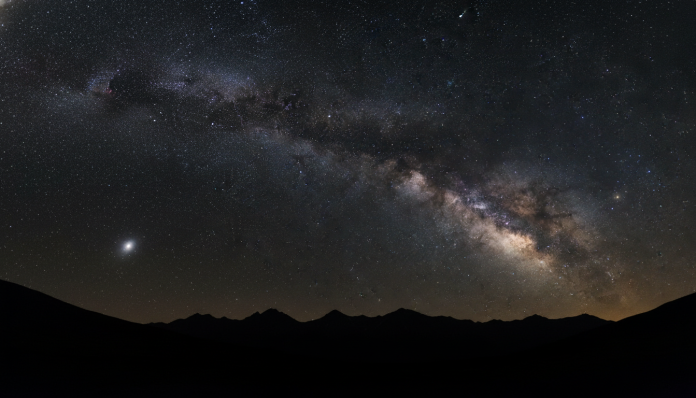
Look up at the sky on a clear night, far from city lights, and an inevitable sense of vertigo takes hold. Billions of stars, galaxies that appear as patches of diffuse light, the Milky Way stretching like a bright river overhead. It seems like a lot, doesn’t it? But here’s what science knows and what transforms this experience into something even more disconcerting: everything you can see, feel, or measure represents only about 5% of everything that exists in the universe. The rest — 95% of reality — is composed of something we can’t see, touch, or detect directly. We call these enigmas dark matter and dark energy.
This is not science fiction or philosophical speculation. These are solid scientific concepts, supported by decades of astronomical observations, gravitational calculations, and cutting-edge experiments. The scientific community reached these conclusions not by believing in the invisible on faith, but because the numbers simply didn’t add up without them. Galaxies were spinning too fast. The universe was expanding too fast. Something was there, shaping everything, without revealing itself.
This article is an invitation to dive into this hidden side of the cosmos — what we know, what we suspect, and what may take decades (or centuries) more to understand.
The universe we can see: just the tip of the iceberg
Everything humanity has ever observed with telescopes, radio antennas, X-ray detectors, and gravitational wave sensors makes up what is called the baryonic universe — that is, the universe made of ordinary matter, composed of protons, neutrons, and electrons. Stars, planets, nebulae, black holes, cosmic dust, interstellar gas: all of this is baryonic matter.
Throughout the twentieth century, physicists and astronomers refined their models of the universe. With the standard model of cosmology, the so-called ΛCDM model (Lambda-CDM, short for Cosmological Constant + Cold Dark Matter), an estimate was reached that clashes with common sense: only ~5% of the total energy content of the universe is ordinary matter. About 27% is dark matter and the impressive remaining 68% corresponds to dark energy.
These numbers were not pulled out of thin air. They emerge from precise measurements of the cosmic microwave background (the “oldest light” in the universe, emitted about 380,000 years after the Big Bang), from the dynamics of galaxies and galaxy clusters, and from observations of distant supernovae. It is a consensus built on multiple independent lines of evidence.
Dark matter: the invisible skeleton of the cosmos
What it is (and what it isn’t)
Dark matter is not simply matter that hasn’t yet lit up. It’s not dust, nor dark gas, nor unseen planets. We know this because the amount of “hidden” baryonic matter that could exist in invisible forms doesn’t come close to explaining the observed gravitational effects. Dark matter is fundamentally different: it doesn’t emit, absorb, or reflect light at any known wavelength. It interacts with the visible universe only through gravity.
The evidence that made it inevitable
The first consistent clue came in the 1930s, with astronomer Fritz Zwicky. While studying the Coma Cluster, he noticed that galaxies were moving too fast to be held together by the gravity of visible matter alone. He called the phenomenon “dark matter,” but the idea was forgotten for decades.
The turning point came in the 1970s, with astronomer Vera Rubin and physicist Kent Ford. They measured the rotation speeds of stars in spiral galaxies and discovered something disturbing: stars at the edges of galaxies orbit just as fast as those at the center. According to Newtonian physics and the distribution of visible mass, they should orbit much more slowly. The conclusion: there was an enormous amount of invisible mass — a halo of dark matter — surrounding each galaxy.
Since then, multiple observations have reinforced the case:
- Gravitational lensing: light from distant objects is bent by concentrations of invisible mass, revealing where dark matter concentrates
- Bullet Cluster collision: when two galaxy clusters collided, visible gas slowed due to friction, but dark matter passed through without interacting, creating a detectable separation
- Cosmological simulations: computer models that include dark matter accurately reproduce the large-scale structure of the universe (cosmic filaments, nodes, and voids)
What could it be?
The leading candidate for decades has been WIMPs (Weakly Interacting Massive Particles), hypothetical particles that would interact with ordinary matter only through gravity and the weak nuclear force. Underground experiments like LUX-ZEPLIN in the USA and PandaX in China search for direct detection of them. As of 2026, no WIMP has been confirmed.
Other candidates include axions (very light particles originally proposed to solve another physics problem), primordial neutron stars, or primordial black holes — formed before stars existed. The question remains open.
Dark energy: the force pushing the universe apart
If dark matter is the gravitational enigma, dark energy is the cosmological enigma. In 1998, two independent research groups — led by Saul Perlmutter, Brian Schmidt, and Adam Riess — made a revolutionary discovery: by measuring Type Ia supernovae (stellar explosions used as standard “distance candles”), they found that the universe isn’t just expanding. It is expanding faster and faster. The three were awarded the Nobel Prize in Physics in 2011.
This would have been impossible if gravity were the only player, which should have been slowing the expansion. There was a repulsive force acting on cosmic scales — something that permeates empty space and pushes everything apart. This “something” was called dark energy.
The simplest candidate is the cosmological constant (Λ), a term that Albert Einstein himself inserted — and later removed — from his equations of general relativity. The irony is that observations suggest he may have been right to include it. Physically, the cosmological constant can be interpreted as vacuum energy: empty space is not really empty, but possesses an intrinsic energy density that acts as negative pressure, accelerating expansion.
The problem is that quantum physics calculations predict a value for this vacuum energy that is 10¹²⁰ times greater than what is observed. This is considered one of the greatest discrepancies between theory and observation in the entire history of physics.
Horizons of the universe: what we can never see
There is an absolute limit to what any observer will ever be able to see: the cosmological horizon. It exists because the universe has a finite age (about 13.8 billion years) and light has a finite speed. We can only see regions from which light has had time to reach us since the Big Bang.
But the acceleration of expansion makes this even more dramatic. Galaxies beyond a certain distance are moving away from us faster than the speed of light — not because they break the laws of physics, but because the space itself between us and them is expanding. Light from those galaxies will never reach us. Over time, the observable universe will become increasingly “empty” as distant galaxies cross this horizon and disappear forever from our perspective.
In billions of years, astronomers of a hypothetical civilization in the Milky Way will see a seemingly solitary universe — with no other visible galaxies. The evidence of the Big Bang and cosmic structure will have disappeared beyond the observable horizon.
Other mysteries the universe hides
Dark matter and dark energy are the biggest enigmas, but not the only ones. Here are other puzzles that intrigue physics and astronomy:
- Matter-antimatter asymmetry: the Big Bang should have created equal amounts of matter and antimatter. When they meet, they annihilate. Why was there enough matter left to form everything that exists?
- Primordial supermassive black holes: the centers of almost every large galaxy contain black holes with millions or billions of solar masses. How did they grow so fast in the young universe?
- The Hubble tension: different methods of measuring the universe’s expansion rate give slightly different results. This discrepancy may indicate new physics beyond the standard model.
- Hot vs. cold dark matter: the exact nature of dark matter affects how galaxies form. The debate over its details continues.
- Multiverses: some interpretations of quantum physics and cosmic inflation suggest our universe may be just one among countless others — but for now, the hypothesis is beyond observational reach.
How science investigates the invisible
Although we cannot “see” dark matter or dark energy directly, scientists have developed sophisticated methods to study their effects:
- Space telescopes: the James Webb Space Telescope (active since 2022) observes galaxies formed shortly after the Big Bang, helping to map cosmic structure
- Underground particle detectors: installed kilometers deep to shield from cosmic rays, they search for direct signals of dark matter
- Particle colliders: the Large Hadron Collider (LHC) at CERN seeks to create exotic particles that may correspond to dark matter
- Gravitational lensing mapping: missions like Euclid (from the European Space Agency, launched in 2023) map the distribution of dark matter throughout the observable universe
- Gravitational wave observation: LIGO and other detectors have opened a new “window” to the cosmos, capturing collisions of massive objects and potentially revealing new insights into the nature of dark matter
Conclusion: the beauty of what we still don’t know
Perhaps the most humbling — and at the same time most exciting — fact of modern cosmology is this: we’ve built rockets, sent probes to the edge of the solar system, detected gravitational waves from collisions billions of light-years away, and yet we don’t know what most of the universe is made of.
But this is not a defeat for science. It is exactly the opposite. It is science working as it should: honest enough to admit that data doesn’t fit simple models, and brave enough to follow the evidence wherever it leads — even if it leads to 95% of an invisible universe.
For the general reader, this reality invites genuine reflection: the cosmos is far larger, stranger, and more wonderful than any everyday intuition can capture. And the frontier between what we know and what we ignore is exactly where scientific adventure is most alive. Just as there are lesser-known destinations worth visiting in Brazil, the universe holds regions and phenomena that still await discovery — by humanity or by generations to come.